

They’re the taste of summer, and this year Australians will eat their way through as much as 75,000 tonnes of the “king of fruits”.
While most mangoes are grown in the Northern Territory, two popular varieties originated in the North Queensland town of Bowen.
Here are some facts to chew over while you enjoy a summer feast.
Where did our mangoes come from?
Some say there was a tree in Sydney’s Royal Botanic Garden as early as 1823 that never fruited and, by the 1860s, a tree was growing in Rockhampton.
What’s not in dispute is that mangoes were first commercially produced in Bowen.
The story goes that traders from India and South-East Asia gave Bowen’s harbour-master seeds in the 1880s, and he went on to crossbreed varieties.
The “best of the best” were given to farmer Harry Lott, who selectively bred the fruit on his property, Kensington Farm at Adelaide Point, until he had something bigger, better and tastier.
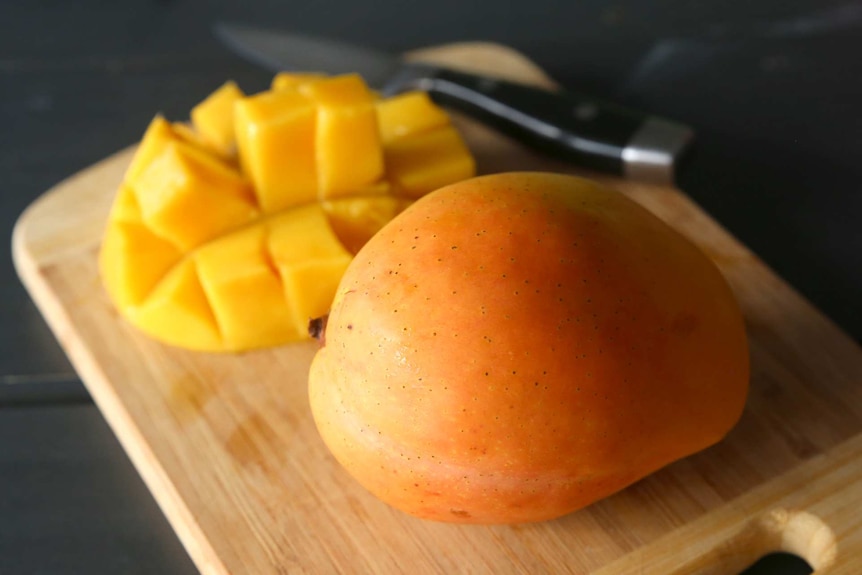
Kensington Pride mangoes have a sweet, tangy flavour. (ABC News: Jo Joyce)
Kensington Pride — the original ‘Bowen mango’
Harry Lott’s mango became the Kensington Pride, and it is still the most popular in Australia.
It’s not the biggest, but its sweet, tangy flavour is uniquely Australian, according to Heather Smyth, deputy director of research at the University of Queensland’s Alliance for Agriculture and Food Innovation.
Professor Smyth is a flavour expert and has helped with breeding programs for most major modern Australian mango varieties.
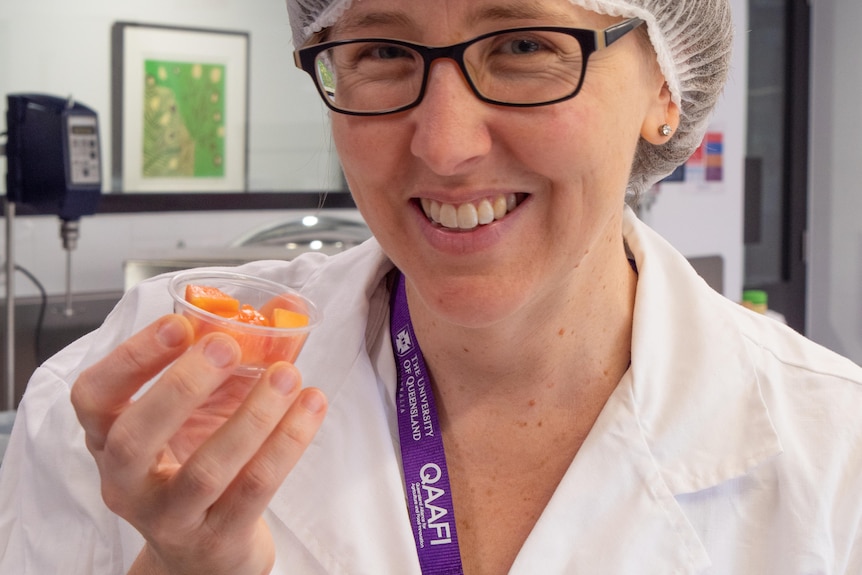
Heather Smyth says Australian mangoes have a unique flavour, thanks to the Kensington Pride. (Supplied: University of Queensland)
She said Australian mangoes owed their unique taste to a compound called alpha-terpinolene, which produced the strong, sweet flavour.
“Mangoes don’t taste like that anywhere else in the world, and that’s because of the Kensington Pride,” Professor Smyth said.
All other major mango varieties developed in Australia contain some Kensington Pride genetics, including the Ruby Gold variety that is about to hit supermarket shelves.
R2E2
The R2E2 is a large, round mango with firm flesh and a sweet, fresh flavour.
The variety was created in Bowen after shortcomings with the Kensington Pride were realised, Queensland DPI senior principal horticulturalist Ian Balley said.
“It was a very big tree with quite low yielding, it was very susceptible to the disease anthracnose and very irregular cropping,” he said.

Ian Balley says the R2E2 has a good shelf life. (Supplied)
The Mango Improvement Program began at the Bowen Research Centre in the 1960s and involved crossbreeding Kensington Pride with overseas varieties.
In 1984, Mr Balley helped test a crop, and the stand-out was a half Kent, half Kensington Pride variety dubbed R2E2 for its position in the plot of test trees.
“It was obvious that it had some potential. It was larger than a lot of the others, and it was slightly cleaner … and it had this great shelf life,” he said.

The original R2E2 mango tree in Bowen. (ABC Tropical North: Liam McNally)
A decade later, it was released as an official variety.
Professor Smyth said R2E2 had a similar “beautiful” flavour to the Kensington Pride, though not as strong.
“I find it’s best eaten when it’s really firm … it can develop some musty flavours when it gets overripe,” she said.
Many growers, including Mangalloo Farms managing director Marie Piccone said the variety was best when it ripened on the tree.
Today, the Kensington Pride makes up about 40 per cent of mango production, while R2E2 makes up about 20 per cent and is the number one export variety.
Calypso and Honey Gold
Other popular Queensland varieties commercialised in the 2000s include the Calypso and Honey Gold.
The Calypso is medium in size with a small seed, yellowy-orange skin with a deep pink blush.
“The Calypso can be absolutely gorgeous when it’s looking really good,” Professor Smyth said.
“It is a much more delicate flavour compared to the other fruit, really nice and sweet.”
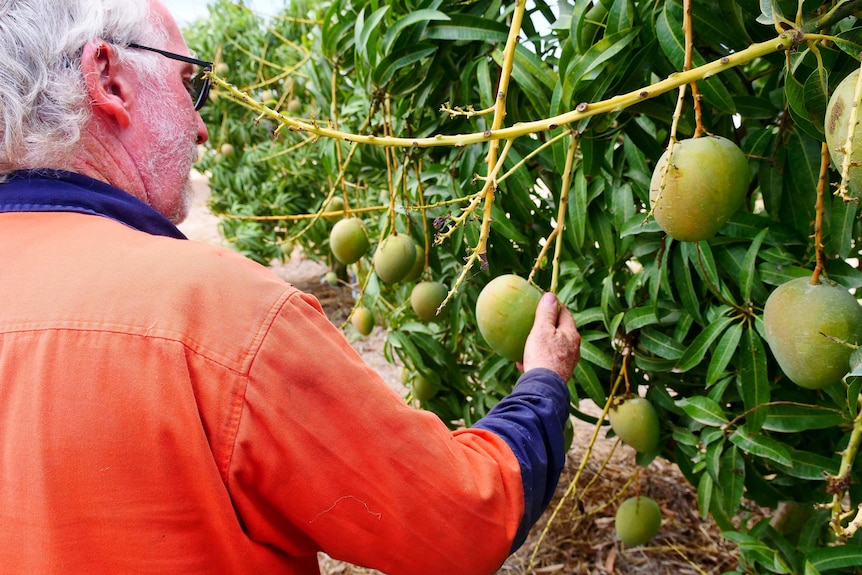
Dale Williams inspects the Honey Gold mangoes ripening at his Bowen farm. (ABC Tropical North: Liam McNally)
Honey Golds have brilliant golden skin, a rich, sweet flavour, and are medium to large in size.
Professor Smyth said it was a “premium version of mango”.
“It’s a beautiful mango,” she said.
“It’s really golden in colour, it’s a beautiful, smooth texture inside, nice firmness, but also can be eaten when a little bit soft.”
What’s the best way to eat a mango?
Professor Smyth said mangoes were best eaten after they had been refrigerated for no more than two hours.
“Eating a cool mango is very nice, but putting a mango in the fridge [for longer] can actually cause bruising under the flesh,” she said.
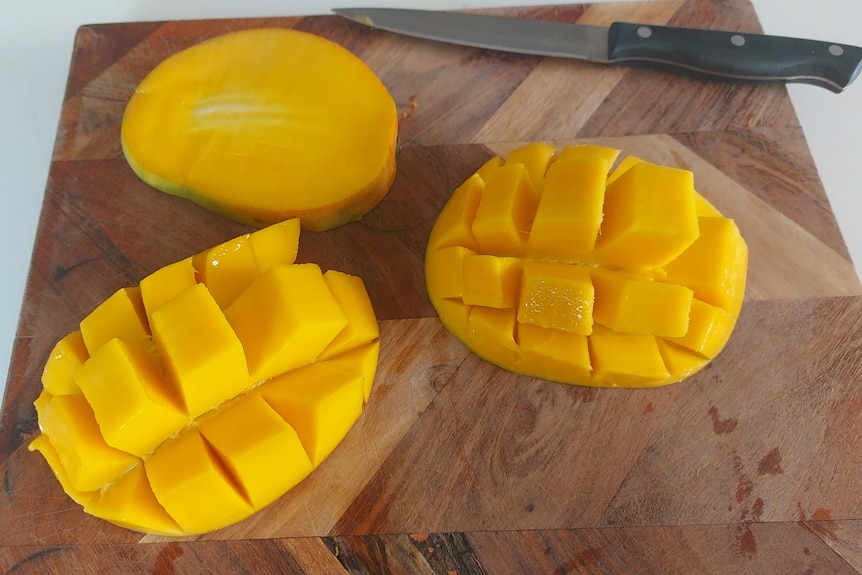
Professor Smyth said the most common way to enjoy the fruit was slicing each cheek off and scoring a grid pattern into the flesh before popping the cheek inside out.
The Ruby Gold mango has a strong flavour and is less fibrous compared to other varieties. (Supplied: John Nardi)
But she had a fondness for a style she adopted as a kid in Darwin.
“My friend had a swimming pool,” Professor Smyth said.
“In mango season, we’d pluck them off the tree, plop them into the swimming pool, and then you could just tear the skin off with your teeth and tuck into the mango just as it is.”
In her professional life, mango tasting has taken on a more clinical approach — each mango must be diced at the same size and served at 18 to 20 degrees Celsius.
“The volatile compounds, the smells of the mango, are most active when it’s a little bit warmer,” she said.