
The perpendicular arms of the humble backyard rotary clothesline have provided the inspiration for a newly named species of Australian bloodroot.
The native plant has been named Haemodorum collevatum, drawing on the Latin words “collis”, meaning hills, and “levatum”, to lift up (or, in this case, hoist).
The field of taxonomy sometimes look to popular figures, such as David Attenborough or a Star Wars character, when choosing scientific and common names for new species of plant or animal.
Other times, a name stems from a defining characteristic.
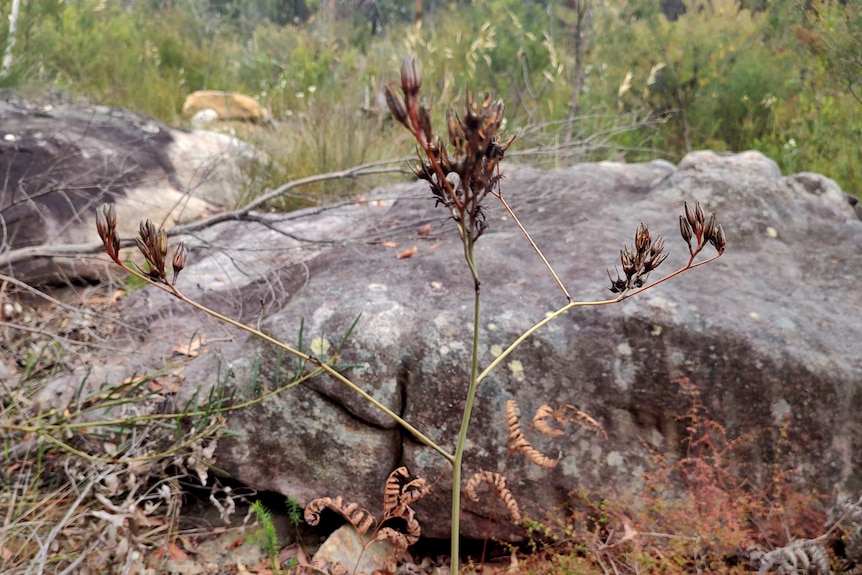
The “Hills hoist” clothesline bloodroot is named because of its branches splaying nearly 90 degrees from its stalk. (Supplied: Botanic Gardens of Sydney)
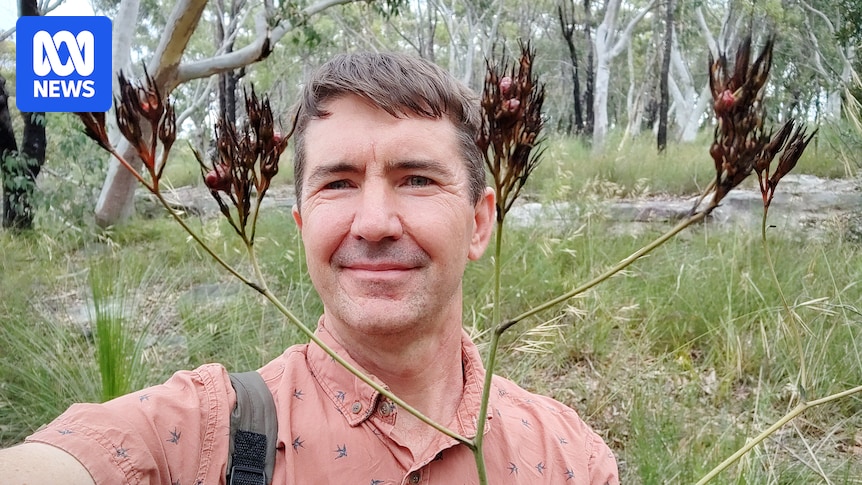
For systematic botanist Russell Barrett, from the Botanic Gardens of Sydney, it was the tall centre flower and unusual branches of the bloodroot that stood out.
“The majority of these bloodroots have quite slender flower stalks clustered together,” he said.
“So the fact this one had long spreading branches and branches that came out at right angles is unusual in the genus.
“In looking through our field photos [of the plant] … some of the photos really looked like a Hills hoist.”
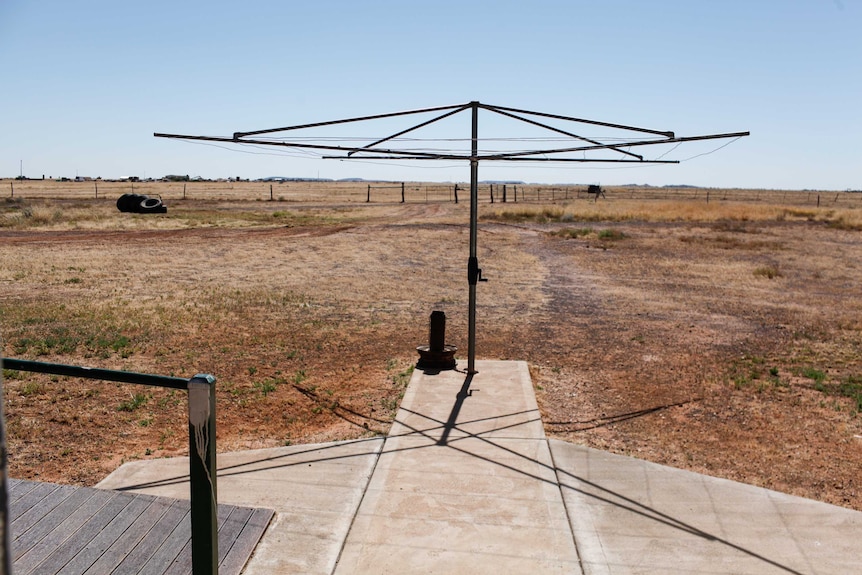
The rotary clothesline was popularised after World War II by the design known as the Hills hoist. (ABC News: Aneeta Bhole)
One plant becomes four
Dr Barrett named the species with the Western Australian Herbarium’s Terry Macfarlane in the journal Nuytsia.
The clothesline species is found around Sydney and Newcastle and is believed to be fairly common.
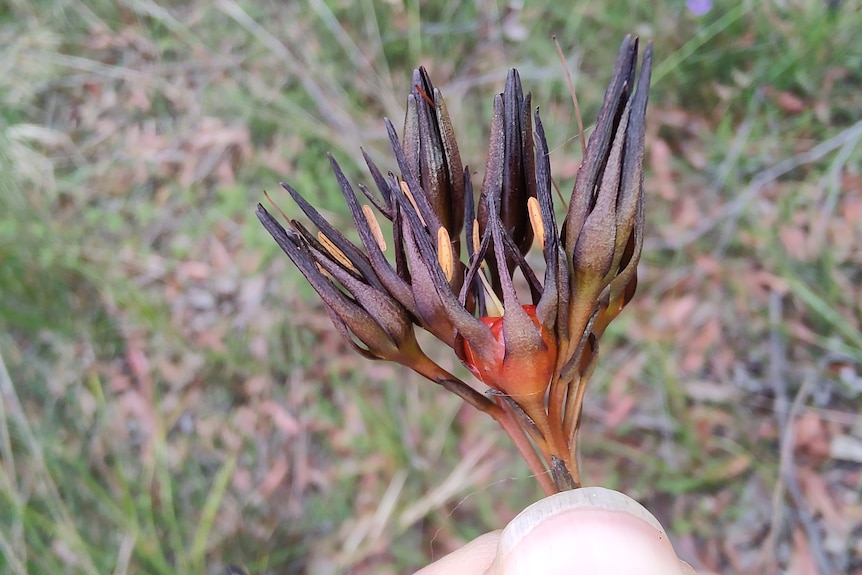
The flower of the clothesline bloodroot has dark brownish petals. The open flowers are in fruit. (Supplied: Botanic Gardens of Sydney)
Bloodroots belong to the plant family Haemodoraceae, which also include kangaroo paw plants.
University of Western Australia conservation biologist Stephen Hopper, who studies the plant family, said the two scientists had done some good detective work to identify the bloodroot.
“They thought it was one undescribed species on the east coast and they turned up three,” he said.
The clothesline bloodroot and two other newly named NSW species were originally thought to be the one species, Haemodorum planifolium, but are actually four separate organisms.
Their identification takes the number of known bloodroot species up to 36 plants, which are found mostly in Australia but also Papua New Guinea. These species are in a separate family to the North American plant Sanguinaria canadensis which is also commonly called bloodroot.
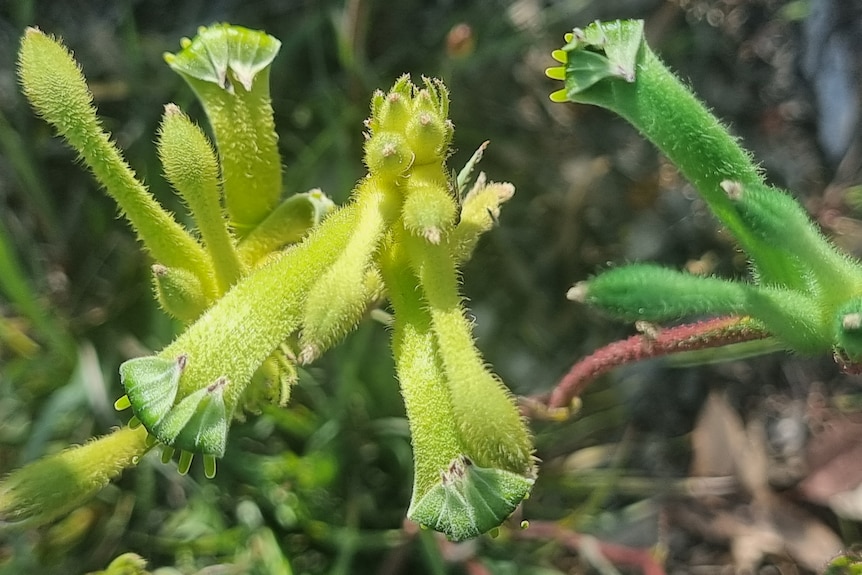
The virtuous kangaroo paw (Anigozanthos viridis sophrosyne) is one of several new additions to the Haemodoraceae family. (Supplied: Stephen Hopper)
Professor Hopper recently completed an update of the overarching Haemodoraceae family and found it contained more than 100 species that spread as far as South Africa and the Americas.
The update takes the number of known species of kangaroo paws, a common flower found in gardens around Australia but endemic to southwest Western Australia, up to 16.
“To me the exciting thing is kangaroo paws are a pretty well-known group of plants but we’re still turning up new ones as recently as three years ago,” Professor Hopper said.
What are bloodroots exactly?
Bloodroots are named for their underground tubers, which can vary in colour from orange to deep red.
The native perennials have long stems which can shoot up to over a metre tall.
Species found in northern Australia have more colourful flowers including bright reds and attract a wide vary of pollinators.
But more southern species in WA and NSW have dark brown or black coloured petals that exclude most insects and birds, except for a pair of unique bees.
Two years ago, different species of native bees were found to be key pollinators of bloodroots in the west and in the east.
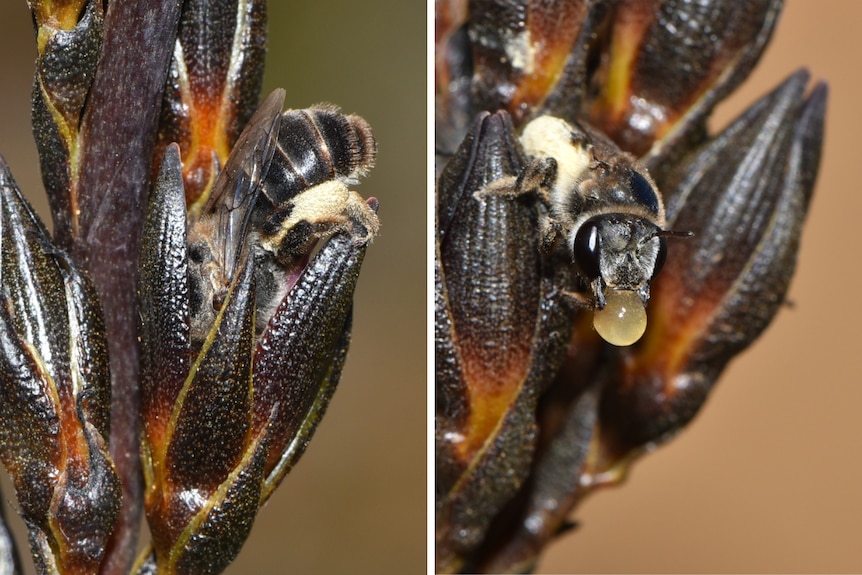
Two species of bees, one on the east coast and the other on the west coast, were identified two years ago as specialised pollinators of southern bloodroots. (iNaturalist: Kate Brown, Leioproctus haemodori, CC BY-NC 4.0)
“These bees are strong little buggers specialised in prizing apart the petals and the sepals to get into the flower to the nectar,” Professor Hopper said.
“Even [European] honey bees can’t get the nectar in these things.”
Bloodroots are a culturally important food
The tubers of bloodroots have an array of uses in First Nations cultures around Australia.
Bloodroot species that grow in northern Australia are used in practices as a dye in, for instance, basket making.
In the southwest of WA, the tubers are a valued food source.
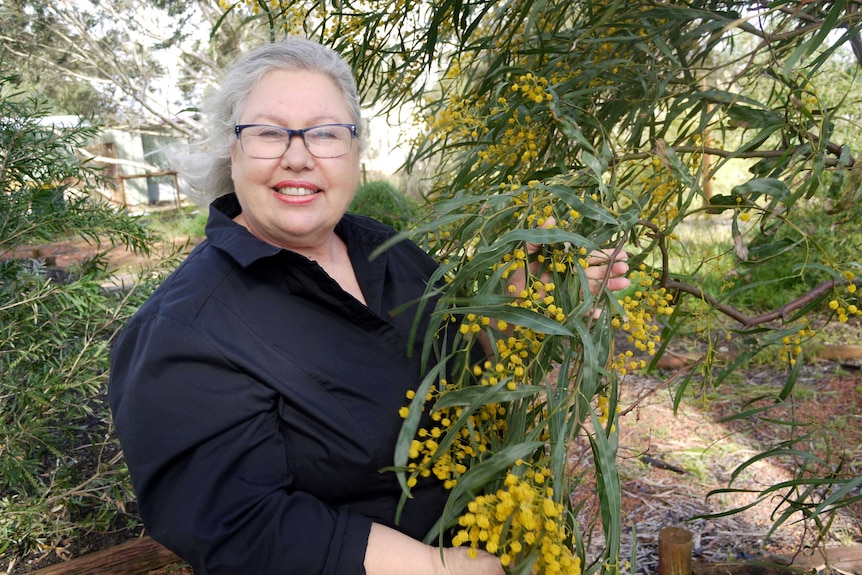
Dale Tilbrook has seen a growing use of bloodroot by restaurants and distilleries. (ABC News: Rebecca Turner)
Wardandi Bibbulmun woman and cultural tours operator Dale Tilbrook, whose family’s country is in the Busselton region, said the bulb could be eaten raw or pounded into a paste.
“Over the past few years, a lot of chefs and distillers have used bloodroot,” she said.
“It comes out as this beautiful red oil that has this lovely hot flavour, so it’s nice as a spicy garnish.”
Ms Tilbrook said the spice level depended where the plant grew.
Around Perth, where the plant is called bohn, it is a bit spicy; near Collie it’s called mardja and is a little hotter; and Albany, where the plant is known as meen, it is very hot.
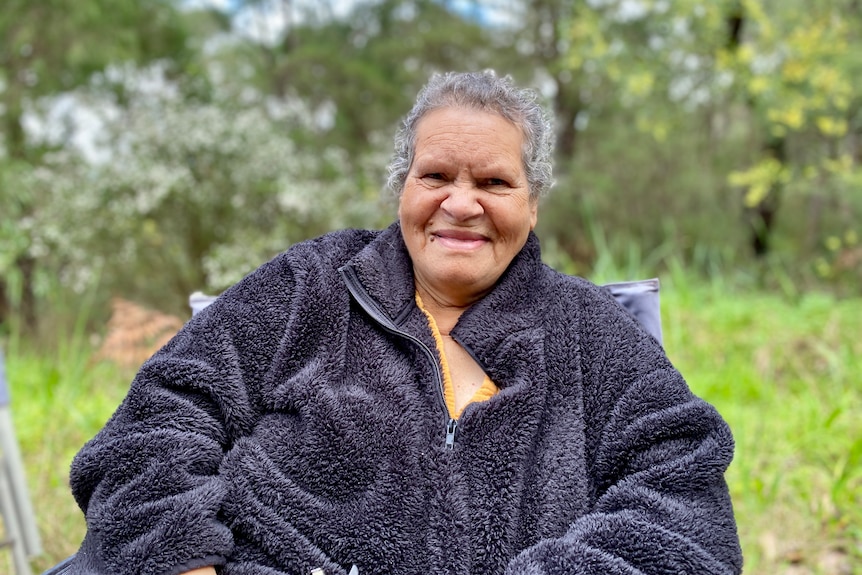
Lynette Knapp describes meen as a culturally significant plant in Albany. (ABC Great Southern: Lauren Smith)
Merningar Barduk Elder Lynette Knapp from Albany said meen was a very significant plant.
She said when people ate it, the juices would run from their mouths and colour their faces red.
“It looks a bit like beetroot, but not as tasty as beetroot,” Ms Knapp said.
“If it’s flowering, we just leave it until it grows some meen, some decent bloodroot we can eat.”