
Explosive internal files reveal big tech has long known their apps are addictive for some children.
These revelations of profit-first thinking come after a study by the International Journal of Environmental Research and Public Health claiming social media can be as addictive as hazardous substances.
And while a leading neuroscientist baulks at the word ‘addiction’ Dr. Anne-Noël Samaha says social media apps can definitely be “habit forming” and that means withdrawals when stopping.
Know the news with the 7NEWS app: Download today Arrow
It all paints a concerning picture for families across Australian when, from December 10, 2025, the following platforms will be off limits for children under-16:
FacebookInstagramKickRedditSnapchatThreadsTikTokTwitchX (formerly Twitter)YouTube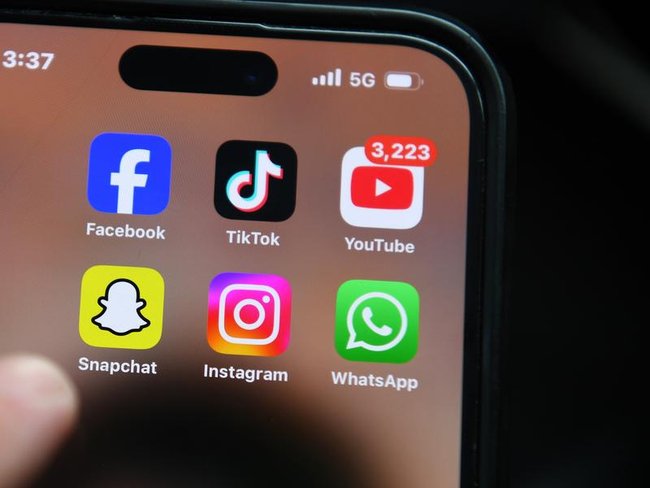 Social media sites caught up in the ban will have to take steps to keep young users off them. (Jono Searle/AAP PHOTOS) Credit: AAP
Social media sites caught up in the ban will have to take reasonable steps to keep young users off them, or face fines of up to $49.5 million.
There’s no doubt everyone’s buzzing about the ban — yet few are telling parents how to cope when their kids freak out after losing screen time.
Why is social media so addictive?
These apps are engineered to hijack your brain with constant dopamine hits — thanks to push notifications, likes, and comments that demand your attention. They’re built to keep you coming back, again and again.
Court documents filed in the United States show that TikTok changed its push notification feature from targeting users who were inactive that day to targeting those who had been inactive for just a few hours.
Snapchat also “experimented” with notifications to find a user’s “predicted best hour” for increasing use.
Over time these constant reminders and need for a quick hit can form habits according to neuroscientist Dr. Anne-Noël Samaha.
Dr. Samaha runs a behavioural neuropharmacology laboratory located in the department of Pharmacology and Physiology of the Université de Montréal where they’re trying to understand more about drug addiction and its brain mechanisms.
While reluctant to draw direct comparisons between drug addiction and social media use Dr. Samaha says the dopamine that’s triggered via apps isn’t actually a burst of happiness, in fact it creates another emotion – desire.
Dopamine makes you want things.
“It allows you to pursue things you assign value to because those things increase our dopamine levels” she told 7NEWS.com.au.
Even if you might not actually like it and know it’s bad for you.
 Dr Anne-Noël Samaha: Neuroscientist, Associate Professor, University of Montreal Credit: Benjamin Seropian
Sparking desire has become a critical part of the business model for tech giants.
“Tech companies have taken some major vulnerabilities that kids especially have and created design features.” Gaia Bernstein, Technology, Privacy and Policy Professor at Seton Hall Law School told 7NEWS.com.au.
 Professor Gaia Bernstein: Technology, Privacy and Policy Professor at Seton Hall Law School Credit: Supplied
“Those design features include infinite scrolls where there’s never an end to a page or autoplay where one video follows another” she says.
An expert report recently filed by Dr. Stuart Murray, a Clinical Psychologist, for a major social media addiction lawsuit in California states: “Adolescent brain development increases sensation seeking during adolescence, which can be satisfied through novel experiences… and the novelty continues as the adolescent keeps watching (via autoplay).”
Back in 2017, Meta openly listed autoplay on its “roadmap” to keep Instagram users glued to their screens. Snapchat’s Discover and Stories do the same — rolling content nonstop — and when TikTok hit the U.S., it arrived with autoplay baked in from day one.
TikTok
Using its algorithm, TikTok’s “For You” feed is engineered to hook users fast — internal files show just 35 minutes (about 260 videos) is enough to get addicted.
Algorithms stalk every search, like and tap — then decide exactly what to feed you next. And for young people, that “what’s coming next?” thrill is irresistible.
In a high-stakes US court battle to ban TikTok, legal filings uncovered evidence that the company knew its app could be addictive for young users. The following quotes come straight from employees and internal memos:
From TikTok executives
“The product in itself has baked into it compulsive use.”
“The reason kids watch TikTok is because the algo[rithm] is really good…. But I think we need to be cognizant of what it might mean for other opportunities. And when I say other opportunities, I literally mean sleep, and eating, and moving around the room, and looking at somebody in the eyes.”
From TinkTank (an internal group studying issues affecting TikTok)
“Tiktok is particularly popular with younger users who are particularly sensitive to reinforcement in the form of social reward and have minimal ability to self-regulate effectively.”
Snapchat
For countless parents tough, it’s Snapchat that’s taken over their kids’ lives.
Internal data from Snap Inc, the company that owns Snapchat shows: “45% of Snapchat Users 13-17 use Snapchat “almost constantly”
“Snapchat is addicting children and requires addiction to be profitable” says Nicki Petrossi leading social media expert and Scrolling 2 Death podcast host.
 Nicki Petrossi: Scrolling 2 Death Podcast Host Credit: Supplied
“Lots of the functionality within Snapchat instigates compulsive use and one of those primary functions is the Snapstreak”
Snapstreaks track the number of consecutive times friends send each other snaps – encouraging you to message every day so you don’t break the ‘streak’. It creates compulsive behvaiour.
“This is like currency to kids, and they will stress out so much if they go on holiday or don’t have service, they’ll have someone log into their account to make sure they keep up their Snapstreak Nicki explained recently on ‘The Heat Is On…’ podcast.
 Snapchat is one of the apps being banned. Credit: AAP
In documents released for a State of New Mexico court case against Snap Inc statements and conversations from company employees, consultants, and executives were exposed:
From a 2017 internal email — “Snapstreak distribution first look”
“Wow, we should add more addicting features like this” – employee
“… if we find that streaks are addictive or a gateway to already deep engagement with other parts of Snapchat, then it would be something positive for “healthy” long term retention and engagement with the product.” – employee
From a 2018 presentation — “Understanding the Consumer and Snapchat Discovery”
“As the true digital natives, Gen Zs see their mobile devices as an extension of themselves, and while this allows constant access, it also creates constant pressure. There is never a break from the very real FOMO that exists.” – focus group feedback
From a 2019 presentation
“Streaks make it impossible to unplug for even a day”
If you want to read the full court documents afterbabel.com has summarised them here.
Then there’s Snap Maps — tracking friends in real time, second by second, a constant, irresistible lure for kids.
 Snap Map has over 400 million monthly active users Credit: SnapInstagram
In a sweeping US legal battle alleging big tech giants engineered addictive, dangerous platforms for teens, previously hidden Instagram internal chats have just been filed:
From internal communication
“IG [Instagram] is a drug” – Meta senior researcher
“LOL, I mean, all social media. We’re basically pushers” – Meta employee (apparently said sarcastically).
Author of ‘Unwired’ Professor Bernstein highlights Instagram stories as a feature that could lead to addiction.
“The stories on Instagram disappear. So, if you don’t get back, you won’t be able to see who looked at your stories, how many people have seen it, or you might miss people’s stories,” she says.
Adding, “Many of these addictive features are all over the internet, but (the social media companies) have enhanced them and made it much worse.”
With lawsuits piling up and once-secret files now spilling into court, big tech is facing a tidal wave of questions over whether they knew all along just how addictive their products are.
‘The business of addiction’
Social media may be free, but your time and attention are what really keep these companies in business.
“How they make revenue is with targeted advertising and for that they need to collect data and to collect data, they need us, our kids to stay there for as long as possible” says Professor Bernstein.
“They also need everybody to stay there as long as possible so they can see the advertising so people will purchase the services or the products – our time is a resource”
Nicki Petrossi told 7NEWS.com.au simply, “More time on the product equals more money” and that “… “you’ll see over time (the tech companies) have added things like notifications and endless scroll in order to keep us on longer.”
“That design and that business model is fundamentally in conflict with child development. Both things cannot coexist” says Emily Cherkin, a teacher of 12 years and author of The Screentime Solution. Adding, “To go cold Turkey, a parent is going to need to be prepared to deal with quite literally a withdrawal.”
 Emily Cherkin, author The Screentime Solution. Credit: SuppliedSocial media vs substance abuse
The Social Media Victims Law Centre says certain features make apps particularly addictive compared to other vices.
Cost. Most social media sites are free, so there are no financial barriers to using them for excessive lengths of time.Ease of access. Social media is widely available, and there’s almost no effort required to log in and start using it.Entertainment value. Social media is designed to be entertaining to encourage people to use it for longer.Social connection. As humans, we’re hardwired to seek connection with others. Social media takes advantage of this tendency.The signs of social media addictionExcessive hours spent on social media platformsSpending less time with friends or familyLosing interest in hobbiesExhibiting poor work or school performanceOversharing personal detailsBeing unable to detach from their smartphone or computerFeelings of intense anxiety when not using social media Top tips for dealing with withdrawal Credit: 7NEWSTop tips for children dealing with withdrawal
Neurologist Dr Samaha warns that when teens suddenly quit their favourite apps, they can feel “lost” — showing restlessness, irritability and just feeling awful — but stresses it won’t be catastrophic.
However, Emily Cherkin says to parents: “While it’s not your fault, it’s your responsibility.”
So here are some ways to make the comedown smoother.
Start talking to children now
Explain why this ban is happening — i.e. ‘because social media has been shown to be unsafe for children.’
Here’s a resource with potential talking points.
– Nicki Petrossi, social media expert
Wait 5 minutes
Dopamine surges have a short half-life. If you take away what’s triggering the dopamine and wait two to five minutes, a lot of the urge usually goes away. But here’s the key. You have to put the dopamine trigger out of sight because seeing a phone or laptop can start the cycle of wanting over again.
– Neuroscientist Kent Berridge originally published on NPR.
What to do if your child melts down
When this is withdrawal related, it will be about staying calm and validating. ‘I can hear you’re upset. This is really hard. I know how much you love the iPad. This is really going to be really difficult. I’m here to support you. Is there something I can do?’
– Emily Cherkin, The Screentime Consultant
Be conscious of your own phone use
I think the parental modeling piece of this is extremely important and it’s very easy for us to say, oh, you can’t have this kids, but I’m going to go and use my phone in front of my children all the time. And that sends a pretty strong message as well. Kids hate hypocrisy.
– Emily Cherkin, The Screentime Consultant
Use this as an opportunity
This is an opportunity for parents to reevaluate their own relationship to social media or addictive apps.
– Emily Cherkin, The Screentime Consultant
Live your life out loud
When you use apps, speak out loud – ‘I’m using this to see what traffic will be like or I’m texting your friend’. Play by play has such a powerful effect. It’s modeling, it’s showing how we use it as a tool, not an entertainment device.
– Emily Cherkin, The Screentime Consultant
Find alternative rewards
Kids spending hours on apps? You’ll need to fill that dopamine gap with real-world rewards and activities that give their brains a healthy buzz.
– Neuroscientist, Dr. Anne-Noël Samaha
Change of context
If your child races home from school and disappears into their room to dive straight onto the apps, it’s time to shake up the routine — change the setting, change the habit. Get them doing something else after school to break that automatic rush to the screen.
– Neuroscientist, Dr. Anne-Noël Samaha
Download contacts and phone numbers
Kids these days often don’t even have each other’s phone numbers so they would lose contact. That’s the kind of planning that kids would not do, but parents can help them do.
– Professor Gaia Bernstein
Create new habits
When you want to break an addiction, you’re breaking habits. You need to create new habits in its place. You have to find things which are attractive for them to do and think about it in advance. If your daughter likes to dance, maybe it’s time to register for dance after school.
– Professor Gaia Bernstein
‘Hold their hand’
Hold their hand with finding other things to do, at first. Many kids have literally lost the skills and ability to fill their time without addictive tech. So parents may need to make a list of activities, and/or block out time to spend with them playing games, going on hikes, to the movies etc. Spending more time with them will give them natural, healthy dopamine to replace the dopamine that they’re missing from the tech.
– Nicki Petrossi, social media expert
Be careful of ‘tech transfer’
Don’t let children move from addictive social media to another addictive tech! That means games like Roblox and Fortnite, and AI chatbot systems like Character.AI and ChatGPT. This should not be a situation where kids just transfer their addiction to another harmful platform.
– Nicki Petrossi, social media expert
In this together
Experts say there’s safety in numbers — the social media ban hits every Australian under-16, so teens won’t feel singled out or left behind, that will make the transition easier.
But there’s no doubt this generation faces a brutal challenge: going cold turkey on apps many are seriously hooked on.
Dr. Samaha reassures parents though: for most under-16s, “it will just be a matter of weeks” to adjust. “It certainly won’t be years,” she adds, “and there’s no permanent brain damage.”
Big tech responds
Meta and TikTok did not response to our request for comment.
Snap Inc told 7NEWS.com.au:
“Streaks are designed to foster fun, meaningful interactions which celebrate friendships. They are completely voluntary, not public, and are only visible between the two friends who have a Streak. We do not use push notifications to encourage Snapchatters to maintain streaks.” – a Snap Spokesperson
Want more information
Meta Exposed: Secrets from Inside the Tech Giant – watch here or listen here.
Watch 7NEWS Spotlight: Sextortion on 7plus.
If you need help in a crisis, call Lifeline on 13 11 14. For further information about depression contact beyondblue on 1300 224 636 or talk to your GP, local health professional or someone you trust.
Note: The author worked for Meta – Sept 2021 to Jan 2023