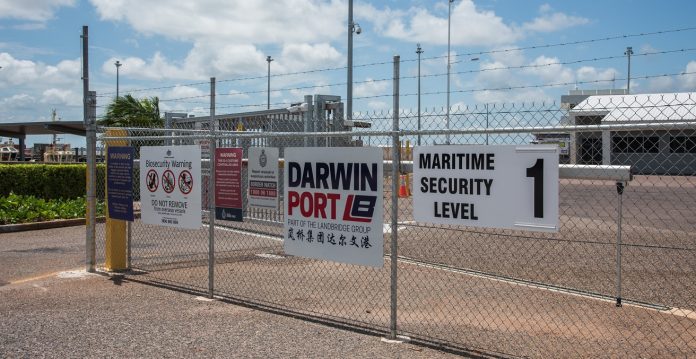
 The Port of Darwin
By Clive Williams*
Unlike Ukraine or Taiwan, Australia faces no threat of large-scale invasion. No regional power currently has, or is likely to develop in the foreseeable future, the amphibious lift and sustainment capacity required to mount such an operation. That reality should liberate our thinking.
Australia’s 2024 National Defence Strategy emphasises that “an invasion of Australia is an unlikely prospect,” prioritising denial of access to our sea and air approaches over continental defence. The NDS and the 2023 Defence Strategic Review highlight deterrence by denial, focusing on regional stability rather than repelling border crossings.
Our problem is not tanks crossing the border. It’s something far more fundamental: our dependence on the outside world for the essentials that keep the country running. Australia is one of the world’s most exposed nations when it comes to reliance on imports. Much of what powers our economy arrives by sea or air: fuel, pharmaceuticals, machinery, fertiliser, electronics, and key industrial inputs.
It’s not our borders that are biggest weak point.
In any regional crisis, it won’t be a landing force that threatens us; it will be interruptions to these lifelines. Our greatest vulnerability is not the enemy at the gate, but the ships or planes that don’t arrive.
This is one relevant lesson from Ukraine: the strategic consequences of stressed supply chains and societies slow to adapt. Modern conflict punishes states with fragile logistics and those that assume global markets will keep supplying them in a crisis. It also exposes militaries that lack resilience.
A realistic scenario affecting Australia could begin with pressure on maritime routes, delays at chokepoints, cyber attacks on ports, or threats affecting shipping and aviation insurance. These circumstances may not even be intentionally directed at Australia. It takes little uncertainty to deter commercial carriers. Similar effects can come from diplomatic pressure on states along our trade routes. Our geography protects us from invasion, but not from disruption.
This is where debate goes astray. We discuss the Australian Defence Force (ADF) as if we’re preparing to fight a distant “big war.” In reality, our challenge is keeping the country functioning during a crisis. That means focusing on national resilience.
Start with fuel – a vulnerability that remains under-addressed. Australia’s fuel stocks remain far below the 90 days of import coverage required by the International Energy Agency (IEA). Depending on the fuel type and measurement method, Australia holds roughly 20-60 days of supply, with particularly low levels of diesel and jet fuel.
Australia imports around 90 per cent of its refined fuels. In a crisis affecting maritime trade, fuel shortages would hit first and hardest. Australia also counts fuel held in the US toward its IEA obligations – stock that may not be practically accessible in a regional crisis.
Without fuel, transport, agriculture, emergency services, and the ADF would all come to a halt. Hardening ADF bases so that we can better protect what we have should also be part of a resilience strategy. There is little point buying more combat aircraft if the ones we have can be destroyed on the ground in a surprise attack.
No number of submarines or fighters can compensate for a country that runs out of diesel and aviation fuel. Ukraine demonstrated the value of attacking an adversary’s logistics – including fuel supply – when direct engagement was costly or ineffective.
Our priorities should be hardening and dispersing fuel storage; securing minimum refining capacity; expanding the use of synthetic and biofuels; and protecting maritime fuel supply routes with alliance partners and regional stakeholders who share an interest in secure sea lanes. It’s not glamorous, but it’s essential for national survival.
Next, Australia must focus on the domains where our security truly lies: the sea and air approaches. The central defence task is keeping trade flowing – not invading others. That requires submarines (not necessarily manned or nuclear-powered), long-range patrol aircraft, undersea sensors, and over-the-horizon surveillance – forces designed for sea and air protection, not power projection.
National resilience also demands domestic industrial capability – not to match great powers, but to produce enough for our own needs. Enough missiles, spare parts, drones, and medical supplies to operate when global supply chains tighten. Enough cyber capacity to protect critical infrastructure. Enough redundancy in communications and energy to survive single-point failures.
Modern defence is no longer just the ADF’s job. Ukraine shows that resilience is a whole-of-nation effort involving government, industry, communities, and individuals.
Australia needs stockpiles of food and medicine, plans to keep essential workers operating, secure power grids, and reliable public communication. The ADF cannot fix ports, stock supermarkets, or keep broadband running. That requires national planning and political commitment.
Australia’s defence problem is not invasion – it’s vulnerability. Our remoteness helps us only if we can withstand disruption and isolation. The task is building a resilient nation: fuel-secure, defence-secure, trade-secure, cyber-secure – and industrially capable enough to continue functioning during a crisis.
*Professor Clive Williams MG is a former army and defence officer
This article first appeared in The Canberra Times and is republished with the author’s permission.