
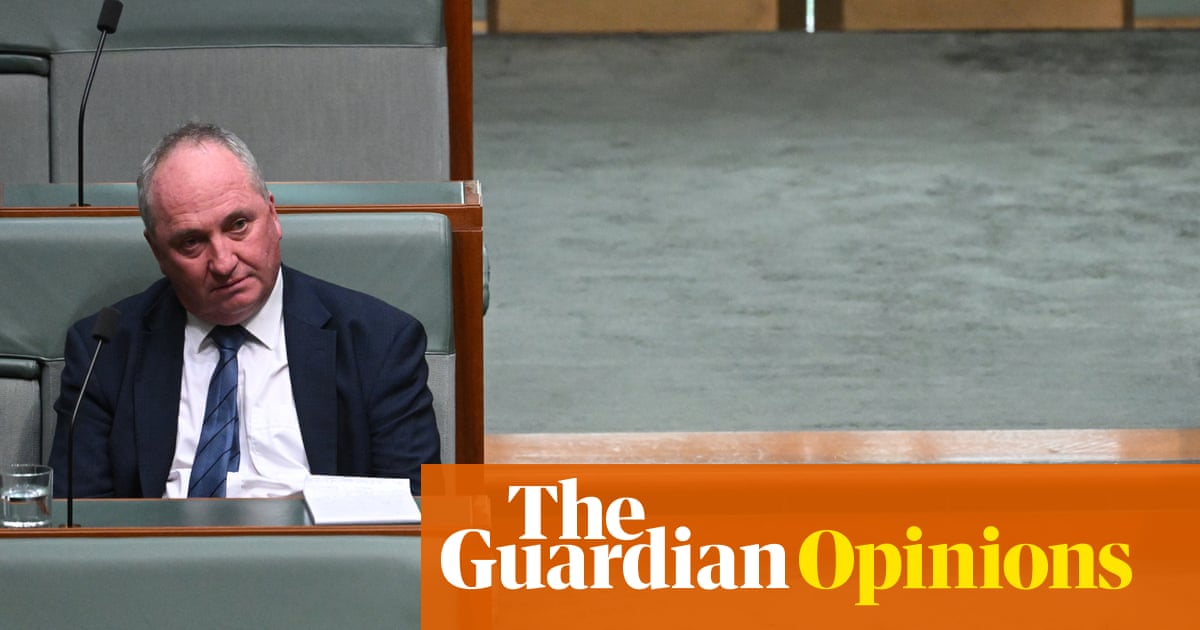
The 30 minutes before question time in federal parliament don’t usually warrant much media attention. A laundry list of members deliver 90-second statements about matters in their electorates.
On Wednesday, those speeches included a Christmas poem, a tribute to a Vietnam war veteran and a shout out to primary schools raising money for charity.
But – with a heavily flagged move about to be confirmed – the press gallery was packed, and all eyes were on the member for New England.
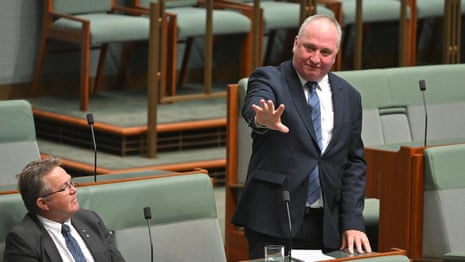
More than a month after he first mooted a split with the Nationals, Barnaby Joyce finally announced he was leaving his political home of 30 years to sit as an independent.
Joyce pointed to his spot high on the opposition backbench, dubbing it “the ejection chair”. Far from the action, it was a sign his party leadership wanted him gone, he said.
It was another sad low for Joyce, an outsize figure who once sat in cabinet, led the Nationals and served as deputy prime minister. He is expected to join Pauline Hanson’s One Nation to run for the Senate at the 2028 election.
Famously described by Tony Abbott as the country’s best retail politician, Joyce’s 20-year career in parliament has instead seen a string of scandals and misadventure, poor policy and bad judgment.
Consider just a few of the greatest hits.
Elected to the Senate in 2004, he arrived just as the Coalition took control of both houses under John Howard. But with a one-seat majority, Howard could not rely on Joyce to be a team player. Instead Joyce fought his own government on policy, crossed the floor and ignored appeals for discipline.
Sign up: AU Breaking News email
When Abbott appointed him as shadow finance minister in 2009, Joyce suggested the US might default on its loans, stoked fears about Chinese investment and confused billions with trillions in a set piece speech.
Fast forward to the Turnbull government, when Joyce had shifted to the lower house and held the agriculture portfolio. He moved the country’s pesticides regulator from Canberra to his own electorate, under the guise of public service “decentralisation”.
Joyce refused to release a cost-benefit analysis of the plan and the agency was quickly smashed: wifi-deprived staff worked from a local McDonald’s, large sections of the workforce quit, and approval times plummeted.
 Barnaby Joyce announces he’s quitting the National party – video
Joyce became deputy prime minister in 2016. A year later he resigned his seat after being ensnared in parliament’s dual citizenship saga through family ties to New Zealand.
Reelected, rumours about Joyce’s personal life started to overwhelm the government in 2018. It would emerge his marriage had ended and Joyce was expecting a child with a former staffer. The political damage was tremendous, with Turnbull and Joyce soon publicly sledging each other. The saga forced the ministerial “bonk ban”.
Bitter at having had to quit the Nationals leadership, Joyce and his backers soon worked to undermine successor Michael McCormack, forcing another leadership spill in 2021. This week Joyce blamed current Nationals leader David Littleproud for his exit, despite having consistently agitated against Littleproud since his 2022 elevation to the top job.
Joyce was forced to take leave last year after footage emerged of him completely sozzled on a Canberra footpath late at night.
His political judgment has hurt the Coalition the most since the May election.
After the Liberal and National parties briefly split, Joyce has ensured the media spotlight has remained firmly on the opposition by campaigning against the net zero by 2050 policy he signed the Coalition up to in government.
Joyce and his close ally Matt Canavan have ensured Labor had a near free run for six months, further hurting the chances of inner-city Liberals with voters concerned about climate change. Joyce called the shots on the Coalition’s entire emissions policy and the environment will be the ultimate loser if the Coalition finds a way back to government.
In his speech on Wednesday, Joyce accused Labor of building “swindle factories” and destroying regional communities. His ideological and science-free opposition to renewables can’t be separated from mining magnate Gina Rinehart’s support. Their relationship has coincided with the Nationals’ shift from being the party of country Australia to one representing the interests of the resources sector.
Joyce is a cautionary tale for the press gallery too. Criticising the circus of politics and insisting he did not want media attention, he places himself at the centre of events and distorts reality. Journalists should not mistake his antics for news.
Despite dining on steaks cooked on a sandwich press in Hanson’s office this week, Joyce refused to confirm he was joining One Nation. The expected plan is for him to eventually replace the 71-year-old as leader, bringing his profile high just as the party’s public support grows to nearly 20%.
The party wants to be taken seriously, and to represent real people, but Hanson’s main contribution this week was a stunt, denigrating Muslim Australians on an issue most voters don’t care about. Her grievance politics has grown tired.
Similarly, Hanson’s record of punching down on migrants and Indigenous Australians is badly out of step with the mainstream. The Coalition risks being pulled to the far right on the politics of immigration, even if a fight with One Nation is really a race to the bottom for mainstream parties.
Hanson’s lowest common denominator politics aside, Joyce will have to survive working with his likely new leader, who usually falls out with anyone with sufficient profile to rival her own. Just ask Mark Latham and David Oldfield who runs the show.
If he goes back to the Senate, Joyce will join Jack Duncan-Hughes and Philip McBride as the only politicians who have switched houses, only to switch back. Voters might wonder why Joyce can’t make up his mind, given Duncan-Hughes and McBride represent long gone eras.
Canavan and McCormack have pledged to try to convince Joyce to rethink his plans. Loved by many in his electorate and with fans of his maverick style around the country, they consider him an asset.
In parliament, Joyce pledged to continue his fight from a position better than “the ejection chair” on the opposition backbench.
After more than two decades in Canberra, he should ponder if that better spot is much farther afield.