
OpenAI, which opened its first Australian office in Sydney this year, isn’t ceding ground. Speaking at Canva’s Create event, OpenAI’s managing director for international, Oliver Jay, said Australia was already one of the company’s most important markets.
“The user growth in Australia has gone two and a half times since a year ago,” Jay told Canva co-founder Cameron Adams on stage. “We’re seeing a lot of momentum.”
Jay said OpenAI was hiring aggressively locally and working with partners including CommBank, Coles and Canva. The company has developed an “OpenAI for countries” program to work directly with governments on national AI strategies.
In a separate interview, Jay acknowledged the case for local investment: “Countries investing in their own AI capabilities is a good thing – it builds resilience and sovereignty.” But he argued OpenAI’s frontier models could serve Australian needs through localisation “across three layers – in the model itself, in the product, and in the broader ecosystem of Australian partners.”
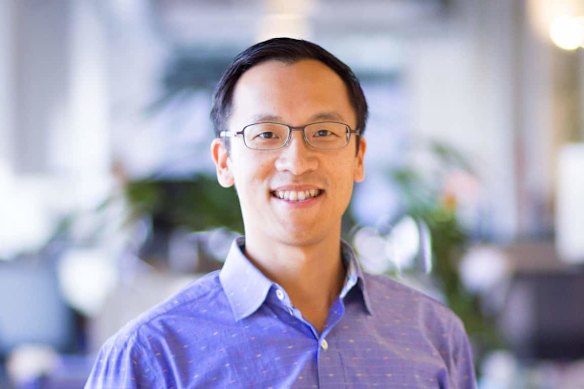
OpenAI executive Oliver Jay.
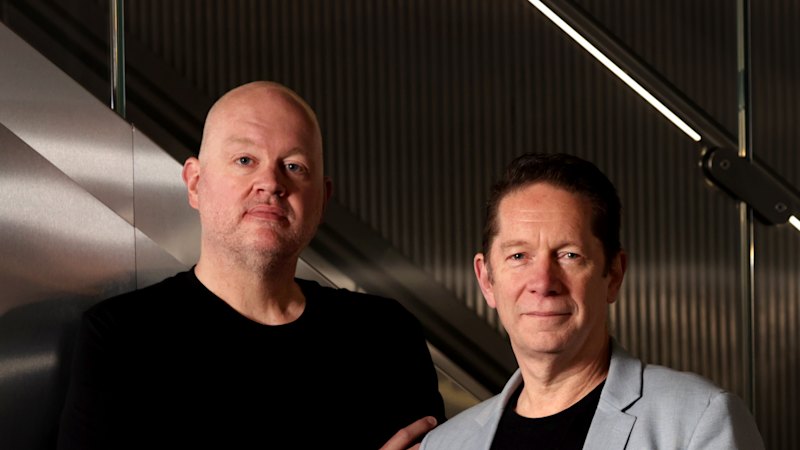
Kriss isn’t buying it. He points to Donald Trump’s recent directive to American AI founders that their next models “cannot be woke” – no discussion of diversity, inclusion or climate change.
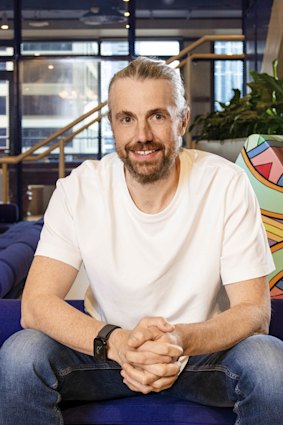
Atlassian CEO Mike Cannon-Brookes in the company’s new Melbourne office.
“Is that what we want for Australia? We have our own values here,” he said. “It’s the same thing as should we pay for copyrighted content. We believe we should, because that’s Australian.” Sovereign Australia AI has earmarked $10 million to compensate copyright holders and announced research partnerships with UNSW and Deakin University to develop benchmarks for measuring how “Australian” an AI model actually is.
Mike Cannon-Brookes, Atlassian co-founder and Australia’s most prominent tech billionaire, is sceptical. He argues Australia should focus on applying AI rather than building foundation models.
“I’m not building foundation models. There’s some crazy, cool science in building these models – it’s an awesome intellectual exercise,” Cannon-Brookes told this masthead. “What I need to be good at is applying those models to customer problems.”
He said Australia’s real opportunity was cheap renewable power for AI data centres and smart adoption across the economy – not chasing Silicon Valley’s model-building race.
“This sense that we need to own all the fundamental technologies – I get lost by that,” he said. “If we provided a shedload of power to data centres and we’re applying AI in our economy, we’d be in a way better spot.”
Technology veteran Craig Dargusch, chief data officer at information services company Cotality, said the challenge was more fundamental than most realised.
“If we gathered every word ever written by Australians throughout history, it still wouldn’t come close to the data required to train a purely Australian foundational model,” Dargusch said. “Large language models are built on humanity’s collective knowledge-wisdom accumulated over thousands of years. AI has already broken free of nations and borders.”
But he argued the solution wasn’t necessarily building from scratch – it was fine-tuning existing models for local context.
Still, Dargusch said Australia should aspire to build its own model. “There’s an opportunity to create something uniquely Australian – unlocking ancient Aboriginal stories passed down through oral tradition, concepts like mateship and the ‘fair go’ woven into the digital fabric,” he said. “Wouldn’t it be great to lead that charge?”
Loading
Sovereign Australia AI isn’t alone. Melbourne-based Maincode debuted its model Matilda at SXSW Sydney last month, although chief executive Dave Lemphers has distanced himself from sovereignty rhetoric, calling it “very divisive”.
OpenAI’s research suggests AI could add $142 billion annually to Australia’s economy by 2030. But Kriss warns that benefit could flow offshore if the underlying infrastructure isn’t Australian-owned.
“If the foundational AI models Australians rely on are built offshore, we risk losing control over how our national values are represented.”
Get news and reviews on technology, gadgets and gaming in our Technology newsletter every Friday. Sign up here.