
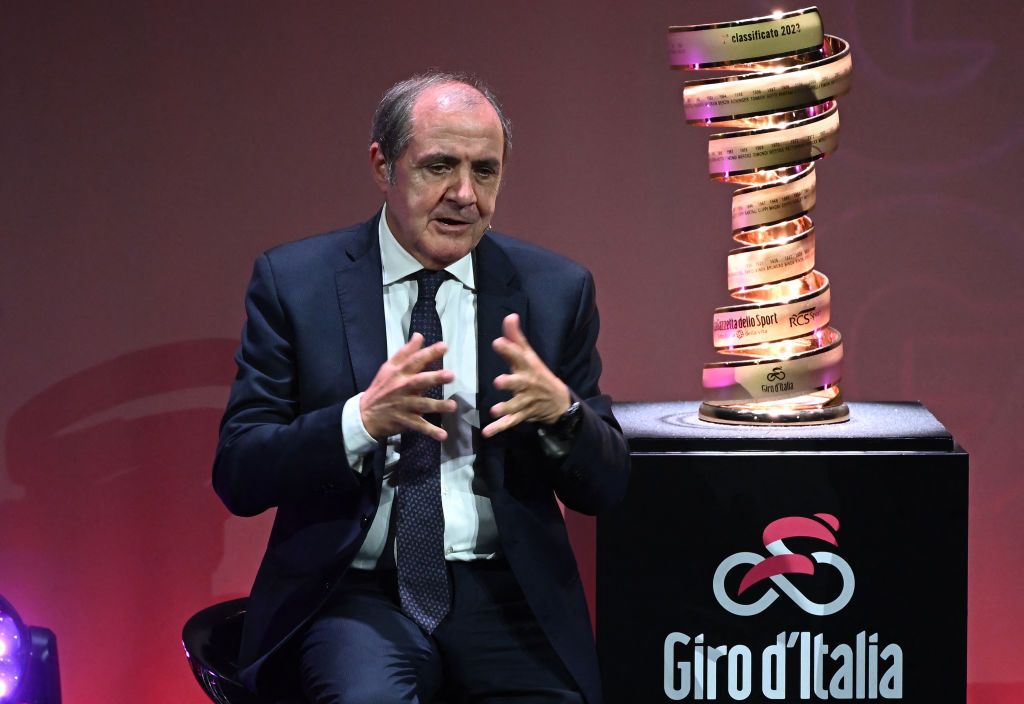
Mauro Vegni will present the route of the Giro d’Italia for the last time in his long, distinguished career on Monday. The 66-year-old race organiser oversaw the design of next year’s race but will retire in February, before it is contested in May.
Vegni’s name may not be widely known in the English-speaking cycling world, but in Italy, his sanguine talents as a veteran race organiser and especially his passionate defence of the Giro and Italian cycling are legendary.
Best picks for you
From Rome to Milan
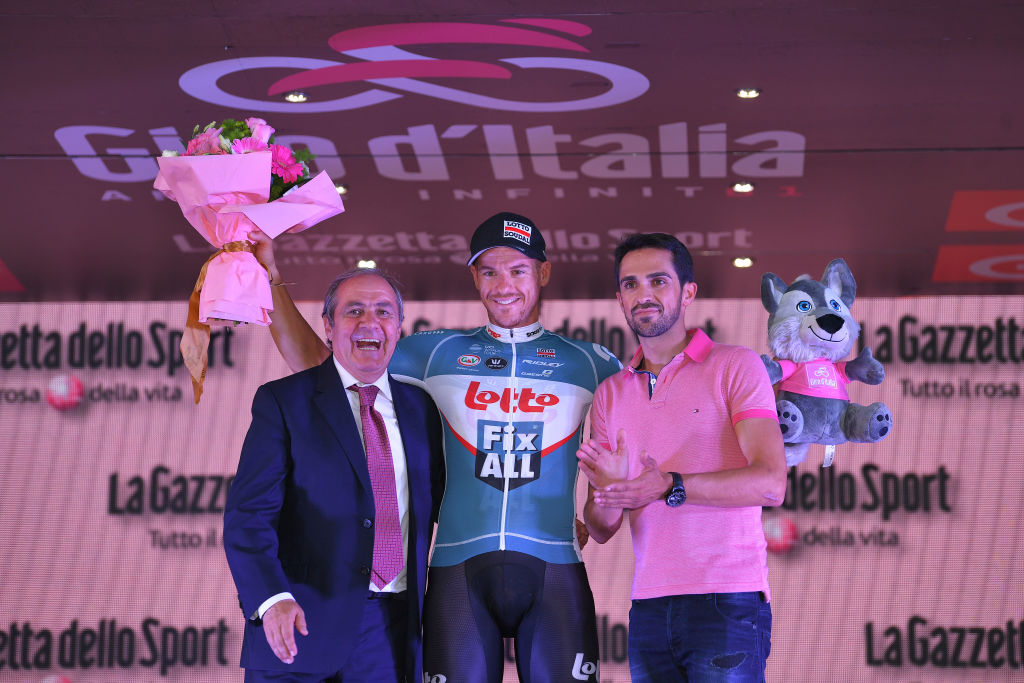
Mauro Vegni with Adam Hansen after he completed twenty consecutive Grand Tours and Alberto Contador (Image credit: Getty Images)
Vegni was born in Cetona near Siena in 1959, but his family soon moved to Rome, and they lived opposite Franco Mealli, the creator of Tirreno-Adriatico and other races in the south of Italy. He began working with Mealli when he left school in the early eighties and quickly showed his race organising skills.
In 1994, he played a key role in the organisation of the road and track world championships in Sicily. RCS Sport were impressed with Vegni’s work; they hired him when they bought Tirreno-Adriatico and Mealli’s other races. He worked under Carmine Castellano, Angelo Zomegnan and Michele Aquarone before becoming race director in 2012.
Don’t miss these
“I’ve been the Giro director for 14 years but had a key role in a total of 31 editions of the race and other Italian races,” he says. “Apart from Torriani, who was a legend of the sport, I think I’ve worked the longest for RCS and managed the most editions of the Giro.”
Vegni’s Giro d’Italia memories could fill several history books. He was in charge during dramatic moments such as snowstorms, landslides, major crashes, rider protests, doping scandals and a thousand other Italian polemics. He has also witnessed some historic victories and dramatic defeats.
“It’s difficult to know where to start,” Vegni says when asked to look back at his thick book of Giro memories.
“I suppose I’m especially proud of some of the special Grande Partenza we managed to create, including in Belfast, in Israel and even in Sardegna, in Italy.
“Going over the iconic climbs is always special, as is seeing the Giro visit in the centre of a busy city like Naples or Rome. We’ve never been scared to innovate, and so the Giro has climbed the Colle delle Finestre fire track, we created the Strade Bianche race and included gravel sections in the Giro. We sometimes take risks, and sometimes our ideas go wrong, but they’re always worth the work when we add something new and extra to the Giro.”
Vegni has often clashed with the riders when they protest about the weather. His battles with Adam Hansen, now the president of the CPA riders’ association, were fierce and personal at times, but now both respect the role of the other.
“Sadly, everyone blames the director and the organisers when things go wrong at a race,” Vegni says with regret.
“The tifosi blame us, the riders always take aim at us, and the media always criticise us but few people really understand what we do and how complex and how demanding it is to put on a major bike race.
“When riders work for RCS after they retire, they’re always shocked by how much work is involved and how complex it is to organise major races, especially in Italy, with all the bureaucracy and politics.”
Vegni remains critical of the riders’ insularity.
“Riders don’t respect each other or the races like they once did. Now it’s ‘Mors tua, vita mea’, it’s a dog-eat-dog world, with riders fighting for every position in the peloton and every UCI point up for grabs,” he suggests.
“There used to be the so-called ‘sceriffo’ or patron of the peloton, like Francesco Moser, Bernhard Hinault, or even Vincenzo Nibali. Now riders are scared of speaking out, and they don’t even point out potholes in the road to each other anymore.”
“Safety is a huge problem, especially with the higher speed and increasing road furniture. The average speed of the Grand Tours has gone up from about 38 kph to 44 kph. But it’s up to the riders to protect each other; they can’t just complain and blame others.”
‘Cycling deserves to be a far wealthier sport’
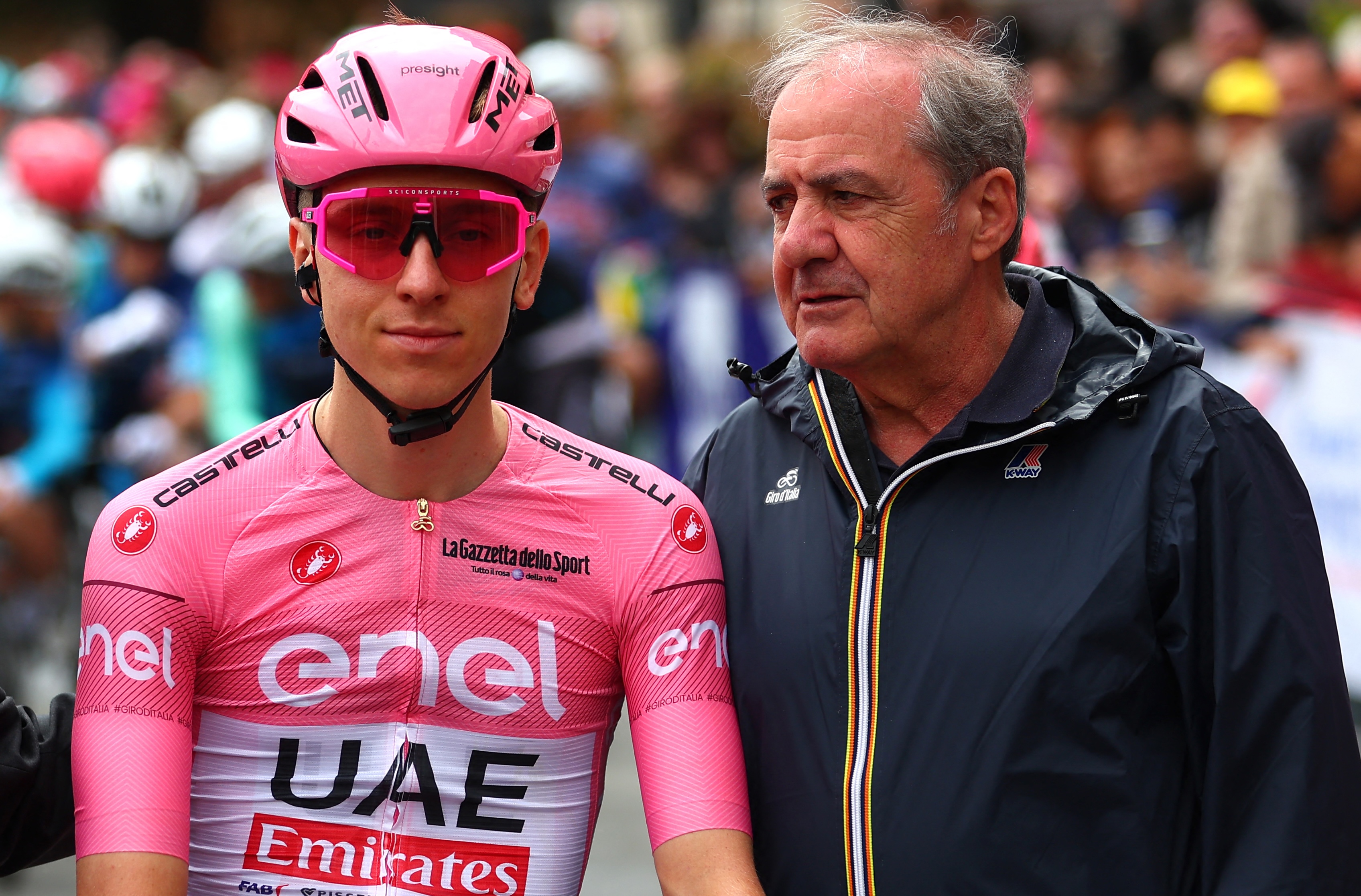
Mauro Vegni with Tadej Pogačar at the 2024 Giro (Image credit: Getty Images)
Vegni has always fought to defend the Giro and RCS Sport from the dominance of Tour de France organiser ASO. Cycling’s governance favours the strongest and biggest race organiser, and ASO plays a soft power game via the different stakeholders to defend its interests.
“Everyone is scared to criticize the Tour because it’s so important, but everyone seems to like to take cheap shots at the Giro. I’ve never liked that,” Vegni says.
He is against the idea of charging spectators to watch the races from the roadside, but RCS Sport has reportedly been close to doing a deal to be part of the One Cycling reforms, backed by SURJ investment from the Saudi Arabian sovereign wealth fund.
“Cycling deserves to be a far wealthier sport, but the blanket is always too short. If we pull it one way to give more money to the riders and teams, then others will suffer, including the race organisers and the fans. We’ve got to generate more income for everyone,” Vegni says.
He admits he may be emotional when the 2026 Giro route is presented in Rome on Monday. He has gradually lost the emotivity of his youth in Rome after years of living in Milan, but it will be a significant moment in his long career and mark another step near his official retirement in February.
The 2026 Giro is expected to start in Bulgaria, then travel to Calabria in southern Italy, before gradually heading north via Naples and Tuscany for the final week in the high mountains.
Vegni has recently reduced the total metres of climbing and reduced stage distances in the hope of attracting the biggest Grand Tour riders. Tadej Pogačar completed a rare Giro-Tour double in 2024, and Jonas Vingegaard seems keen to ride the 2026 Giro, perhaps in exchange for a start fee from RCS Sport.
Despite late-spring weather often disrupting the mountain stages, Vegni has insisted that the 2026 Giro route returns to the thin air of the high mountains.
“It’s important to race over the high mountains, so up to and above 2,500m. It changes the racing so much and really tests the GC contenders and shows their true abilities,” Vegni argues.
“The Giro has always got to include the iconic climbs, so we’ve put some of them back in the route. That’s what we call ‘vero ciclismo’, real cycling, otherwise the Giro would just be like other races.
“The riders ultimately decide if a race is legendary or not by how they race it, so let’s see what happens on the road to Rome in May. That’ll be the final judgment on my final Giro.”