
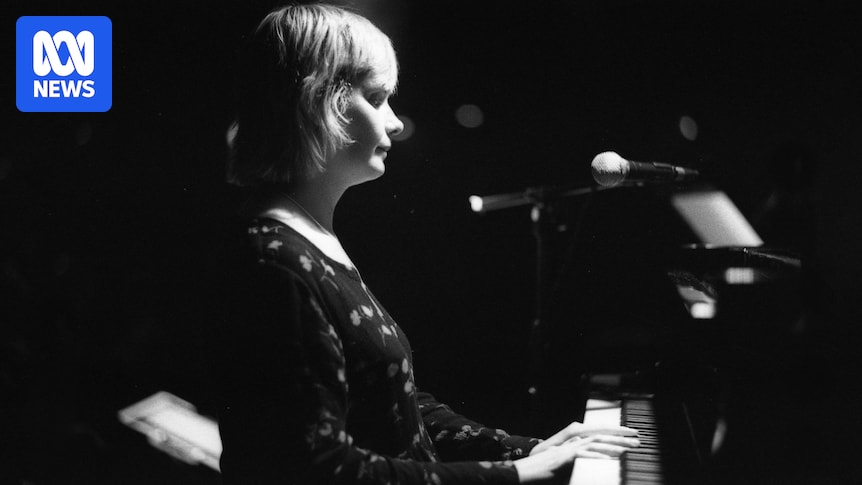
Jazz pianist Jann Rutherford was a pioneer and role model for many. But her accomplishments were often overshadowed by the fact she was blind from birth.
“She was a very skilled musician who could play anything in any key in any style,” says Jordie Howell, a soprano and braille music transcriber who was one of Rutherford’s students.
Rutherford was one of a handful of women who won the prestigious National Jazz Award at the Wangaratta Jazz Festival, and the only female instrumentalist to do so in the festival’s history.
Loading…
She was a passionate supporter of the broader Australian jazz community.
Saxophonist Sandy Evans remembers how Rutherford “was always at everybody’s gigs.”
When she died at the age of 38 in 2003, Rutherford had recorded several albums in collaboration with longtime colleagues in Sydney, including many of her own original compositions.
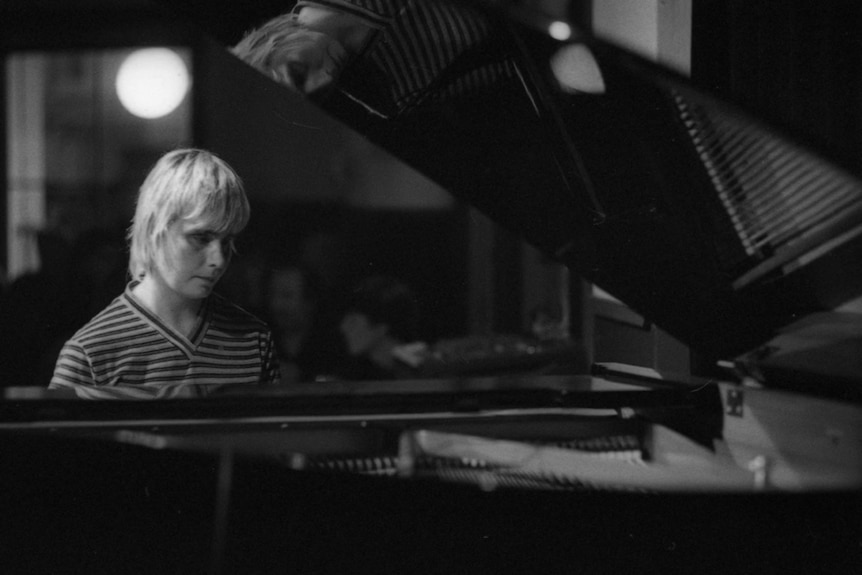
Jann Rutherford established herself in Sydney when she was 25. (Supplied: Paul Cutlan)
Rutherford’s legacy is still shaping the Australian jazz world.
The Jann Rutherford Memorial Award, set up by Evans and others, supports young female and gender diverse jazz instrumentalists.
This year, the awards celebrate 20 years of championing these artists.
A pioneer musician and role model
Rutherford grew up in Dunedin, a small town in New Zealand. She was 25 when she moved to Sydney in 1989.
“She was very cool, but she suffered no fools.”
“She had really high standards about being a professional musician,” Howell says.
Howell first met Rutherford at the National Braille Music Camp, an annual week-long program where older blind musicians teach braille music and mentor school-aged students.
“Jann was a very accomplished classical pianist,” Howell says.
“You can tell that her jazz compositions have roots in classical music.”
Rutherford composed and arranged music with ease.
Howell remembers the buzz she felt as a 16-year-old when Rutherford set one of her poems to music.
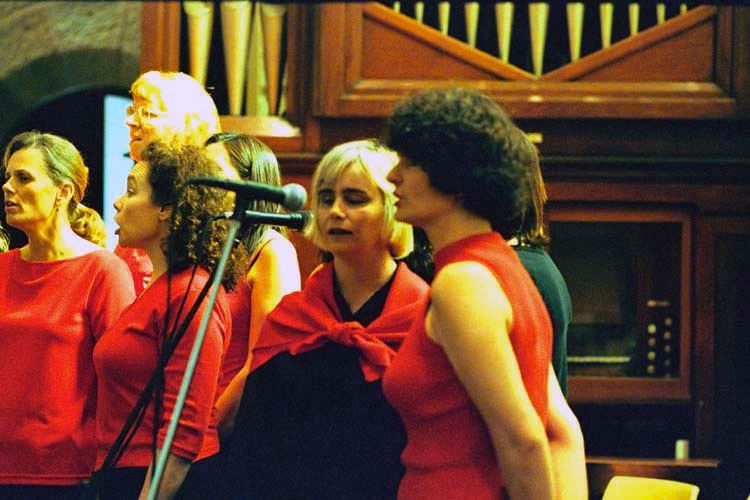
Rutherford was equally at home with classical music and jazz. (Supplied: Paul Cutlan)
“She liked the jazz lifestyle of coffee, alcohol and cigarettes, but she would also sing arias by J.S. Bach and Gabriel Fauré,” Howell says.
Rutherford was a pioneer in using technology to compose.
As well as traditional cassette tapes, she used Cakewalk, an early digital music software to write down her compositions and arrangements.
“She would write out the music for her sighted peers,” Howell says.
Those peers include some of the leading jazz musicians in Australia, many of whom are still active today.
Thriving in Sydney’s ’90s jazz world
One of Rutherford’s longtime friends and bandmates was bassist Craig Scott, Chair of the Jazz Studies Unit at the Sydney Conservatorium of Music from 2005 to 2016.
Scott played many of Rutherford’s original compositions.
“Jann walked into a situation where there was quite a lot happening, particularly around the middle of the city,” Scott says.
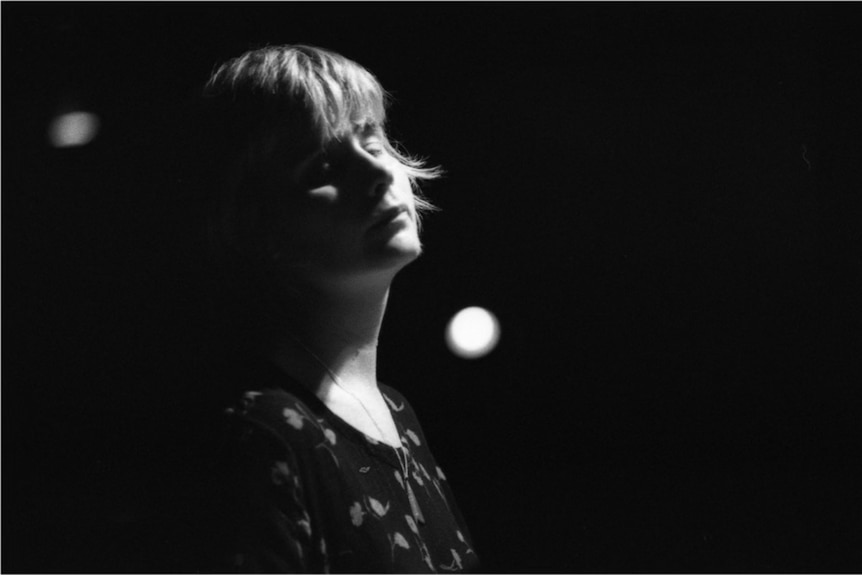
Jann Rutherford frequented Sydney’s ’90s jazz clubs, either performing or supporting friends. (Supplied: Paul Cutlan)
Sydney was home to several dedicated jazz clubs within walking distance of each other in the 1990s, according to Scott.
Rutherford frequently played at venues including the Strawberry Hills Hotel, the Side On Café, the Soup Jazz Club, the Basement and others.
Rutherford also undertook further studies at the Sydney Conservatorium, where her teachers included Mike Nock and Roger Frampton. She also met legendary pianist Judy Bailey.
“[Historically], the Con was regarded as being a boys club,” Scott says. But Rutherford thrived.
“Jann was part of a [quintet] of young female players called Any Woman’s Blues,” Evans says.
The group, led by vocalist Kate Swadling, became one of Rutherford’s sources for support.
At the time, Evans says, “it was very common to be the only woman in a band.”
Rutherford was also involved with several other leading Sydney-based bands.
She recorded the album Pentatonic in New York with the Graeme Norris Quintet in 1995.
Two years later, she recorded Ed Street with the Ed Hughes Quintet.
Jann Rutherford meets Julian Lee
Rutherford also collaborated with blind multi-instrumentalist and braille music reader Julian Lee, who also came from Dunedin.
Their tribute album to pianist and composer Fats Waller was recently discovered in the archives of ABC Jazz.
In 1998, Rutherford released her solo piano album Discovery, containing 15 original compositions.
“I use tapes to write music, and I ‘discovered’ this tune a long time after I had written it,” Rutherford explained about the titular track.
Recording The Scented Garden
Rutherford was planning to record a new album in 2002, The Scented Garden, when she was diagnosed with cancer.
Despite her illness, the recording went ahead.
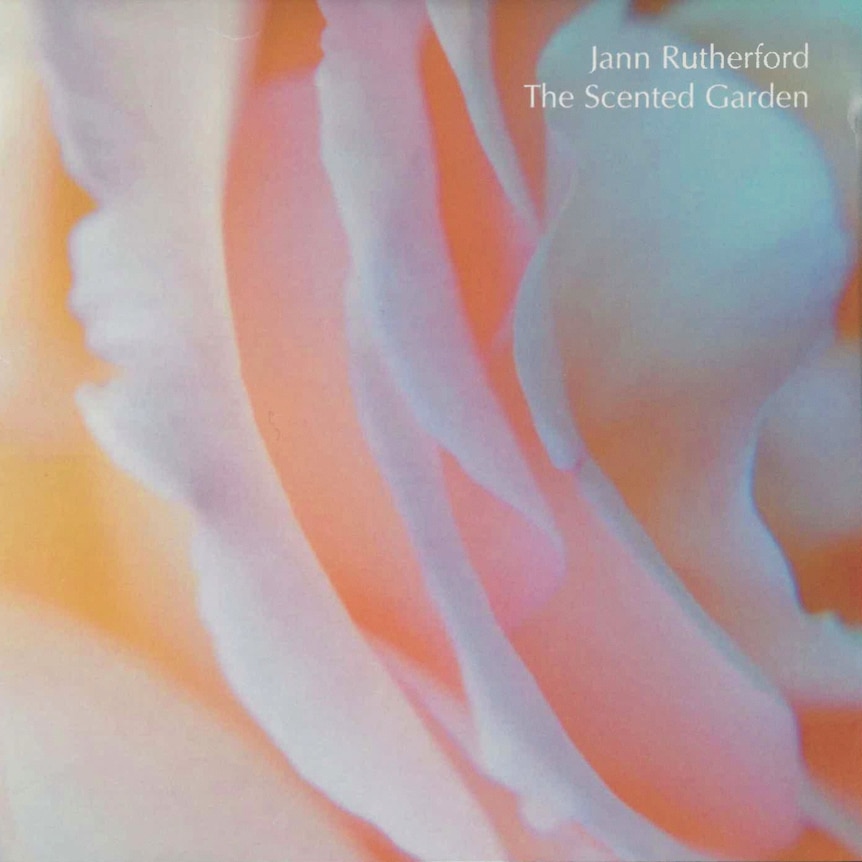
The Scented Garden was Rutherford’s last album, inspired by her mother’s garden. (Tall Poppy Records)
Scott vividly recalls going into the studio with Rutherford and longtime collaborators saxophonists Paul Cutlan and Roger Manins and drummer Rease Cameron [formerly performing as Dave Goodman].
“We tried to get everything down in one take because Jann was really unwell,” Scott says. “She had very little petrol in the tank by then.”
“I remember how wonderful she was on the session and how desperately keen we were to do our very best for her,” Scott shares.
Shortly after recording The Scented Garden, Rutherford returned to New Zealand to be with her family.
Before Rutherford left Australia, Scott and other friends organised a tribute concert for her featuring music from the album.
“There was a huge outpouring of affection for Jann,” Scott says. “Matt McMahon played the piano because by then Jann was too sick.”
“When we finished, I gave her a kiss on the cheek and I left. She went back to New Zealand and she passed away.”
The Scented Garden was released posthumously.
Paving the way for other young women in jazz
Rutherford’s death left a huge hole in the Sydney jazz community, where she was well-loved and respected.
“She had the musical credentials to be at the vanguard of jazz,” Scott reflects.
The Jann Rutherford Memorial Award Concert
When Evans was asked to set up an award to support female instrumentalists, she named it in memory of Rutherford’s extraordinary life.
Jazz has a DNA in diversity, with a history of protest against discrimination.
The music has also been a platform for several musicians with disability.
But according to Evans, it’s harder for female instrumentalists to break through, despite legendary female jazz musicians like Ella Fitzgerald, Sarah Vaughan and Nina Simone.
“In Sydney as well as in America, the history of female instrumentalists in jazz has been hidden,” Evans reflects.
The Jann Rutherford Memorial Award was set up in conjunction with workshops platforming female instrumentalists by the Sydney Improvised Music Association.
The award was initially funded by a private donor, with additional support from Rutherford’s royalties, the Mietta Foundation and ABC Jazz.
In its 20-year history, the award has been pivotal in opening opportunities for many influential jazz musicians of today, including guitarist Jess Green, electric bassist Lucy Clifford and drummer Hannah James.
Pianist Lauren Tsamouras is the recipient in 2025.
Clifford says the award helped her to achieve more recognition as a composer and form a band of her own.
As part of the award, she also recorded an album released by ABC Jazz.
That album, Between Spaces Of Knowing, recently won Best Jazz Album at the ARIA Awards.
“Lucy’s creative spirit and musical excellence honour Jann’s legacy in the most wonderful way,” says Evans of Clifford’s win.
Some past award recipients have gone on to hold positions of influence in the jazz world, doing their part to continue Rutherford’s trailblazing work.
In 2024, Green was appointed as the program leader for Sydney Conservatorium’s Equity in Jazz Program, which focuses on female and gender diverse representation at the institution.
“There’s not any [one] way to play jazz,” Evans says.
“Everyone should have the same opportunity to share this joy.”
Get the latest jazz and classical music stories direct to your inbox