
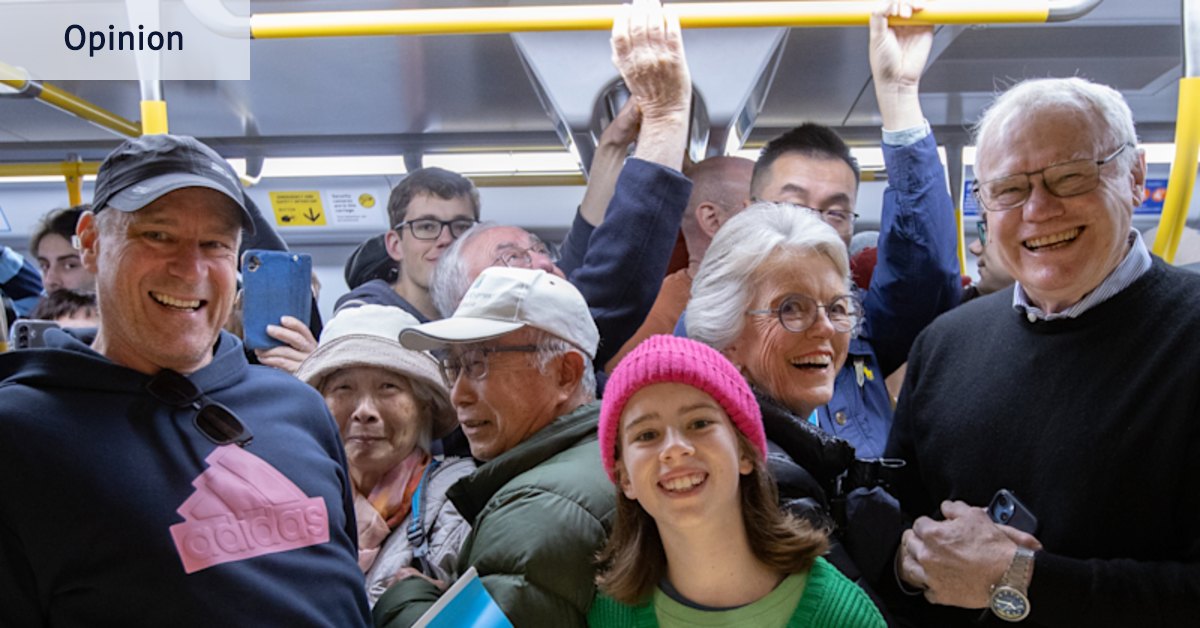
The engineering alone is impressive, such as the 42-metre-long escalator at the State Library, which is 12 metres longer than those at Parliament station.
The trains, for the most part, are running smoothly through the tunnel, hurtling along from Arden station to Anzac and crossing directly under the Yarra River.
Everything is high-tech and clever – platform doors open simultaneously with the train doors, creating an air and security lock for passengers.
You can even check how full each carriage is on little screens on the platforms before the train arrives.
For Melburnians accustomed to our somewhat scruffy and worn-out train system, all this shiny newness is exhilarating.
However, Allan’s promise of a metro train system in which you can just “turn up and go” in a similar style to London’s Tube or Paris’ Metro seems a long way off.
The trains on the Metro Tunnel will operate for only five hours a day for the first two months, and trains will run every 20 minutes outside the peak periods.
Testing has been done for the trains to operate at a frequency of every three minutes, but the government has given no indication of what the timetable will look like beyond February.
Loading
The clearest indication is that we might expect off-peak services every 10 minutes, which is good for Melbourne – where train waiting times can sometimes stretch to 40 minutes – but not by global standards.
High-frequency services for which you don’t have to look at a timetable and can just turn up to the station are what is really needed to coax car-obsessed Melburnians out of their four-wheel-drives and onto the train.
The Metro Tunnel gets people from one part of the city to another quickly, but it doesn’t change the radial design of Melbourne’s train network where most lines originate in the suburbs and converge on the city centre.
Nathan Pittman, education fellow in transport planning at the University of Melbourne, says if the Suburban Rail Loop is eventually built it will provide a way for people to travel between suburbs rather than only into and out of the city, but the Metro Tunnel as it stands does not provide this type of connectivity.
Loading
If the premier wants to focus on fairness, the Metro Tunnel does little to address the public transport deserts that makes up much of Melbourne’s booming western suburbs.
That would require construction of the Metro Two, once seen as a follow-up project to the Metro Tunnel and consisting of a 15-kilometre rail tunnel from Newport to Clifton Hill, via Fishermans Bend, the CBD, Parkville and Fitzroy.
“Metro One is such a brilliant project it helps make the case for Metro Two, which is a much-needed project,” Reece said on Sunday.
Then there is the long-promised Melbourne Airport Rail.
Before the Metro Tunnel’s opening this week, I spotted a family dragging their suitcases past City Square and the fenced-off entrance to Town Hall station.
“Soon we’ll be able to catch a train to the airport from here,” the father said to his children pointing to the station entrance.
“Soon” is doing a lot of heavy lifting in that sentence: the airport rail is slated to open in 2033.
Building new train infrastructure is exactly what Melbourne should be doing, but the Metro Tunnel is just the start of what needs to be an ongoing process of updating, improving and extending our public transport system.
Start the day with a summary of the day’s most important and interesting stories, analysis and insights. Sign up for our Morning Edition newsletter.