
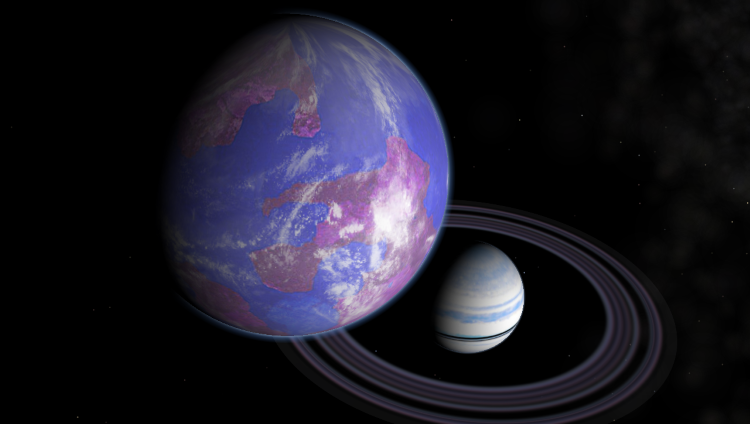
Have scientists finally confirmed the existence of the first exomoon? This is what a recent study accepted for publication in *Astronomy & Astrophysics* hopes to address as a large international team of researchers investigated new methods for identifying an exomoon orbiting a gas giant exoplanet. This study has the potential to help scientists develop new methods for finding exomoons, the latter of which has yet to be confirmed.
For the study, the researchers used a method called astrometry to detect the existence of a secondary object orbiting HD 206893 B, which is located approximately 133 light-years from Earth and has a radius and mass of 1.25 and 28 Jupiters, respectively, along with an orbital period of 25.6 years. Astrometry is used to detect tiny wobbles between stars and planets or even planets and secondary objects like exomoons or binary planets. In this case, the researchers used the VLTI/GRAVITY instrument to measure wobbles between HD 206893 B and a potential companion object ranging from several days to years. In the end, the researchers discovered that a secondary object could be orbiting HD 206893 B with an orbit of 0.76 years and approximately 0.4 Jupiter masses.
The study notes in its conclusions, “Our results demonstrate the potential of high-precision astrometry in the search for exomoons. While the detection around HD 206893 B requires further validation, this study establishes the methodology and proves the feasibility of the technique. GRAVITY, designed with the hope to reach micro-arcsecond precision, is currently the only instrument capable of pursuing this astrometric pathway to Neptune-like exomoons around directly imaged exoplanets and substellar companions. We therefore conclude that VLTI/GRAVITY has a pivotal role to play in the emerging field of exomoon and binary planet discovery.”
As noted, astronomers have yet to confirm the existence of an exomoon, and there are currently only a handful of exomoon candidates aside from the one identified in this study. While the closest candidates were Kepler-1625 b-i and Kepler-1708 b-i, which are located approximately 7,500 and 5,500 light-years from Earth, respectively, a 2024 study refuted those claims after re-analyzing Hubble and Kepler data.
The reason why exomoons are so hard to detect is simply due to their small size, as moons are typically much smaller than their parent planet. As demonstrated in this study, while HD 206893 B is estimated to be 28 Jupiter masses, its alleged exomoon candidate is estimated to be only 0.4 Jupiter masses. Additionally, while Kepler-1625 b and Kepler-1708 b are estimated to be approximately 30 Earth masses and 4.6 Jupiter masses, and before the 2024 study, their exomoon candidates were only estimated to be approximately 10-20 Earth masses and approximately 5-15 Earth masses, respectively.
The reason exomoons are gaining interest among the scientific community is due to our own solar system having more than 200 moons. Several of them are currently targets for astrobiology, including Jupiter’s Europa and Saturn’s Enceladus and Titan. Currently, NASA’s Europa Clipper spacecraft is en route to Europa to ascertain its habitability while NASA is also gearing up to launch its Dragonfly quadcopter to Titan sometime in 2028. While no missions are currently slated to re-visit Enceladus, scientists continue to analyze the data obtained by NASA’s Cassini mission, which intentionally burned up in Saturn’s atmosphere in 2017, but not before discovering plumes on Enceladus’ south pole and even flying through them.
In addition to our solar system, the search for habitable exomoons also takes its cue from science fiction, as the moon Pandora in the Avatar film series is habitable for a myriad of intelligent beings, although not technological.
What new discoveries about exomoon candidates will researchers make in the coming years and decades? Only time will tell, and this is why we science!
As always, keep doing science & keep looking up!