
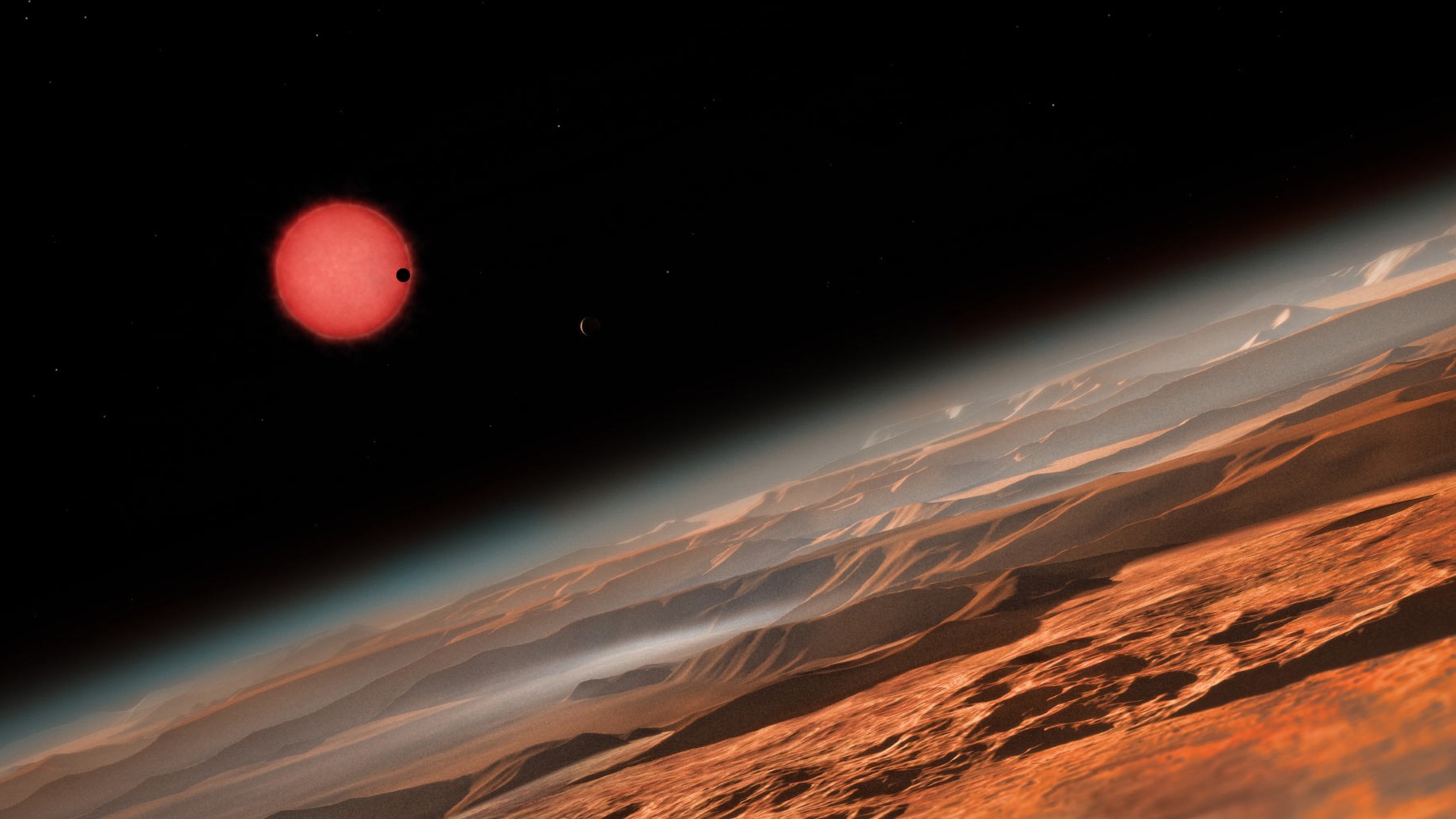
Earth has been known as the only planet with favorable conditions to host life, but what if it is not as unique as we thought? Recent studies have been finding evidence of planets in other solar systems, with characteristics similar to Earth’s. One of the seven Earth-sized planets, TRAPPIST-1d, caught the attention of researchers and is one of the promising planets that could have a high chance of hosting life. This planet falls within the “Goldilocks zone” where the temperature and other factors are “just right” for liquid to be present and possibly life.
Why is the idea of finding a planet similar to Earth so exciting?
The scientific community has been searching for a planet similar to Earth for some time now, and finding it in the TRAPPIST-1 system is what they’ve been waiting for. This particular solar system is roughly around forty light-years away, and the planets orbit around an ultra-cool dwarf planet. What a coincidence that the planet similar to Earth, happened to also be he third planet in its own system. The planet itself has become an exoplanet science star since it orbits so close to the inner region of the habitable zone and receives enough starlight to have potential liquid on its surface.
The idea of Earth having a twin will solely rely on TRAPPIST-1d’s atmospheric stability; it needs a blanket of gases to ensure that the heat remains trapped. If not, then even an amazingly placed planet would still freeze. The excitement about this planet stems from the possibility that it could have survived its violent stellar conditions and holds crucial periodic elements such as nitrogen, carbon dioxide, as well as water vapour, which make up the basic elements a planet needs to be able to host living organisms.
Is it possible that TRAPPIST-1d has the conditions needed to sustain long-term human habitation?
To confirm whether or not life exists on this planet, NASA resorted to using the most advanced telescope, called the James Webb Space Telescope (JWST), to find the answer to this question. The researchers studied the starlight that penetrated through the rim of the planet using its Near-Infrared Spectograph (NIRSpec). Scientists searched thoroughly for a planet that had water vapour (H20), methane (CH4), and carbon dioxide (CO2).
Identifying these gases would not only support the theory that this planet is Earth’s possible twin but could also rewire the possibilities of what life would be like living in the coolness of the red dwarf star in the galaxy. The accuracy of the NIRSpec allowed the scientists to compare many possibilities of the atmosphere, including a thick layer of hydrogen to compact the layer of nitrogen that resembles Earth.
The truth revealed about planet TRAPPIST-1d and the chances of humans ever living there
When the long-awaited data finally came back, all the anticipation of the possibility that Earth isn’t the only habitable planet was extinguished. Instead of confirming an Earth-like world, the results showed that there were no clear signs of any of the three elements mentioned earlier. Scientists have now ruled out the possibility of an Earth-like atmosphere. Lead researcher Caroline Paiulet-Ghorayeb explained that while the goal is to find a familiar environment somewhere else, TRAPPIST-1d can now be dismissed as Earth’s twin. Without biosignature gases found on the planet, there will be no chance of it being able to host living beings.
And the intense search for a habitable planet continues
Although TRAPPIST-1d is unlikely to host life, the mission continues to find a planet that will host living organisms. Scientists are now more focused on systems on the outer planets of TRAPPIST-1e, f, g, and h, hoping to find a planet that has less damaging radiation, increasing the possibility that the planet might be able to hold onto its atmosphere and water.