
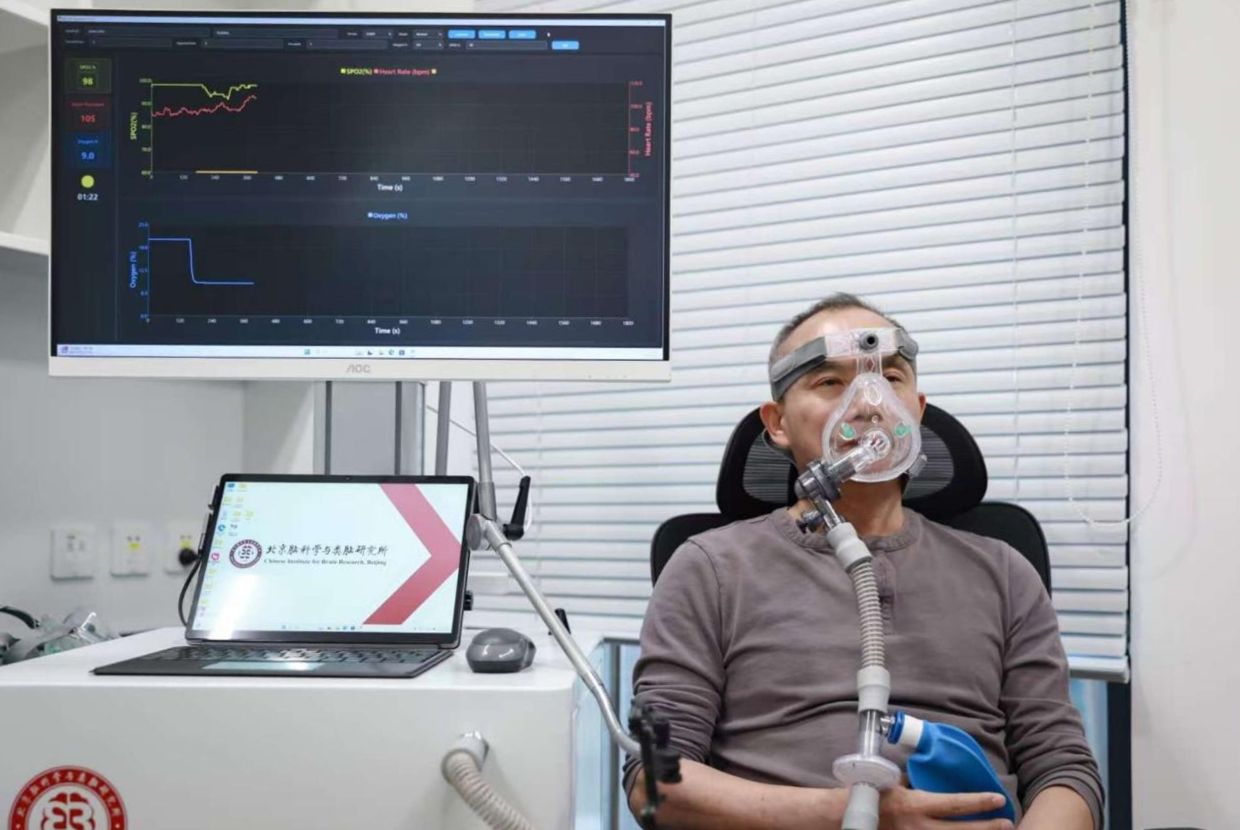
Brief, controlled bouts of oxygen deprivation – essentially moments of safe suffocation – can alleviate severe depression as effectively as electroconvulsive therapy (ECT) and ketamine, two of the most powerful treatments known to psychiatry, Chinese scientists have concluded.
This radical new approach, called acute intermittent hypoxia, harnesses a natural mechanism triggered by a temporary drop in oxygen in the brain and activates a naturally occurring compound known as adenosine, which acts as a biochemical “master switch” that rapidly reverses depressive symptoms.
The research team has developed a prototype device and is now conducting clinical trials involving 30 patients in collaboration with Beijing Anding Hospital, a renowned psychiatric institute affiliated with Capital Medical University.
Their discovery may also solve one of psychiatry’s longest-standing mysteries: how established treatments such as ECT and ketamine affect the brain, as well as help researchers develop alternative and safer treatments.
ECT, first used in the 1930s, involves passing electrical currents through the brain to induce a seizure and alleviate the symptoms of mental illness.
Despite its effectiveness, it has been one of the most controversial treatments in psychiatry.
Early treatments involved the use of high doses of electricity without sedation, leading to greater pain, fear and anxiety, fractured bones and other serious side effects.
Today, the procedure is much safer – though side effects such as short-term memory loss and impaired cognition are still a concern.
Using advanced imaging tools, the Chinese team discovered that brief surges of adenosine in the medial prefrontal cortex, a key mood-regulating region of the brain, were necessary for these therapies to be effective.
In the oxygen deprivation therapy, when patients briefly and controllably breathed hypoxic air, which has a lower concentration of oxygen – the team found it could induce the brain to produce significant quantities of adenosine in the cortex.
The study, which was jointly led by Luo Minmin from the Beijing Institute for Brain Research and Wang Xiaohui from the Changchun Institute of Applied Chemistry, was published in the peer-reviewed journal Nature earlier this month.
“Our findings establish adenosine as a pivotal mediator of rapid-acting antidepressants and a tractable target for scalable, non-invasive therapeutics in major depressive disorder,” the paper said.
Luo said in a recent interview with National Business Daily that he had started investigating ketamine and adenosine several years ago.
The main problem he encountered was that the latter is metabolised extremely rapidly within the brain, leaving traditional biochemical detection methods incapable of capturing its dynamic changes.
A key turning point came in 2019 when a team led by Li Yulong, a professor at Peking University, developed a genetically encoded fluorescent probe that specifically targeted adenosine.
By using this technique, Luo’s team managed to observe adenosine in real time within the brains of living animals.
They discovered that low-dose ketamine injections and ECT both triggered rapid, substantial and sustained increases in adenosine levels within the brain.
Through further experiments, they also discovered that blocking the brain’s reception of adenosine signals through genetic or pharmacological means nullified the antidepressant effects of ketamine and ECT.
Having identified this “master switch”, the team went on to synthesise over 30 novel ketamine derivatives, which Luo estimated would take three to five years to bring to market.
Feng Guoping, a chair professor of neuroscience at the Massachusetts Institute of Technology who was not involved in the study, wrote on social media: “This study provides a major breakthrough by identifying a single signalling molecule, adenosine, as the master switch … This insight is more than a discovery; it’s a blueprint that shows us how to decouple the therapeutic benefit from side effects.
“Impressively, the study validates this blueprint by identifying more potent drug candidates and a promising non-invasive therapy based on the same mechanism.”
— SOUTH CHINA MORNING POST