
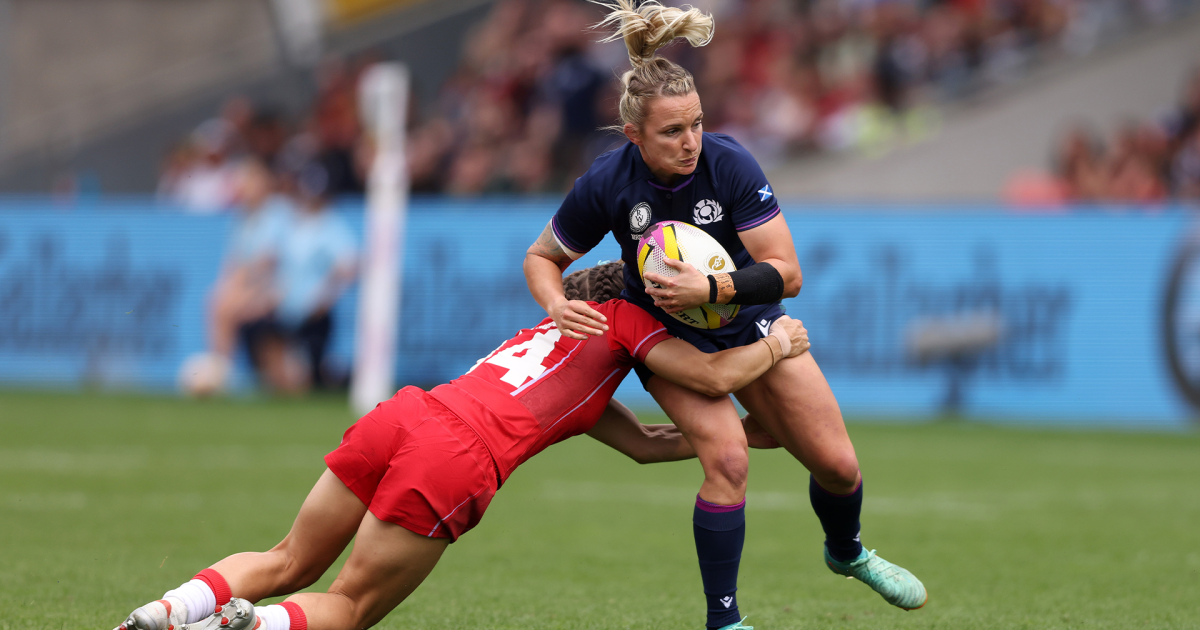
Scotland full-back Chloe Rollie likes a challenge. How else do you explain leaving the relative certainty of Premiership Women’s Rugby side Trailfinders Women after one season for a side that has just been promoted to the top-flight AXA Elite 1 league in France?
She explained it in five words: “I just needed a change.”
“I needed a different environment,” the 30-year-old continued. “A different challenge. And it wasn’t just the rugby that I had to learn. It was also the language, the culture, a new group of girls, [in] a team that had just come into the Elite 1.”
So Trailfinders’ full-back swapped leagues and crossed the Channel to become Rugby Club Toulon Provence Méditerranée’s full-back for their Elite 1 debut, a matter of weeks after four high-intensity Women’s Rugby World Cup outings.
The French competition is not entirely alien to Rollie. She made her professional debut for Lille Metropole Rugby Club Villeneuvois in October 2017 and helped the team to the semi-finals of what was then France’s Top 8 league.
That was the better part of a decade ago and in another part of the country. About as far away as it’s possible to be from Toulon in metropolitan France.
Even so, Rollie remembers that period in her early career fondly.
“When I was in France last time, up in Lille, I enjoyed the way that they played,” she recalled. “It was a bit more free and a bit more ‘do what you want to do as a player’.
“I felt a bit stuck where I was. The way we played [was] very structured, very by the book. You go through this step, then you do this and then you do this.
“In France it’s more heads-up rugby playing what’s in front of you. That’s the kind of player I am. I can catch the ball and one thing can change in front of me, so why play that same call or that same move if something’s different?”
And that’s really rather the point, as far as she’s concerned.
“Everyone plays the game to have fun,” Rollie said. “You want the result at the end, but we play the game because we enjoy it.
“I felt like sometimes, in PWR, it was a bit more like going through the motions — we’re going to do this and we’re going to do that. In France, we’ll try this — if it works, great, if not, see what’s going on next. How else do you want to attack the game? What do you see in front of you? How are you going to exploit that?”
That freedom to play instinctively is rugby life for instinct players like Rollie.
“I want to find the gap,” she said. “I want to find the space. I want to find the weaknesses in defence.
“Obviously, playing full-back, you catch the ball and you’ve got three decisions to make — run, kick or pass. If I have options in other phases of play, it’s perfect for me because anything can change in front and you just need to play off-the-cuff rugby. For me, it’s really good to play with a bit of freedom, to express myself.”
The start of the season has been as expected, something of a baptism of fire for Rollie and her new Toulon team-mates. Five defeats in six outings in an opening block that has included matches against big name clubs in the women’s game — Blagnac, Montpellier, Grenoble, Toulouse and Bobigny. Their sole win to date has come at home against Lyon.
It’s been difficult, Rollie admitted.
“This team needs to find its feet in terms of setup and environment and professionalism. It takes time for the mentality to change. Elite 2 was probably a lot easier.
“We’re building every game. We played Blagnac, and only lost by seven points. It’s not a big margin, especially against a team like that. It was a close game and a very good performance.
“Tthen we played Montpellier and the first half was really not great at all. But this is what Elite 1’s like. Teams will punish you.”
The victory, by two points over Lyon, was another ‘really tough game’.
“We scored in the last minute. So, yes, we won. But it wasn’t easy.”
She doesn’t want her team-mates to be overawed by the 15 players in front of them every week.
“They might have internationals, they might look really strong. But if we get our gameplan right and we get our points in the match right, there’s no reason we can’t win … if we get all our processes right?”
Her second French adventure comes at what looks a lot like a powerful inflexion point of the women’s game in the country. Talk out of FFR headquarters even before the tournament was that the 2025 Women’s Rugby World Cup would be a springboard to a better future.
Insurance giants AXA have come on board as title sponsors of the domestic women’s Elite 1 league for the next three seasons, as part of a project to triple the budgets of leading clubs.
In November, Francois Ratier was named as the next coach of France. He will officially take charge on January 5, 2026, with an ambitious remit to ‘contribute to the design, implementation, and management of an ambitious performance project aimed at leading the French Women’s XV to the World Cup title in 2029’.
As a player from the standard-bearing PWR, Rollie sees how far the top-flight game in France has to go, the scale of the challenge in front of French rugby. It is, she believes, some five years behind the English league. That’s a lot of ground to make up.
“It’s not as professional over here, it’s more a hobby,” she said. “People play this game for fun rather than as a job or a main focus.
“The girls work all day, then turn up to training. Some girls arrive late because they’ve had to work late. In PWR, when I left, that wasn’t the case. There are a lot of full-time athletes turning up at one in the afternoon to do skills whereas, here, we’re having to wait until 6:30PM to do that because everyone’s working.
“Only a handful of international players are able to fully focus on training and recovery. There’s a big difference in the mentality of it being a professional environment.”
She added a caveat: “Toulon is probably different to other teams in Elite 1 because they are new, they’re still finding their feet, still trying to figure it out. The coaches still work full-time jobs and turn up to coach us in the evenings. That’s a big change for me because coaches in the PWR, that is their main job.”
The change in attitude to the women’s game couldn’t come too soon.
“The French women’s team used to be able to put up good results against England, sometimes beating them if not only a couple of points between them,” Rollie explained. “The French union maybe got a bit of a shock when they realised how big the PWR has made women’s rugby in general and how big the World Cup impact was.”
The scale of the tournament in England, and its wider impact surprised even Rollie. But she understood even before all the data about crowds, TV audiences, social media impressions and viral videos did the rounds.
She knew when she ran out with her Scotland teammates to face England at a packed-out Ashton Gate Stadium in this year’s Women’s Rugby World Cup quarter-final.
“It was surreal,” she said. “I’ve waited for 10 years of playing women’s rugby for this moment, it was almost like, ‘Wow, we’ve made it’.
“We’ve finally grown the game. We’ve finally put women’s rugby on the map. We’ve finally shown everyone that women are able to play rugby and bring in the crowds, and bring in the atmosphere, and bring in the performances.
“It was, genuinely, so cool.”
No wonder, then, she hopes to complete one more Women’s Rugby World Cup cycle.