

The Wignacourt Museum in Rabat is presenting Brushstrokes from the Past/Pinzellati mill-Passat, a solo exhibition by Maltese artist Ray Piscopo.
Running from Wednesday, December 3 to January 3, the show gathers a new body of oil paintings that reinterpret Malta’s cultural and architectural memory through Piscopo’s signature fusion of realism, abstraction and luminous colour.
Set against the baroque architecture of the Wignacourt Museum, the exhibition unfolds as what organisers describe as a “dialogue between canvas and stone” – a meeting between heritage and contemporary vision that is central to Piscopo’s artistic voice.
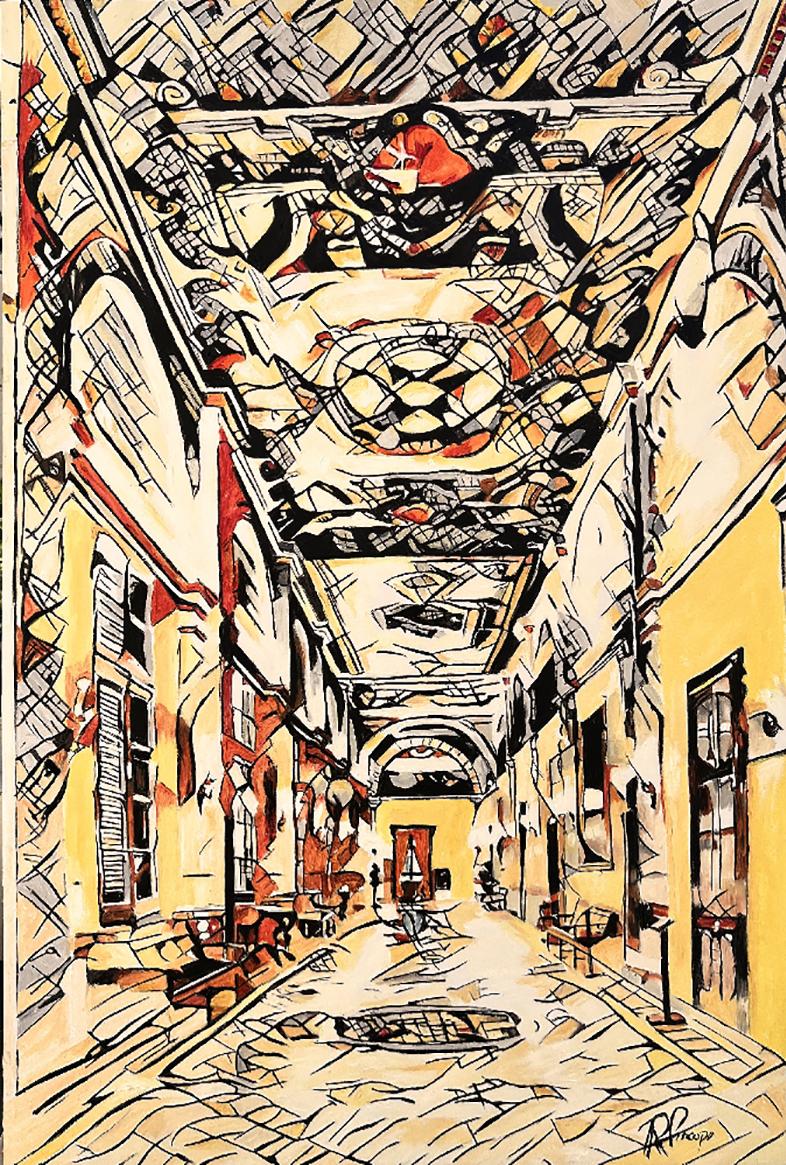 Il-Palazz tal-Gran Mastru
Piscopo’s dual path
In his introductory text for the exhibition, cultural critic Tonio Portughese foregrounds the unique relationship between Piscopo’s engineering career and his artistic evolution.
Portughese emphasises that Piscopo is not merely an artist who once worked in engineering; rather, his two vocations have developed symbiotically.
Drawing on decades of leadership in high-tech industrial contexts – including the transformation of the Kirkop semiconductor facility into a world-class site – Piscopo cultivated what Portughese calls an “effective interaction between engineering know-how and artistic expression.” His contribution to environmental sustainability, particularly in support of early environment, health and safety initiatives, further shaped his disciplined yet imaginative mindset.
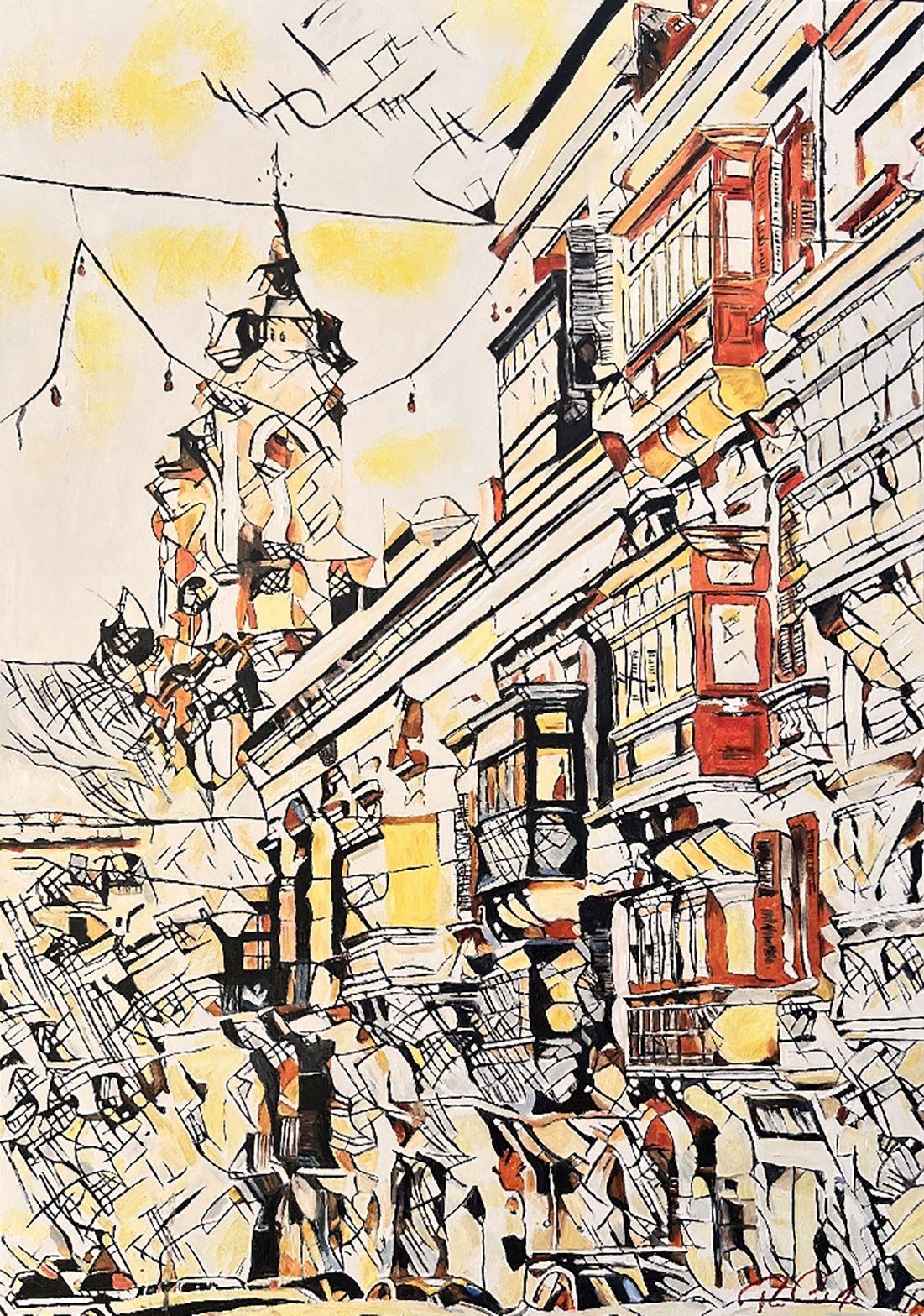 Gallariji fil-Belt 4
Portughese frames this integration through reference to Renaissance ideals, invoking Leonardo da Vinci as the archetype of the artist-engineer whose analytical precision fuels creative interpretation. He describes Piscopo as an exemplary practitioner of STEAM – the union of Science, Technology, Engineering, Art and Mathematics – where scientific clarity and artistic intuition reinforce one another.
For Portughese, the exhibition’s 27 paintings become a “goldmine of brushstrokes” that celebrate Malta’s cultural soul, reflecting an artist who marries structure with sensitivity, discipline with expressive force.
Interpreting style and technique
Where Portughese highlights Piscopo’s personal and professional trajectory, international art critic Marta Lock focuses on the artist’s place within the evolution of modern and contemporary painting.
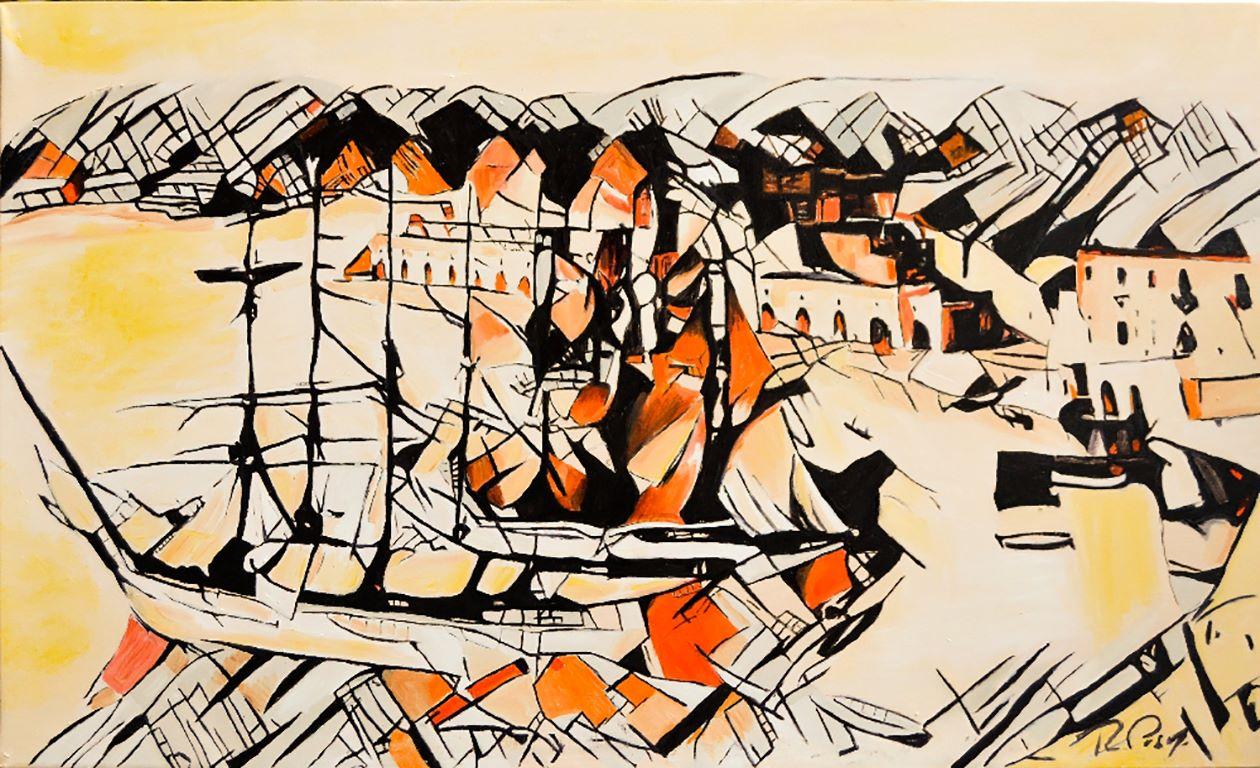 Pinto Wharf
Lock situates Piscopo within a lineage that begins with Turner’s revolutionary use of light and extends through impressionism, divisionism and expressionism. She notes that Piscopo’s work neither imitates these movements nor fits neatly into their definitions. Instead, he transforms their foundational principles into a hybrid style that is entirely his own.
According to Lock, Piscopo adapts the divisionist principle of separating colour – not through dots or strict linear parallelism, but through fragmented strokes and sculptural lines that energise each surface. This technique gives his Maltese landscapes and architectural scenes a tactile, chiselled dimension, as if shaped by the very passage of history.
At the same time, Lock sees in his strong chromatic contrasts and expressive distortions an unmistakable Expressionist impulse, allowing emotion to guide representation. She proposes terms such as macro-impressionism or post-divisionism to describe this synthesis: works that gain clarity at a distance but draw viewers inward with emotional resonance.
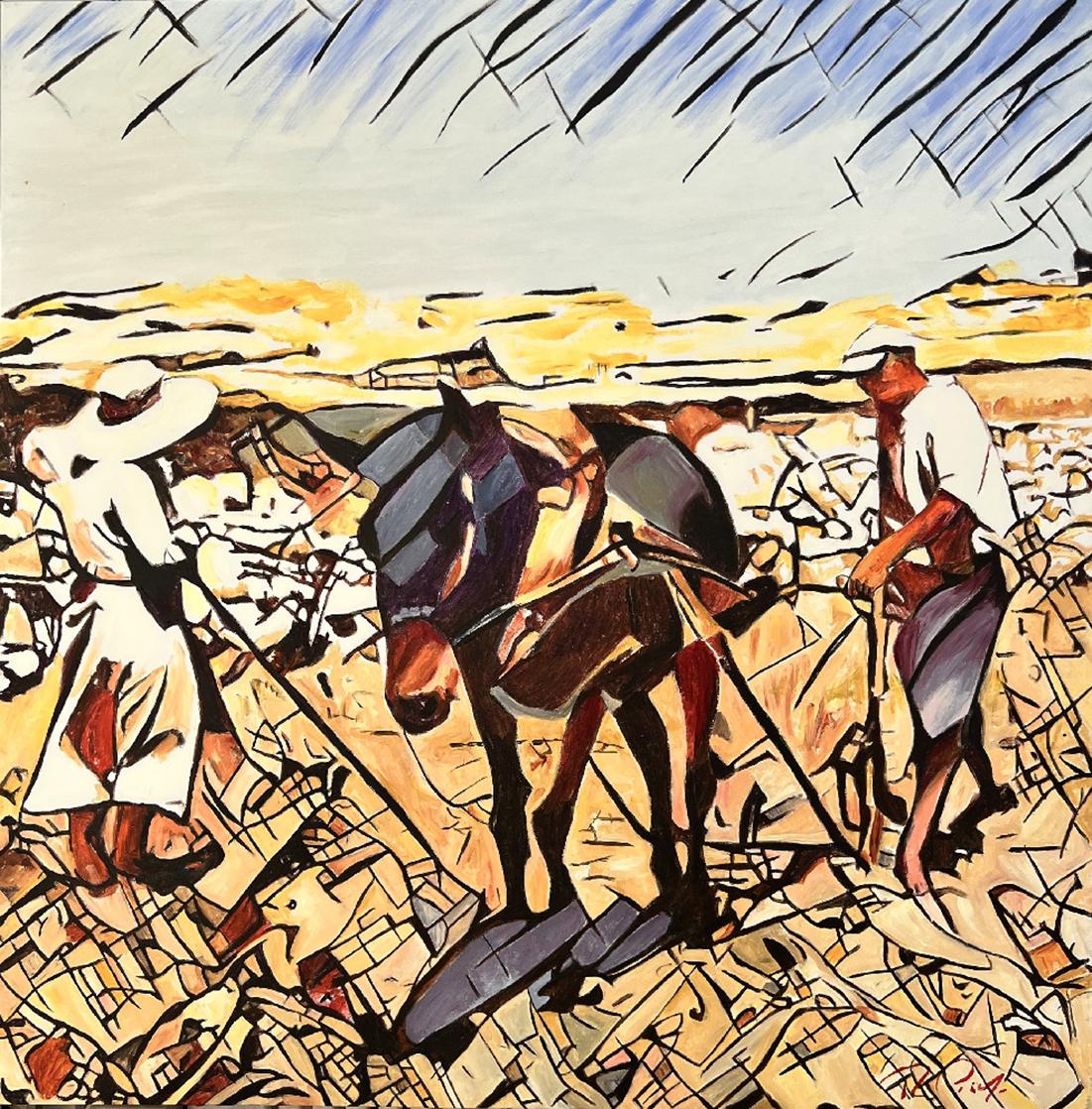 Ħrit tar-Raba
Both critics respond strongly to Piscopo’s engagement with Maltese identity, yet they illuminate it in distinct ways.
From Portughese’s viewpoint, the works serve as a cultural mirror and a national tribute. The paintings’ architectural precision and symbolic richness reflect Malta’s endurance, its heritage and its community spirit. Portughese emphasises the artist’s courage in fusing scientific thought with artistic exploration, celebrating a career that has evolved into a “mesmerising journey dedicated to Malta’s rich cultural heritage”.
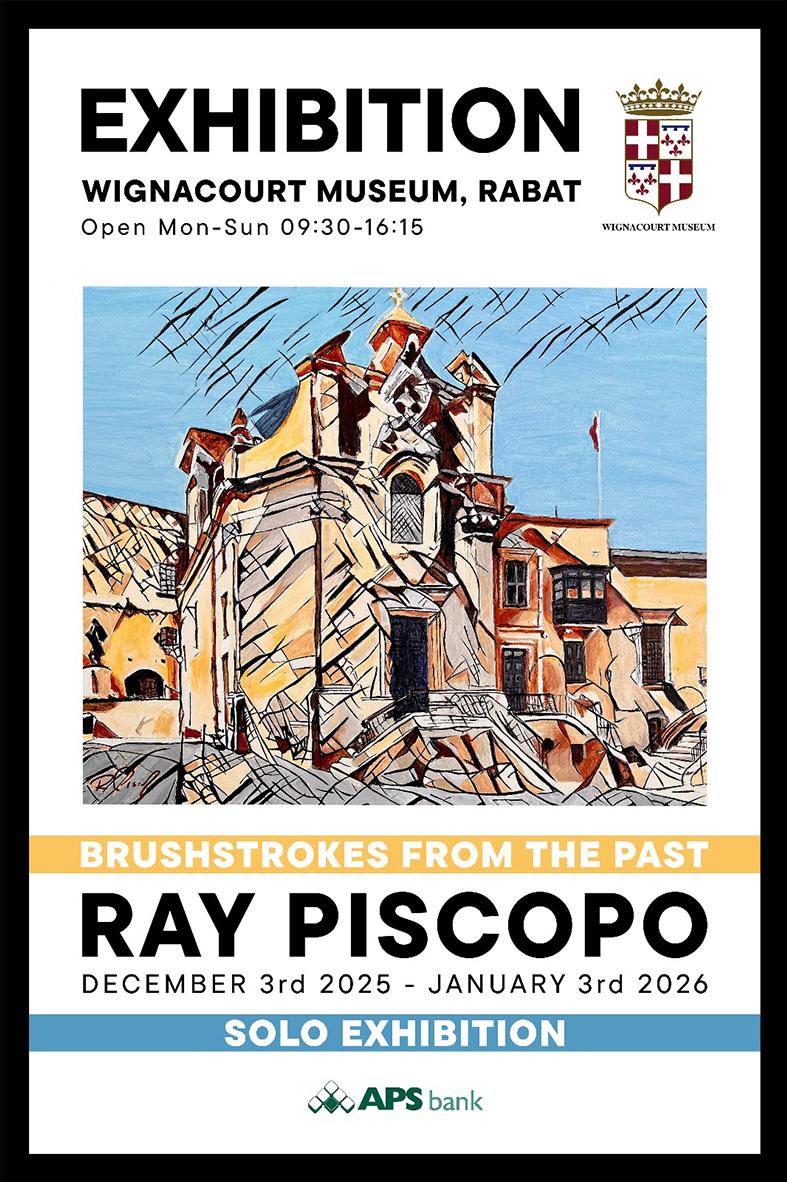 The poster of the exhibition
Meanwhile, Lock examines how individual paintings reinterpret specific histories and locations:
Pinto Wharf becomes a visual metaphor for continuity and renewal – a waterfront where historical function and modern leisure coexist.
Tal-Ħalib retrieves a nearly vanished trade, its clarity and linear texture underscoring the value of memory preserved through art.
Gallariji fil-Belt 4 uses Valletta’s famous wooden balconies to explore themes of community, proximity and individuality.
Ħrit tar-Raba channels the spirit of Barbizon realism, revealing the dignity and serenity of Malta’s agricultural roots.
Knisja tal-Vitorja and Il-Palazz tal-Gran Mastru highlight the spiritual and civic pillars of Maltese identity, elevated through Piscopo’s interplay of fragmentation and light.
Through these analyses, Lock asserts that Piscopo’s art is ultimately a love letter to Malta, shaped by emotional interpretation rather than literal documentation.
Despite their different angles – Portughese emphasising biography and value; Lock emphasising style and interpretation – both critics converge on a single understanding: Piscopo paints Malta not simply as it is but as it lives in the collective memory of its people. His use of warm limestone tones, expressive lines and transformed realism builds a bridge between the past and the contemporary present.
Brushstrokes from the Past/Pinzellati mill-Passat offers visitors a chance to reflect on this continuity during the festive season, encountering familiar landmarks rendered with renewed intimacy and emotional force.
The exhibition is open daily from 9.30am to 4.15pm. Entrance is free.