
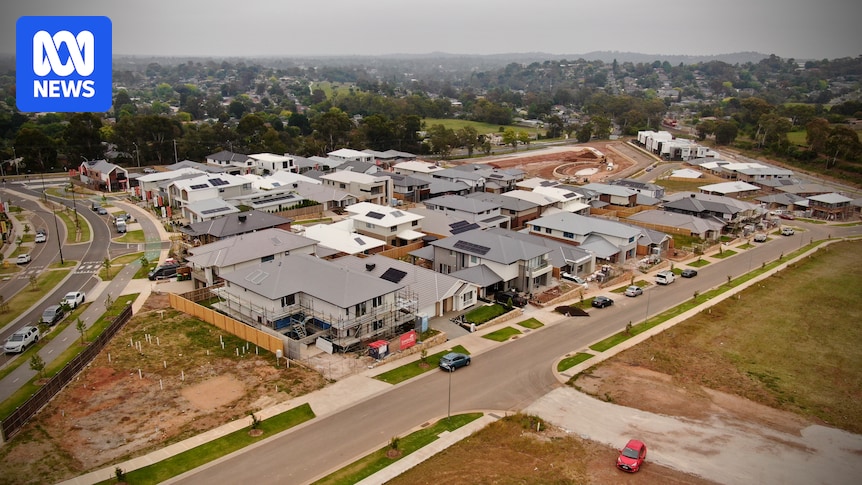
Australia could unlock about a million new homes if just one in four standalone dwellings in major cities were developed into dual occupancies, according to a report.
Public policy think tank the Committee for Economic Development of Australia (CEDA) and urban consultancy firm Urbis found that, if governments increased so-called “gentle density” in the middle rings of the five biggest cities, Australia could increase its housing stock by 9 per cent.
Gentle or modest density would include the development of terraces, townhouses, low-rise apartments and dual occupancy in well-located and serviced areas.
The report argued that the current debate has largely focused on “the extreme ends of the housing supply spectrum — high-density inner-city developments or new ‘masterplanned’ communities in sprawling outer suburban or regional areas” — while overlooking the potential of medium-density housing.

Danika Adams says housing could be increased in areas with existing services and where people want to live. (Supplied: CEDA)
“Australia’s housing crisis has been decades in the making and requires action on many fronts,” CEDA senior economist and report co-author Danika Adams said.
“But ‘gentle density’ can deliver more housing in middle-ring neighbourhoods where people want to live, while making better use of existing infrastructure and transport networks.”
The report estimated the moderate-density approach would add around 12 per cent more homes in Sydney, 15 per cent more in Melbourne, 16 per cent increases in Brisbane and Adelaide and a more than 17 per cent increase in Perth.
Some states have already begun moving in the direction of increasing density — New South Wales and Victoria have introduced reforms to streamline approvals and unlock well-located development, which have faced criticisms from some existing residents.
Western Australia has announced plans to increase density around 10 train stations in Perth.
Large cities can afford more density
Australia needs to build 240,000 homes a year to meet the National Housing Accord target of 1.2 million well-located homes by 2029, set by the Commonwealth and state and territory governments.
But the CEDA report noted the nation had fallen short of that pace every year since 2016.
Builders report ‘green shoots’
With Australia’s population projected to grow by more than 14 million people over the next 40 years, largely in major cities, the report warned housing pressure would continue to intensify.
Population growth in cities and major centres is expected to run at twice the pace of regional areas.
Despite this, Australia’s biggest cities remain low-density by global standards.
For example, Melbourne ranks 100th for population but 858th for density, while Sydney ranks 104th for population and 803rd for density, according to the report.
“When we see what’s happening with our population growth, with our continued economic development, we can’t keep building further and further out,” CEDA chief economist Cassandra Winzar told The Business.
“That puts a lot of pressure on infrastructure; we need new transport systems and leads to long commutes and difficulties accessing services.
“Middle-ring suburbs and this ‘gentle density’ is kind of the best of both worlds.”
The Auckland lesson
The report also examined the impact of broad planning reform in Auckland, which introduced sweeping “upzoning” changes from 2016.
These reforms abolished single-family zoning and allowed medium-density housing across roughly three-quarters of the city.
In the housing debate, a map of Sydney shows what’s at stake
Between 2016 and 2021, the changes delivered around 22,000 new homes, accounting for one-third of all residential building consents and driving a 50 per cent increase in approvals.
By 2024, Auckland’s housing stock had grown by around 80,000 dwellings — about 15 per cent — outpacing population growth for the first time in decades.
The report found house prices in Auckland were 15 to 27 per cent lower than they otherwise would have been, while rental prices were reduced by up to 28 per cent.
“Auckland’s experience shows what’s possible when you implement planning reform at scale,” Ms Adams said.
“It worked because it removed complex processes, allowed feasible development and was applied broadly.”
A recent report from another think tank, the Grattan Institute, found Australian rents and house prices would be 12 per cent lower than otherwise within a decade if all capital cities were rezoned to allow three-storey buildings.
Local councils are key
Ms Winzar said zoning and planning regulations at local council level were an impediment to development.

Cassandra Winzar says state governments could encourage councils towards housing targets. (Supplied: CEDA)
“Rules differ from council to council, we have a huge number of councils in Australia as well,” Ms Winzar told The Business.
“So it’s really hard for developers to get in, to understand what the requirements are, and they are often very restrictive.”
She said local councils did not have much incentive to increase zoning and state governments should apply a carrot-and-stick approach.
“If local governments aren’t meeting their targets … that could mean that state governments actually take over some of the planning regulations,” Ms Winzar said.
“[If they do], we think there should be some financial incentives.”
The report also recommended that local councils should introduce “by-right” planning rules that specify what can be built without objection, based on land size.
Buying a home has never been harder
“I think more and more Australians are becoming aware of the housing affordability issues,” Ms Winzar said.
“If it’s not impacting you individually, it’s almost certainly impacting someone in your family. And most people also want their family members to be able to live near them.”
Property research firm Cotality recently found housing affordability had never been worse in Australia, with more than a decade needed to save a standard 20 per cent deposit to buy a house in most capital cities, while national dwelling values were 7.5 per cent higher than a year ago.