
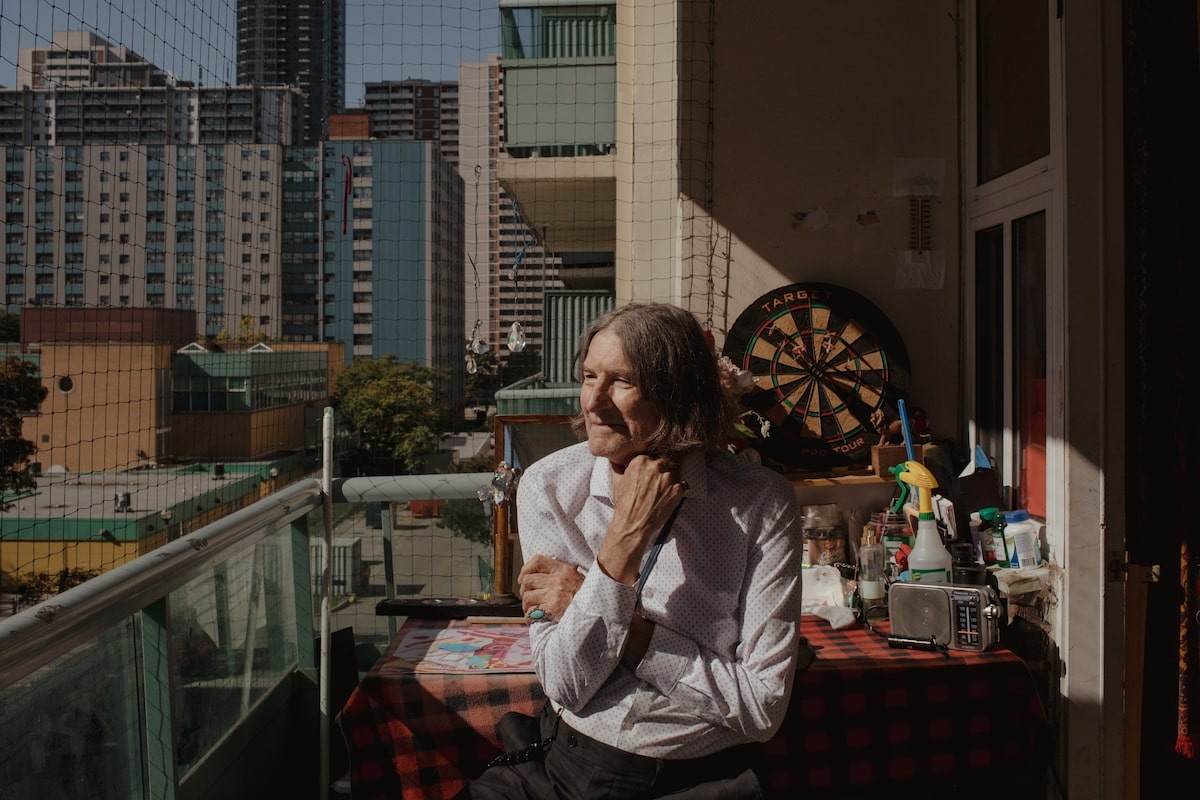
Sometimes, the feeling comes to him as frustration, like the problems in his life are piling up. Other times, it feels like anxiety or dread. Like all he wants is to stay in bed.
Mondays are when 73-year-old Michael Holtom feels it the most. These aren’t the regular Monday blues – the dread that many of us get at the end of the weekend, at the idea of diving back into a regular schedule.
Instead, it’s the opposite. It’s the nothingness he feels. Waking up and staring at the ceiling as he faces down another day, another week, hours and hours ahead with nobody but himself. Wondering, what am I going to do today? and coming up blank.
“I can’t,” he’ll think to himself in these moments. “I just can’t seem to put it together.”
It’s taken decades for Mr. Holtom to be able to identify the feeling. It’s loneliness.
Mr. Holtom lives alone in Toronto. He’s lived his whole life alone. Never married, never had kids. The friends he used to work with down at the marine yard have dropped off. The guys he used to play music with – the bandmates he played in jazz bands, blues bands with – are all gone, too. His drummer died last year, a guy he played with for more than 40 years. It felt like losing his right arm.
So he spends almost all of his time alone. He fills his apartment with books and art and knick-knacks from the road. Old Life magazines and Elvis albums. A picture of Spock from Star Trek, under the words “CHEER UP!” on the refrigerator. And in the background, there’s music – the wailing chords of Jimi Hendrix, the screeching bends of Albert King’s guitar.
But there’s always loneliness. It’s only recently that Mr. Holtom has begun taking measure. Noticing his loneliness and trying to do something about it.
He’s not the only one. Around the world, he’s part of a shift among policy-makers, medical professionals and everyday people beginning to understand loneliness not only as a health hazard but one they need to do something about.
The World Health Organization in 2023 declared loneliness a threat to global health, one that’s linked with nearly 100 deaths around the world every hour. It’s tied with not only mental-health concerns such as depression and anxiety but also increases the risk of conditions including diabetes, stroke and heart disease. And it hits two groups the hardest: the very young (those between the ages of 15 and 24), and the very old – those 75 years and up. Among the latter group, loneliness is strongly linked with a long list of health challenges, including dementia, cognitive decline and premature death.
Although both men and women experience loneliness, men are much less likely to admit to it. And they’re also much less likely to ask for help.
No wonder. When Mr. Holtom does bring up his feelings of loneliness with his peers, the response is often dismissive or judgmental.
“They’ll hear me and say, ‘Get over it,’” he said. “They’ll say, ‘You’re bigger than that,’ or ‘This isn’t you, Michael.’”
And how is he supposed to explain that it is him, that loneliness is a part of him? Especially when, depending on his mood, depending on the day, it can feel different, can look different on him, too – especially when, depending on the person, depending on their experience, loneliness can have so many different faces.
Loneliness isn’t a cold, or an infection, or a rash. It doesn’t present, in health care settings, with obvious symptoms.
Instead, diagnosing it generally takes some digging, said Gary Bloch, a family doctor with St. Michael’s Hospital in Toronto.
“It’s really about encouraging front-line clinicians to spend time listening to people, and trying to understand what their social story is in a really deep way.”
And that, he said, “is not something that’s traditionally been taught in medical school.”
Even as the chair of the social determinants of health committee at St. Michael’s Hospital family health team, even working in a part of downtown Toronto that serves some of the city’s most vulnerable patients, Dr. Bloch admits that it took him until the past couple of years to fully understand the health impacts of loneliness.
Until recently, he focused on what he considered “the sort of ‘tangible’ pieces, like poverty and access to housing – the more traditionally recognized social risk factors for health.”
But in the past few years – and especially after the experience of the COVID-19 pandemic, where we all witnessed the effects that extreme isolation had on many groups – he’s turned his attention to loneliness, too. And, he said, “I stand corrected.”
The evidence that supports isolation as a risk in itself, he said, is overwhelming. Even at the molecular level, stress hormones can have a detrimental effect on so many of our body’s functions, from our immune system to our cardiovascular health.
“You’re looking at everything from heart disease, to stroke, to immune responses to ward off infection, to levels of mortality, depression, anxiety.”
In the United States, loneliness costs the health care system more than $9-billion each year; in Australia, the cost is around $2.5-billion. There’s not yet a similar estimate for Canada, though this much is clear: Lonely people get sick more often, visit their doctors more often and turn up at the emergency room more often.
Another challenge is recognizing the difference between loneliness and isolation. Many people enjoy solitude – spending much of their time alone.
An older photo of (left to right) Michael, his brother and father sits on the mantle in his home.
For many years of Mr. Holtom’s life, for example, solitude was a choice. As the middle child of parents who were divorced, as a quiet, sensitive kid, he often felt lost in the shuffle. It felt easier to go off and spend time on his own.
And as an adult working at the Royal Canadian Yacht Club as a marine yard worker, he lived alone on a houseboat for years. He had girlfriends but nothing serious. He even lived with a woman for a few years, but that ended poorly. Maybe it was better to be alone, he’d think. Maybe he was just a loner.
“Some people are extroverted. I’m introverted,” he said. “The world scares me. It’s a little overwhelming at times, so I try not to take too many chances.”
Loneliness, on the other hand, is not a choice, said Ami Rokach, a psychology professor at York University and author of The Psychological Journey To and From Loneliness.
“No one chooses to be lonely.”
Instead, he said, loneliness is the result when a person’s desire for social connection goes unmet. It’s what results when there’s a gap in expectation between what a person has and what a person wants.
Recently, Mr. Holtom has been feeling that gap more and more – like his solitude is less and less of a choice. After retiring from the yacht club three years ago, he said, he’s had fewer opportunities to connect with people. Fewer excuses to go out.
“It got more secluded. Solitary. Reclusive,” he said. “It really started to bug me.”
These days, the 73-year-old lives in a large downtown apartment building. He still looks every part the jazz musician – tall and scruffy, his long face perpetually hidden behind a pair of Ray-Bans. There are always people around – in the halls, in the park outside or at the coffee shop across the street. But that doesn’t make him feel any less alone.
Exacerbating the experience, said Prof. Rokach, is the stigma and the fact that loneliness is still so misunderstood. The fact that, to many – especially older men raised on traditional beliefs around masculinity – loneliness is still often viewed as a weakness.
To many, he said, “loneliness is seen as a personal failure.”
How loneliness eventually unfolds, said Prof. Rokach, is in stages. It starts with disappointment or anger at the people around them – lashing out at family or friends for not visiting or staying in touch. The next stage, often, is that the person experiencing loneliness becomes demanding.
“That looks like them bringing loneliness into every social encounter,” he said. “Demanding of family to be more in touch, blaming people for not wanting to be with them.”
And the final step, he said, is hopelessness – when they stop believing that their situation can change.
“Loneliness is always very painful,” he said. “Almost torturous.”
Berrisford Joseph’s situation illustrates that isolation doesn’t affect everyone equally.
Berrisford Joseph once considered himself a very social person.
“I used to have lots of friends I used to visit,” says the 78-year-old. “I used to have a lot of friends who would visit me.”
That’s changed in the past few years.
“I don’t know what happened,” he said. “They just dropped out of sight. Now I don’t hear them. I don’t see them at all.”
Mr. Joseph, who was born in St. Vincent and came to Canada in his 20s, used to work as a security guard and as a maintenance worker. But since retirement a few years ago, he’s had fewer excuses to go out. Outside of medical appointments or running errands, he spends almost all of his time in his apartment, watching TV, reading his Bible or sleeping.
He had a bad fall recently, which has made it hard to get out and move around. His TV broke recently – the picture stopped working. So he’s been sleeping even more.
He was referred recently by doctors to a program for socially isolated seniors.
He doesn’t like the word lonely. He says he’s content by himself. He’s content with his TV and his Bible. “I’m not lonely.” He is okay, however, with the word “isolated.”
What Mr. Joseph’s situation illustrates is that isolation doesn’t affect everyone equally.
This was on full display during the COVID-19 pandemic, when older adults were most likely to experience extreme isolation, either living alone or in group settings with little contact with the outside world.
Many older people are still struggling to move on from the pandemic, said Lisa Rae, the director of volunteer programs at Circle of Care at Sinai Health in Toronto. The program offers friendly visits to seniors who have been identified as socially isolated. But in the past few years, it has experienced a drop in volunteers and clients.
“We still have clients who are afraid to go out, who don’t want to come to groups any more,” she said. There’s also the opposite problem – seniors who, because of the pandemic, are afraid to allow visitors into their homes.
And within the demographic of older adults, it’s marginalized groups who are especially vulnerable to isolation.
Those who belong to immigrant, racialized, Indigenous or LGBTQ+ communities – those who are more likely to face discrimination – are especially likely to experience loneliness. Even newcomers with specific ethnocultural communities to rely on for social supports face other obstacles to integration, such as language barriers and employment challenges.
Also vulnerable are those living on lower income or with disabilities. A 2019 Angus Reid survey found that older adults with incomes below $50,000 were twice as likely to describe themselves as “very lonely” or “very isolated.”
Which brings us back to Mr. Joseph. When he stopped working, his world got smaller. This is true for many older people.
But he’s also Black and speaks openly about the racism he’s faced. He’s an immigrant who came to Canada as an adult without existing social networks.
He also faces strict income challenges. He has a monthly income of about $1,500. Two-thirds of that he spends on rent (a cost that’s about to go up to $1,200), which leaves just a few hundred dollars each month for all his other expenses. He uses the food bank to get by.
This means that many of the opportunities that others have for social connection – a walk to the local coffee shop, a fitness class at the community centre – become inaccessible. Even the cost of visiting a friend becomes prohibitive when you consider the cost of bus fare or a taxi.
“I try to leave [my apartment], but there’s nothing suitable,” he said. “It’s too expensive.”
Recently, he’s avoided even going for walks. He’s lived in Regent Park for decades, but the area around his building has begun feeling, to him, more and more dangerous.
He’s taught himself that it’s better, safer, to be alone. Outside, he said, “too many things happen.”
Arkady Balanovsky, 70, treats loneliness like any other potential health risk.
Around the world, countries have ramped up efforts to combat loneliness. In 2018, Britain appointed its first-ever “minister of loneliness.” There, people suffering from loneliness cost the National Health Service each year, on average, £850 (about $1,500) more than those who are not. Japan, Germany and Denmark also have national strategies aimed against social isolation.
But Canada has lagged. In a 2021 Commonwealth Fund study of older adults, Canada ranked as the loneliest of all the 11 countries surveyed.
Still, there are reasons for hope. Many communities – especially urban ones, like the ones where Mr. Holtom and Mr. Joseph both live – have seniors groups and seniors socials. And health care providers such as Dr. Bloch and his team at St. Mike’s have begun experimenting with “social prescribing,” where older patients suffering from loneliness are paired with staff members – non-health care professionals – who pay them weekly visits.
Programs such as these, which operate in a similar manner to Mount Sinai’s Circle of Care, are already seeing positive results.
Take Arkady Balanovsky. He’s a part of the Circle of Care program. It’s easy to see why Mr. Balanovsky was identified as a candidate.
The 70-year-old lives alone, in a one-bedroom Thornhill apartment. His wife and son both died more than a decade ago. He was born in Tiraspol, Moldova, and came to Canada in 2015, so his English is limited. And he’s completely blind. His service dog, his most constant companion over the past decade, died last year.
Mr. Balanovsky meets with Circle of Care volunteer Brahm Goldhamer at his home once a week.
Mr. Balanovsky is isolated in so many ways. But, he said, “it’s not lonely, no.”
He’s taken matters into his own hands, treating loneliness like any other potential health risk. As such, he approaches social connection like a part of a healthy routine.
He’s arranged his schedule such that he has a rotation of regular visitors: Circle of Care volunteer Brahm Goldhamer comes to see him every week; and also his girlfriend, who visits regularly. And he’s an avid musician – he plays the accordion – and meets often to play with other musicians. Mr. Goldhamer, too, is a retired vocal coach and fellow musician. So they’ll play music together as well.
And on days when his friends aren’t available, Mr. Balanovsky pays a personal support worker to visit him – not to help with bathing or cleaning, but just to take him on a walk. To him, this is an act of self-care – not dissimilar to taking a vitamin or getting regular exercise.
“I feel that around me,” he said, “I have a lot of friends.”
And instead of thinking of loneliness as something to eliminate entirely, Prof. Rokach added, it’s helpful to think of loneliness as a necessary warning sign, like hunger or pain.
“It’s a natural reaction that protects us,” he said. “Hunger doesn’t feel good, but it’s an alarm system to go and eat something. The experience of loneliness, similarly, tells you that you need to do something.”
It’s through Dr. Bloch’s program at St. Michael’s that Mr. Holtom was connected with Murshida Samsun Mueen. For the past six months, she’s been visiting with him regularly. They go for walks and talk about what’s going on in his life. She’s introduced him to new community programs and seniors’ groups.
Standing in his St. James Town apartment one recent afternoon, with an Albert King album playing in the background, Mr. Holtom showed Ms. Mueen around his place for the first time. He was proud to show off the guitars and the tapestries he’s hung on the walls. The bachelor apartments in this building are choice, he said – they have the biggest balconies, for parties.
He described a visit he paid to the emergency room recently. He was having trouble breathing and was made to wait for 15 hours. On that day, Ms. Mueen was a lifeline.
Michael Holtom’s calendar shows appointments and meetings that help to fill up his days.
“Just having someone to call and speak to made all the difference,” he said. “It brought me back down to earth.”
Since meeting Ms. Mueen, he’s been trying to take the same approach as Mr. Balanovsky. To fill his schedule so that he doesn’t have time to dwell on loneliness. Seniors’ group on Tuesdays, Thursdays and Saturdays. Picking up groceries for a friend on Fridays. Choir. Church. Still, it’s a constant challenge to find people to connect with.
The day before, Mr. Holtom had walked down to St. James Cathedral for morning mass. It’s one of his favourite places in the city, where the church choir – the voices of dozens of singers blending together – is usually enough to leave his heart feeling full.
But as Mr. Holtom walked out of the church and into the garden that morning, he felt himself still wanting, wanting.
Through Dr. Bloch’s program, Mr. Holtom spends time with Murshida Samsun Mueen, who has connected him with other programs and senior groups.
“There were all these people there, and I don’t know anybody’s name,” he thought to himself.
“Nobody knows my name.”
In that moment, he couldn’t understand what was happening. He was standing there in the park, wanting and wanting, and wondering if he might be losing his mind.
“I just kept thinking, ‘I’ve got to connect with someone today,’” he said. “I’ve got to connect with someone.”
And just then, in that moment, he spotted someone. It was a friend he’d met at the park before. Someone who used to work at the yacht club, too.
They wound up spending the afternoon together there. Laughing and talking. Mr. Holtom trying to convince him to take up the drums.
And just like that, the stress that had been building up – the feeling like all his little problems were piling up, piling up, piling up – all of it disappeared.
“I just needed to burst that bubble,” he said.
“It was,” he said, “a perfect Sunday.”