
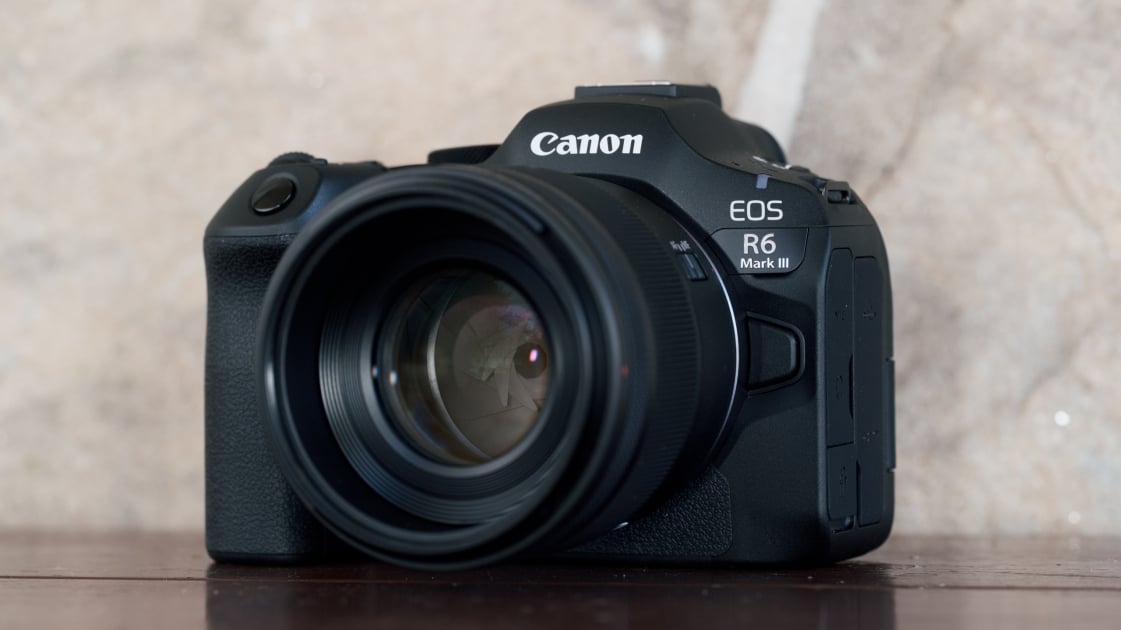
The Mark III doesn’t make too many advancements in autofocus. Its subject recognition modes (Auto, People, Animals, Vehicles, Off) are the same, as is the maximum electronic shutter 40fps drive rate with focus and exposure at every frame, and brisk 12fps mechanical shutter. I had good luck with the R6 Mark II’s animal detection when taking pictures of neighborhood birds and my cats, for instance. The 40fps continuous drive pace is the best in class (the Z6III does 20fps, and the a7 IV trails the pack at 10fps) for Raw format capture, though the Nikon Z6III pushes to 60fps for JPGs.

RF 100-500mm L, 500mm, f/7.1, 1/500-second, ISO 4000 (Credit: Jim Fisher)
Canon says the focus system gets a performance update to put it on par with the EOS R5 Mark II and EOS R1; however, it does not get the Action Priority (for basketball, soccer, and volleyball) focus mode found in those more expensive cameras. A representative from Canon tells me that this is because the EOS R6 Mark III does not include the Digic Accelerator co-processor, a requirement for the focus mode. Action Priority has limited use cases, but sports photographers might miss it.

RF 100-500mm L, 500mm, f/7.1, 1/500-second, ISO 8000 (Credit: Jim Fisher)
It’s easy to fill up a memory card when taking photos at 40fps, but thankfully, the R6 Mark III adds a pre-shot buffer mode to help you reduce the number of throwaway images. When enabled, the R6 continuously buffers the last half-second of photos while focus is engaged and saves those 20 photos, plus any images taken going forward, when you fully press the shutter. The Nikon Z6III has a similar feature, but it only works for JPGs, while the R6 Mark III can use it for either Raw or JPG formats.

RF 45mm F1.2, f/1.2, 1/100-second, ISO 100 (Credit: Jim Fisher)
The pre-shot buffer isn’t something you’re likely to use for every photo session, but it is a handy feature to have for sports and wildlife photography. You can track a player as they break away from the pack to take a shot on goal, but only save the photos of the actual scoring attempt. For birds, I like using the pre-shot function when photographing waders like egrets and herons—it makes it possible to get images of the bird striking the water to catch a fish without filling up your memory card with images of it just waiting around. Most high-speed cameras include a feature like this, but I’ll say Canon gets it right with the R6 Mark III. Its implementation is a notable upgrade versus the Mark II’s Raw Burst Mode feature, which, while similar in concept, is more restrictive as it only works in Raw format and requires Canon’s desktop software to extract images from the burst. The R6 Mark III is a heck of a lot more useful, as it can use any file format and saves files individually so you can process them using the software you prefer.

RF 45mm F1.2, f/3.5, 1/8,000-second, ISO 100 (Credit: Jim Fisher)
The R6 Mark III has a deep buffer that can rattle off hundreds of images at a 40fps pace. I tested it with a Sony 300MBps UHS-II SDXC memory card and took 248 JPG, 237 C Raw, and 132 Raw images in sequence, and a Lexar 3,300MBps CFexpress card goes for a little longer (264 JPG, 251 C Raw, 147 Raw). The faster CFe card nets faster clear times (10 seconds for Raw, 15 seconds for JPG and C Raw) versus SDXC (34 seconds for Raw, 18 seconds for JPG and C Raw). If you plan on using the R6 Mark III’s 40fps drive, it’s worth it to invest in either a speedy SDXC card or CFe.

RF 16-28mm F2.8, 16mm, f/8, 1/100-second, ISO 100 (Credit: Jim Fisher)
Canon, Nikon, and Sony trade bragging rights on the best autofocus system from generation to generation. It’s tough to pick a winner among the three; each offers fast, accurate acquisition, sticky subject tracking, and robust subject detection modes. The Sony a7 IV is slightly behind the latter, as it only supports identification for people and animals, placing the R6 Mark III and Z6 III ahead. That makes sense when you consider that the a7 IV is the oldest of the trio and is a little overdue for an update.