
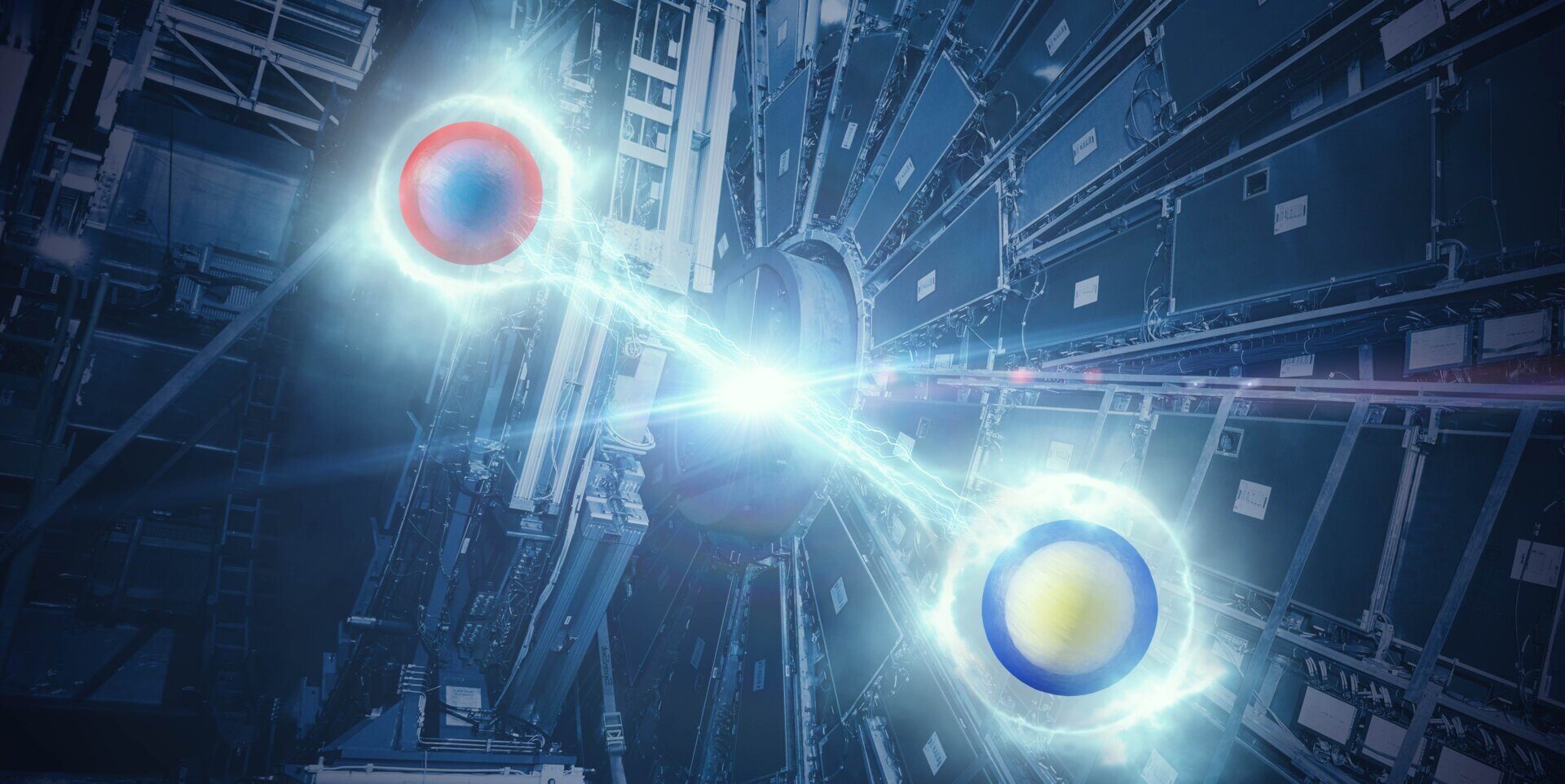
Although still in its early stages, quantum computing is advancing rapidly, along with quantum technologies as a whole. Nobel Prize-awarded work on entangled quantum states and quantum mechanical tunnelling were driving forces behind this progress. Applications of quantum technologies are anticipated to improve our daily lives and contribute to solving global challenges.
Quantum mechanics underpins our understanding of the physical world. The theory that would revolutionise physics was born in the summer of 1925 when 23-year-old Werner Heisenberg, looking for relief from his extreme hay fever on the remote island of Helgoland, formulated the theory of quantum mechanics.
The transition from theory to technology during the ‘first quantum revolution’ led to transformative innovations such as lasers, MRI scanners, and integrated circuits. We are now experiencing a ‘second quantum revolution’ – a shift from explaining quantum mechanics to creating artificial quantum states.
They proved Einstein wrong
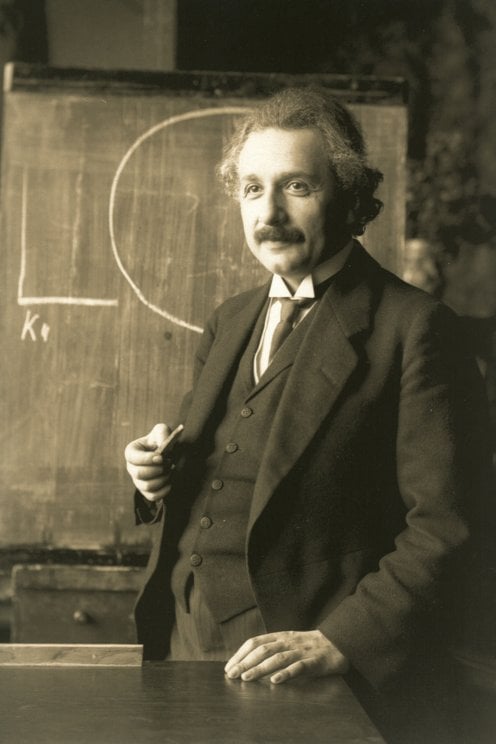 Photo: Ferdinand Schmutzer. Public domain via Wikimedia Commons
The second quantum revolution began in the 1960s. For a long time, the pioneers within quantum physics had tried to understand the phenomenon of entanglement: how two separated particles could remain connected even though they might be far away from each other, something physics titan Albert Einstein called “spooky action at a distance.” Quantum entanglement seemed to conflict with Einstein’s theory of special relativity, which postulates that nothing can travel faster than the speed of light.
In 1964, John Stewart Bell proposed a theory showing that quantum entanglement is incompatible with Einstein’s notion of locality and causality. Inspired by Bell, while still a graduate student, John Clauser managed to transform Bell’s theorem into a very specific mathematical prediction. Through later experiments, Clauser was able to confirm that quantum entanglement is real. The result came somewhat as a surprise to Clauser, who had made a bet for the ‘Einstein side’ to win.
“I was very sad to see that my experiment had proven Einstein wrong,” John Clauser said.
However, Clauser’s results were not iron-clad. Building on his work, French doctoral student Alain Aspect closed an important loophole and provided a very clear result: quantum mechanics is correct. Experiments on quantum teleportation, the way of transferring an unknown quantum state from one particle to another, by Anton Zeilinger and his colleagues were also crucial for our understanding of entangled quantum states. Quantum teleportation has become a powerful tool that is used daily in labs all around the world and with some demonstrations in real-world fibre optics.
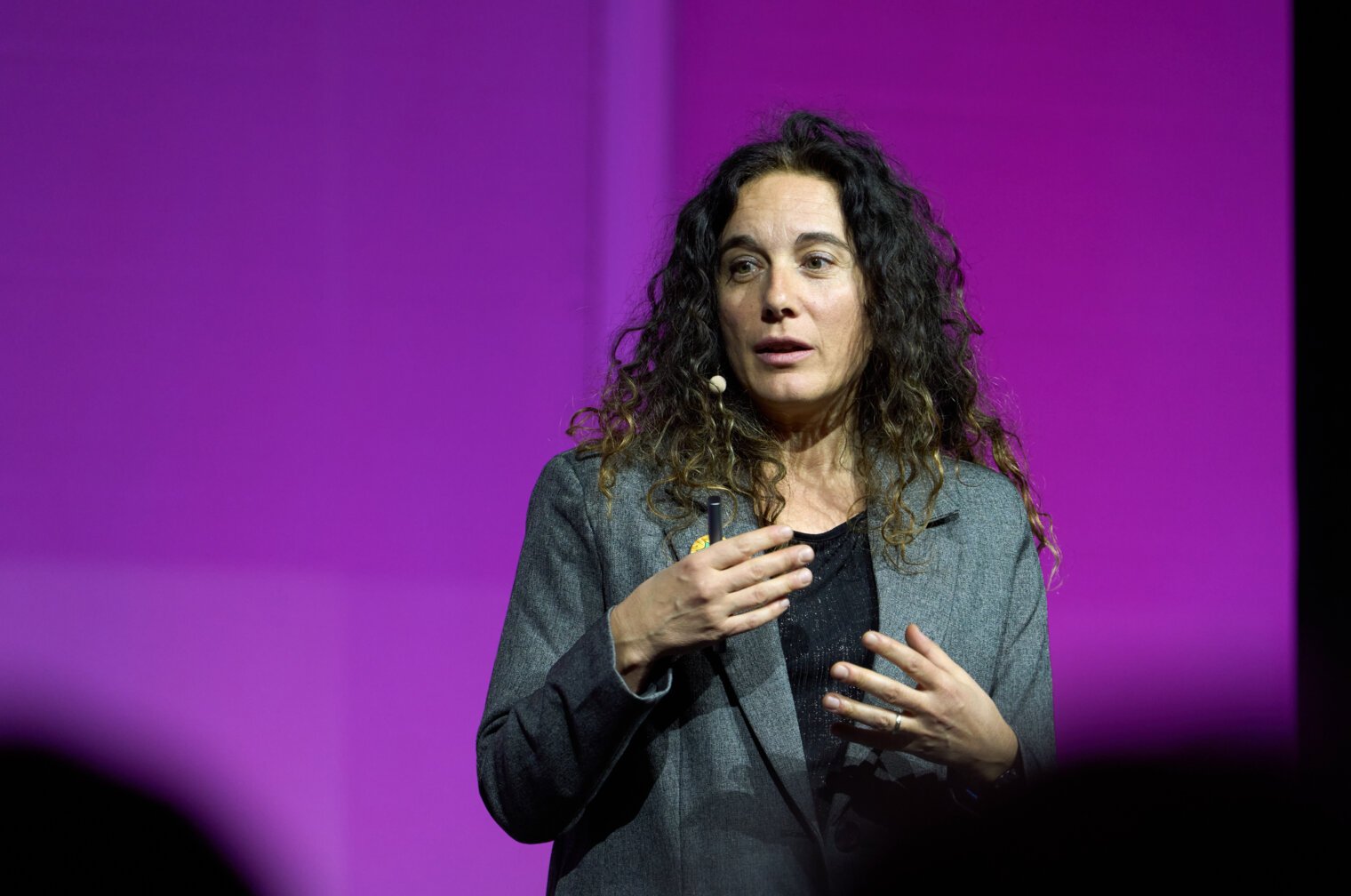 Sofia Vallecorsa. Photo: CERN
“Their work was fundamental. These experiments meant that the quantum physics community could actually use this concept in practical applications,” says Sofia Vallecorsa, coordinator of the CERN Quantum Technology Initiative.
Entanglement – essential for quantum technology
Quantum entanglement is important in all main areas of quantum technology listed in the EU launched initiative Quantum Technology Flagship: quantum computing, quantum simulation, quantum communication and quantum metrology and sensing. These technologies are anticipated to revolutionise numerous industries, address global challenges and improve our daily lives.
An example of quantum communication is quantum key distribution, QKD, which has been in commercial use for a number of years and might be the most mature quantum technology. QKD enables secure communication by providing a method to securely exchange encryption keys. This is used by various actors such as banks and companies within healthcare and is seen as the first step towards a future global ‘quantum internet’ – interconnected quantum computers that may allow people to send, compute, and receive information using quantum technology.
Quantum simulators will allow us to overcome the limitations of supercomputers, enabling the modelling of materials or chemical compounds.
Quantum sensing allows for measurement of physical quantities like time, gravity, and magnetic fields with extremely high precision. One useful application of quantum sensors is the ability to enhance speed and quality of MRI scans.
How quantum mechanics can boost your smart phone
In the future, your smartphone may use a variety of quantum technologies. Quantum sensors may improve the navigation system to help you find your way around. Quantum key distribution might enable you to communicate in a secure way. Quantum simulations may lead to mobile phone batteries that last longer. Quantum computers may be useful if you can access their services through the internet, for example providing you with the best routes in congested traffic.
Source: Quantum Technology Flagship
 Credit: shisheng ling via Getty Images
The promises of quantum computing
Macroscopic quantum mechanical tunnelling, recognised in the Nobel Prize in Physics 2025, is the mechanism behind superconducting qubits used in quantum computers. Qubits, unlike binary bits in classical computers, can exist in multiple states at the same time due to superposition.
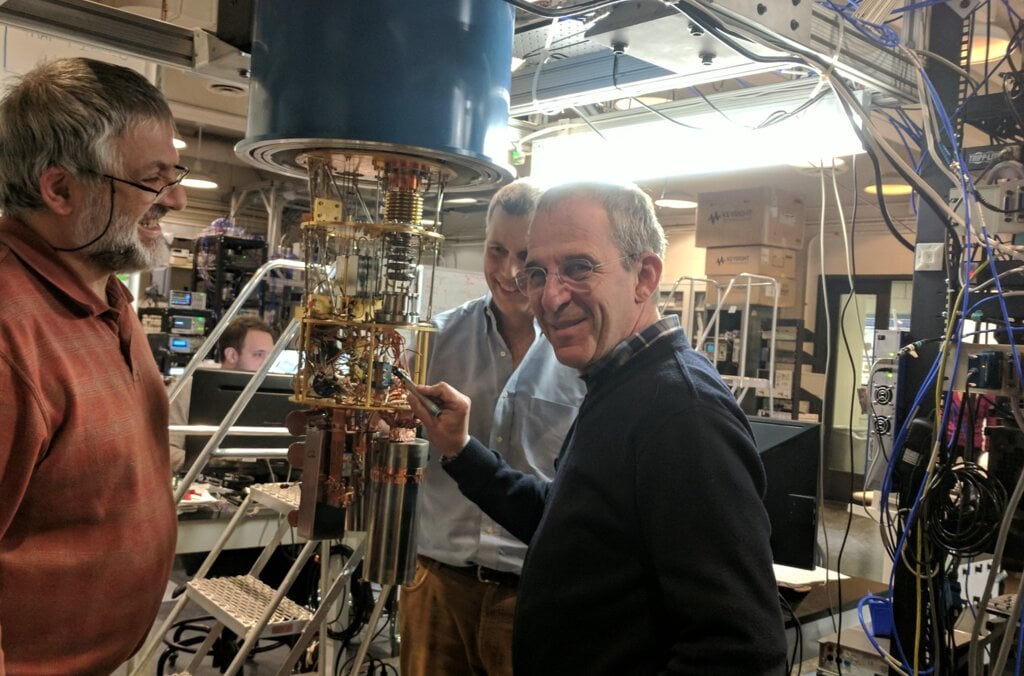 2025 physics laureate Michel Devoret. Yale scientists Michel Devoret (2025 physics laureate,) Luigi Frunzio and Robert Schoelkopf. The trio represents a startup with the aim to build the first useful quantum computer. Photo from November 2017. Photo: Brita Belli
In recent years, Vallecorsa and her colleagues working with quantum technologies at CERN, have observed rapid progress in quantum computing, driven by the potential it can offer in the acceleration of complex computing problems.
In 2023, the highest-energy observation of quantum entanglement to date was reported by the ATLAS experiment, performed at CERN’s Large Hadron Collider, the world’s largest and most powerful particle accelerator. This record measurement, later confirmed by the CMS experiment at the LHC, opened up new ways to test the fundamental properties of quantum mechanics.
While CERN is testing the use of quantum computing for simulating physical processes and analysing experimental data, Vallecorsa closely monitors the rapid development of quantum computing applications.
Improving certain tasks in large classical infrastructure, optimising logistics pipelines in big industrial complexes and quantum chemistry are some examples that profit from quantum computing, says Vallecorsa. Healthcare is another promising field, where advanced calculations could facilitate faster drug discovery.
“If we manage, the potential is great.”
Sofia Vallecorsa, CERN
Numerous initiatives that promote the development of quantum computing applications for the benefit of humanity are underway. The Open Quantum Institute, hosted by CERN, born at the Geneva Science and Diplomacy Anticipator (GESDA), supported by UBS, explores possible applications within a broad field, from predicting gastrointestinal cancer to detecting water leaks in urban water systems. In chemistry, quantum computing could lead to a better understanding and new innovations which would benefit the fertiliser production.
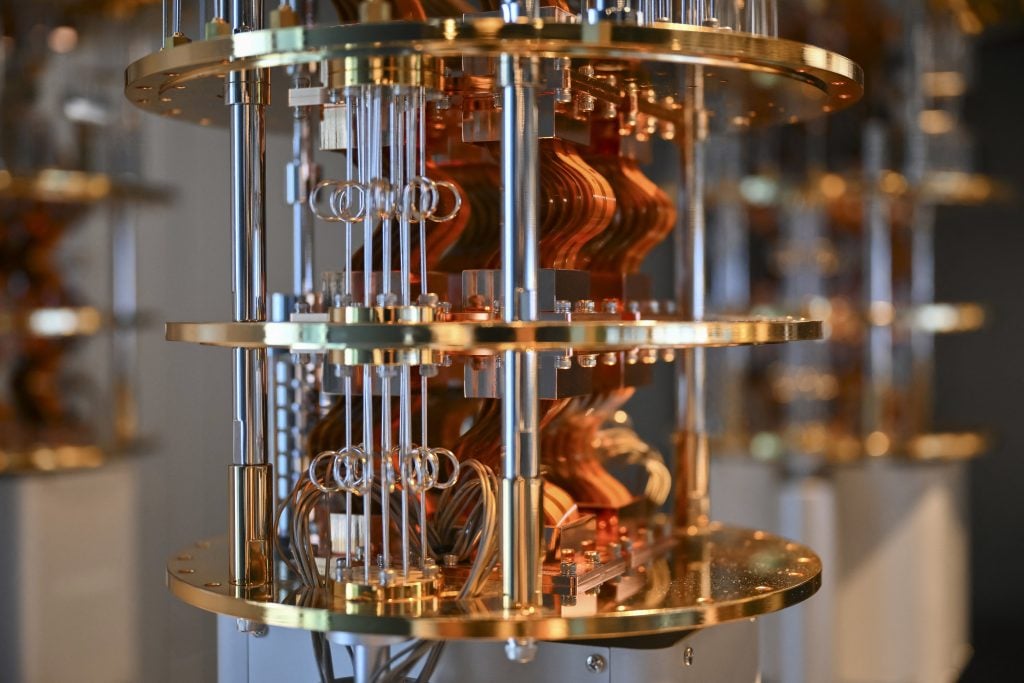 Parts of the IBM Quantum System Two are displayed at IBM Thomas J. Watson Research Center on June 6, 2025 in Yorktown Heights, New York. Photo by ANGELA WEISS/AFP via Getty Images
Law enforcement agencies are also paying close attention. Quantum computing has the potential to revolutionise forensics and security practices – but it also poses risks, such as the potential to break cryptography.
We are still far from a perfect quantum computer, since the qubits – the building blocks of quantum computers – are unstable and undergo “decoherence” when they interact with their environment. To overcome these limitations, major tech players are exploring quantum error correction (QEC), which is a way of detecting and fixing errors while preserving quantum coherence.
Funding and talent shortages are other challenges. While still in its infancy, expectations on how quantum computing can transform the world are high, with potentially great impact on global challenges. Vallecorsa shares the excitement – but is also cautious:
“Just like artificial intelligence is having a very strong impact on us, quantum computing and quantum technologies in general are next – because the potential is very large. However, too much hype can hurt the technology because it raises expectations to a level where if it doesn’t live up to it, the trust in the technology is lost. But if we manage, the potential is great.”
Published November 2025