
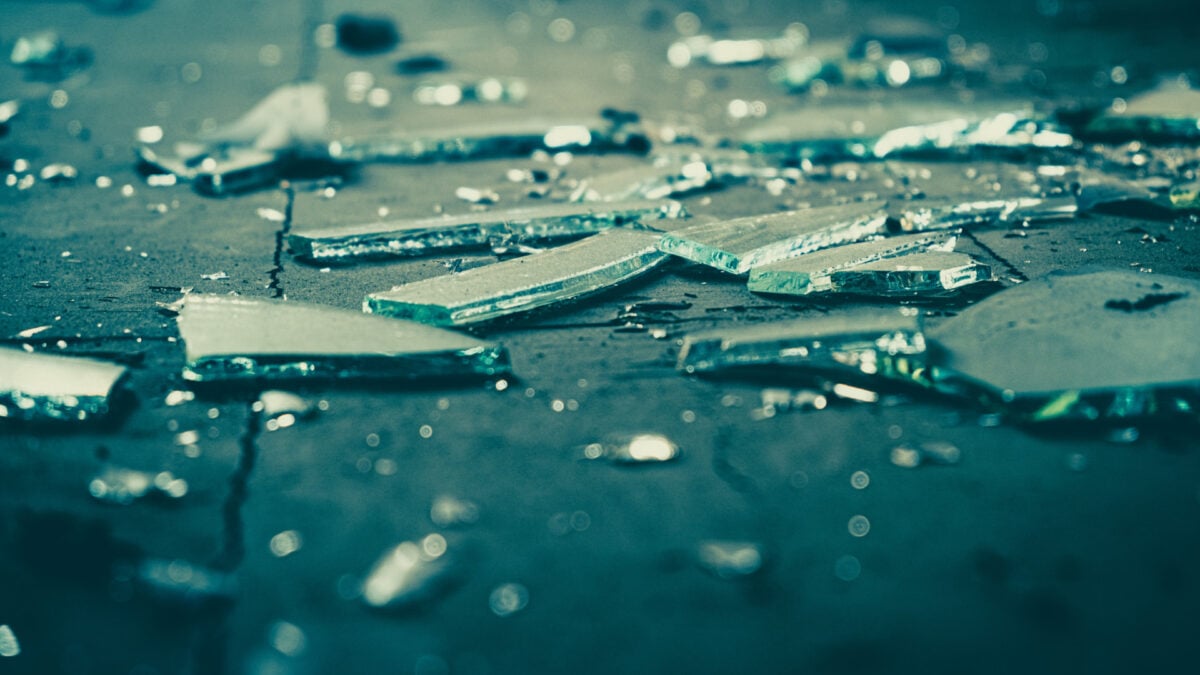
One innate (perhaps underappreciated) function of physics is to explain and generalize how stuff works in the real world. And it appears such endeavors are possible, even for something as random as how things break and shatter—and there is now a new, universal rule to explain how stuff breaks.
According to the new law, any solid capable of shattering—a glass plate, falling rocks, crumbly cookies—follows the same physical processes of fragmentation. In a recent paper for Physical Review Letters, mechanics expert Emmanuel Villermaux at the Aix-Marseille University in France proposed an overarching equation that illustrates an unexpectedly logical, mathematical pattern in the way things break.
A crack in the physics
Imagine recording a glass cup shattering with a high-speed camera. You’d be able to see how the cracks in the surface branch out and merge sporadically, eventually creating large, chunky sections that splinter apart. Predicting how these ruptures form might seem like a thankless task, but physicists have long suspected that a universal mechanism drives what appears to be a random process.
“Fragmentation processes have long fascinated physicists because they combine elements of geometry, dynamics, and disorder,” Ferenc Kun, a physicist at the University of Debrecen in Hungary uninvolved in the new work, wrote in an accompanying Viewpoint.
Before Villermaux, scientists had generally focused on the tinier details, such as the motion of each crack or the distribution of stress on the solid’s surface when dropped on the ground. Other attempts described fragmentation as a “kind of phase transition,” Kun explained. However, none of them were able to capture completely random, outside-the-lab instances of shattering, he added.
Seeing the bigger picture
In contrast, Villermaux took several steps back, focusing not on the cracks but on the outcomes of shattering events. For the new paper, he listed all the possible ways in which something could break in terms of entropy, or a measure of chaos. For example, the simplest, low-entropy outcome might be that a glass plate shatters into four equal pieces, whereas higher entropy outcomes would result in the plate fragmenting into many uneven, more grainy-looking shards of glass.
According to the paper, the more realistic case would be the latter, which Villermaux attributed to a principle called maximal randomness. “This is similar to the way many laws concerning large ensembles of particles were derived in the 19th century,” Villermaux told New Scientist.
He also tacked on a global conservation law, which he and his colleagues had derived previously, to put a physical constraint on how chaotic these fragments could become. Then, Villermaux applied his new equation to an impressive range of real-life objects, a long list of materials, including plates, shells, spaghetti, ocean litter, flaky rocks that served as chimpanzee hammers—and even liquid droplets and bubbles.
The equation worked beautifully for each of these cases, Villermaux reported in the paper. But unlike preceding work on similar topics, Villermaux’s equation works best for truly random fragmentation and doesn’t apply quite as well for softer materials like some plastics.
Still, these limitations are part of what makes the model strong, as it represents the first truly general, statistical foundation for random shattering, Kun said. Such a sweeping principle could “help scientists determine how different physical processes influence fragment-size distributions in industrial, geophysical, and astrophysical settings,” he added.