

A financial election advantage for the three biggest Victorian political parties will be removed in the face of a High Court challenge that has argued the state’s donation laws are unconstitutional.
In 2018, the Andrews government introduced donation caps in Victoria that limit payments to candidates and parties at just under $5,000 every four years.
But the laws contained a special exemption for the Labor, Liberal and National parties that were able to create nominated entities — to access funds built up over decades — to make payments to candidates and campaigns outside the cap.
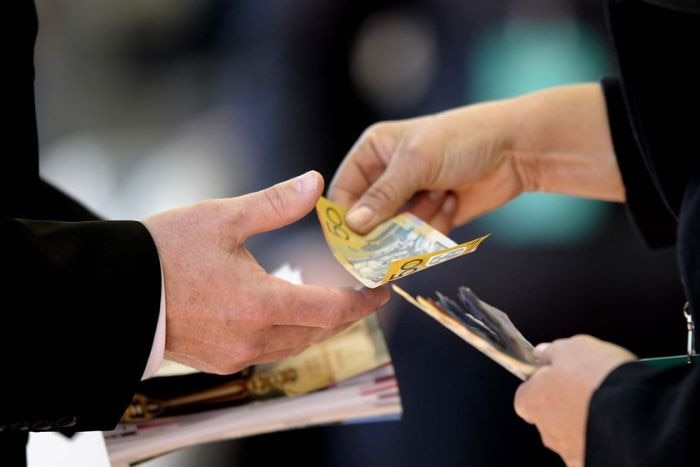
Donation caps were introduced in Victoria in 2018, limiting payments to candidates and parties at under $5,000 every four years. (AAP: Martin Philbey)
It means the parties have tens of millions of dollars they can potentially access.
Other parties and independents were unable to set up the nominated entities and they argue that the laws meant Victorian elections were not a level playing field.
Representatives from the fledgling West Party and teal independents banded together to challenge Victoria’s laws in the High Court, arguing they are unconstitutional.
The government, in its recent defence in the case, conceded that the nominated entities were “discriminatory”.
Caps to be introduced for parties and independents
Premier Jacinta Allan is now seeking to change the laws to allow other parties and independents to set up a nominated entity.
The government said the laws would introduce caps on funds transferred from nominated entities to parties and independents so that they are only used for administrative purposes like paying for office space, not campaign expenses.
Victorian Premier Jacinta Allan is seeking to change the state’s donation laws. (AAP: Joel Carrett)
Transfers will be capped at $500,000 for parties and $50,000 over an election period for independent candidates.
Currently, there are no caps on spending from the nominated entities for political parties or independents.
“Fair elections are the bedrock of democracy, and we are delivering these reforms to ensure Victorians can be confident in their electoral processes,” Ms Allan said.
Last week, one of the plaintiffs in the High Court challenge, Paul Hopper from the West Party, hit out at the government.
He has previously run as an independent in the seat of Werribee.
“Victorians want a level playing field. There should not be one set of rigged rules for the major parties and another set of impossible rules for everyone else,’’ he said.
“The current system must be scrapped immediately.”

Paul Hopper is one of the plaintiffs challenging the government on its donation laws in the High Court. (ABC News: Rudy De Santis)
The state also wanted to change ballots to ensure that if a candidate is dis-endorsed by a party it would be reflected on the ballot paper, even if it occurred after the close of nominations.
The electoral reforms would also cement a default early voting period of 10 days.
No commitment to upper house reform
Despite multiple reports recommending Victoria abolish group-voting tickets in the upper house, the Allan government remains uncommitted to reform.
Group voting tickets allow voters to number one box above the line, with the parties then determining how preferences flow.
This system and a complex scheme of backroom deals have led to some minor parties being elected with a tiny portion of the primary vote.
Despite plenty of experts and parliamentary reports calling for change, the Victorian government is yet to commit to any reform before next year’s state election.
A parliamentary inquiry into upper house voting is due to be tabled in parliament this week.