
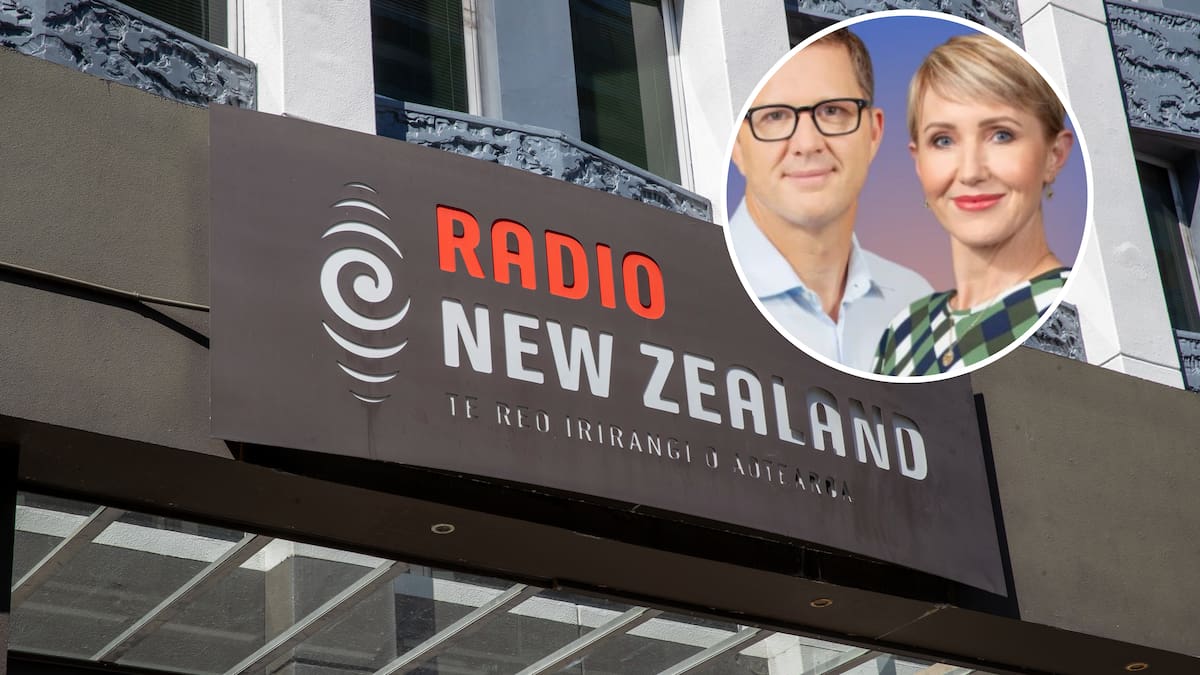
GFK numbers released today reveal RNZ National has 500,300 listeners, up from 475,800 in the previous survey, and from 467,700 – its lowest ever recorded audience – earlier this year.
The station has risen from sixth biggest in the previous survey to now sit in third place behind Newstalk ZB (603,600) and The Breeze (547,900).
While Newstalk ZB still has a healthy lead of 103,000 more listeners than RNZ, the gap is the smallest since late 2021.
RNZ’s audience gains of the past two surveys follow intense internal, media, public and political scrutiny on the organisation’s radio endeavours.
In August, a scathing independent review highlighted a raft of cultural problems at RNZ National and recommended replacing presenters and on-air voices who did not align with its target audience.
Former RNZ news boss Richard Sutherland’s review – released to the NZ Herald under the Official Information Act – did not hold back on myriad issues afflicting the station, resulting in “persistent audience decline”.
It described the proliferation of on-air voices – “especially in news” – who did not meet audience expectations, and it said an audit of all RNZ National presenters was urgently needed.
Since that review, RNZ has appointed a new chief audio officer – respected broadcast producer and journalist Pip Keane.
One of her biggest initial tasks is to find a new Morning Report host, after Corin Dann announced in October he was stepping into the role of business editor at the organisation.
Morning Report hosts Corin Dann and Ingrid Hipkiss. Photos / RNZ
Morning Report has also made several programming changes in recent months – moves that appear to have helped lift its audience.
The changes include shorter news bulletins and new discussion panels, including a head-to-head political panel featuring opposing MPs every Wednesday – a format that ZB has been using for years.
RNZ’s other key shows, including Nine to Noon (258,300, up 20,200), Checkpoint (225,100, up 18,100) and Saturday Morning (208,100, up 4400) also recorded audience increases on the previous survey.
A breakdown by major cities shows RNZ has gained audience mainly in Auckland (132,700 listeners, up 16,700) while Wellington (87,700, up 700) and Christchurch (63,900, up 2600) have had smaller gains.
The only area of major concern for RNZ in this survey would be RNZ Concert – it dropped from an audience of 170,700 to 154,100.
RNZ chief executive Paul Thompson said the RNZ National results showed that the programming changes were beginning to have an impact. He expected to see further growth in 2026.
“We’ve only really begun the work in our audio plan with our chief audio officer being in the role for a little over a month. One of our key focus areas was growing the Auckland audience and seeing a lift in that audience in this survey across all of our major shows is really gratifying.”
Morning Report’s audience is now 352,200, compared with 424,400 for ZB’s Mike Hosking Breakfast.
Newstalk ZB breakfast host Mike Hosking. Photo / Michael Craig
Thompson said RNZ’s audio plan set clear targets to firstly stabilise and then grow RNZ National’s audience. The organisation had been aiming to reach an audience of 500,000 by November 2026 and 520,000 by November 2027.
“We’ve achieved our November 2026 goal a year early with these latest results, and we now want to build on that success in 2026.”
The overall radio ratings, released last week, show Newstalk ZB has finished the year as the country’s leading commercial radio station, for the 17th year in a row, while The Breeze is New Zealand’s top music station.
Digitally, RNZ has been enjoying a healthy increase in its overall, unique monthly audience to rnz.co.nz.
In latest figures released last month, stuff.co.nz had a unique monthly audience of 2.23 million in October, nzherald.co.nz 1.96 million, rnz.co.nz 1.698 million and 1news.co.nz 803,000.
In May, Media and Communications Minister Paul Goldsmith made clear that RNZ needed to focus on building audience engagement and trust.
“Yes, you can have an app which a lot of people read and engage with and use the material that RNZ is developing, but they should never lose sight of the fact that the core business is having live radio and doing that well in a competitive environment.”
Media and Communications Minister Paul Goldsmith. Photo / RNZ, Mark Papalii
He said could never interfere with RNZ editorial decisions, “but as a shareholding minister, I am interested in the performance of the organisation and there are a couple of really core measures”.
“Are people listening, and how they are competing, and then secondly, the broad issue of trust and how does the general public feel about their trustworthiness as a source?”
Editor-at-Large Shayne Currie is one of New Zealand’s most experienced senior journalists and media leaders. He has held executive and senior editorial roles at NZME including Managing Editor, NZ Herald Editor and Herald on Sunday Editor and has a small shareholding in NZME.