
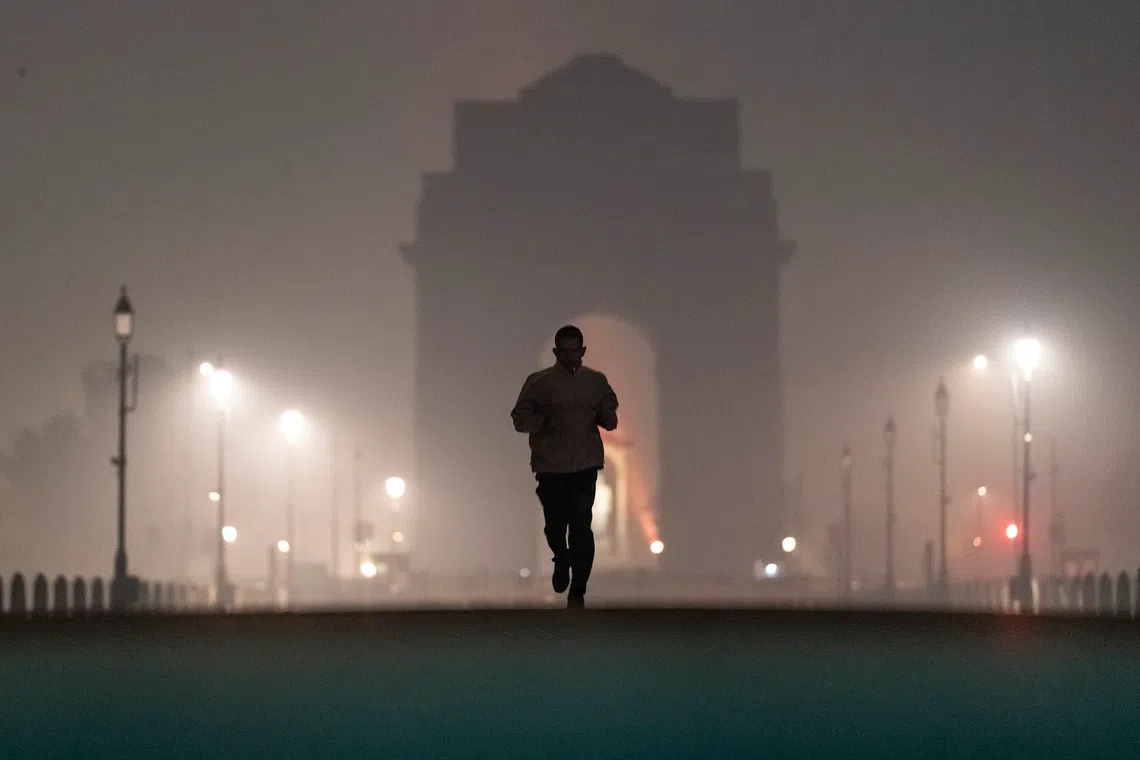
NEW DELHI – October arrives each year in India’s capital with its notorious toxic smog, blanketing the city’s skyline and sending its residents into coughing fits.
It is no different in 2025, but there is a new worrying development: Another “smog” is hovering over the veracity of New Delhi’s pollution readings, denting the credibility of its data and potentially impairing
the fight against pollution.
The Delhi government has been accused of spraying water around air-quality monitoring stations to lower dire readings and even switching them off during key pollution periods – for example, when a litany of firecrackers increased the pollution load during Diwali in October.
India’s Air Quality Index (AQI) classifies pollution as “severe” – the sixth and worst level – when readings are between 400 and 500. A “good” air reading, on the other hand, ranges from 0 to 50.
Critics say artificially lowered pollution readings give a false impression that the city’s campaign against pollution is working effectively, masking the government’s failure in curbing the menace.
“It’s almost like there’s no political will (to tackle pollution) at the end of the day,” Mr Vimlendu Jha, an environmentalist based in Delhi, told The Straits Times at a protest on Nov 18 in the city against its rising pollution levels. “Perhaps it’s better and easier to manage perception than pollution,” he added.
ST witnessed what appeared to be an attempted data manipulation at the pollution monitoring station in Delhi’s Jahangirpuri neighbourhood on Nov 21.
A sprinkler truck was making repeated rounds of the leafy Industrial Training Institute (ITI) campus that houses the monitoring equipment, spraying water not just around it but even in its direction.
Students, meanwhile, played badminton on the damp grounds during their lunch break.
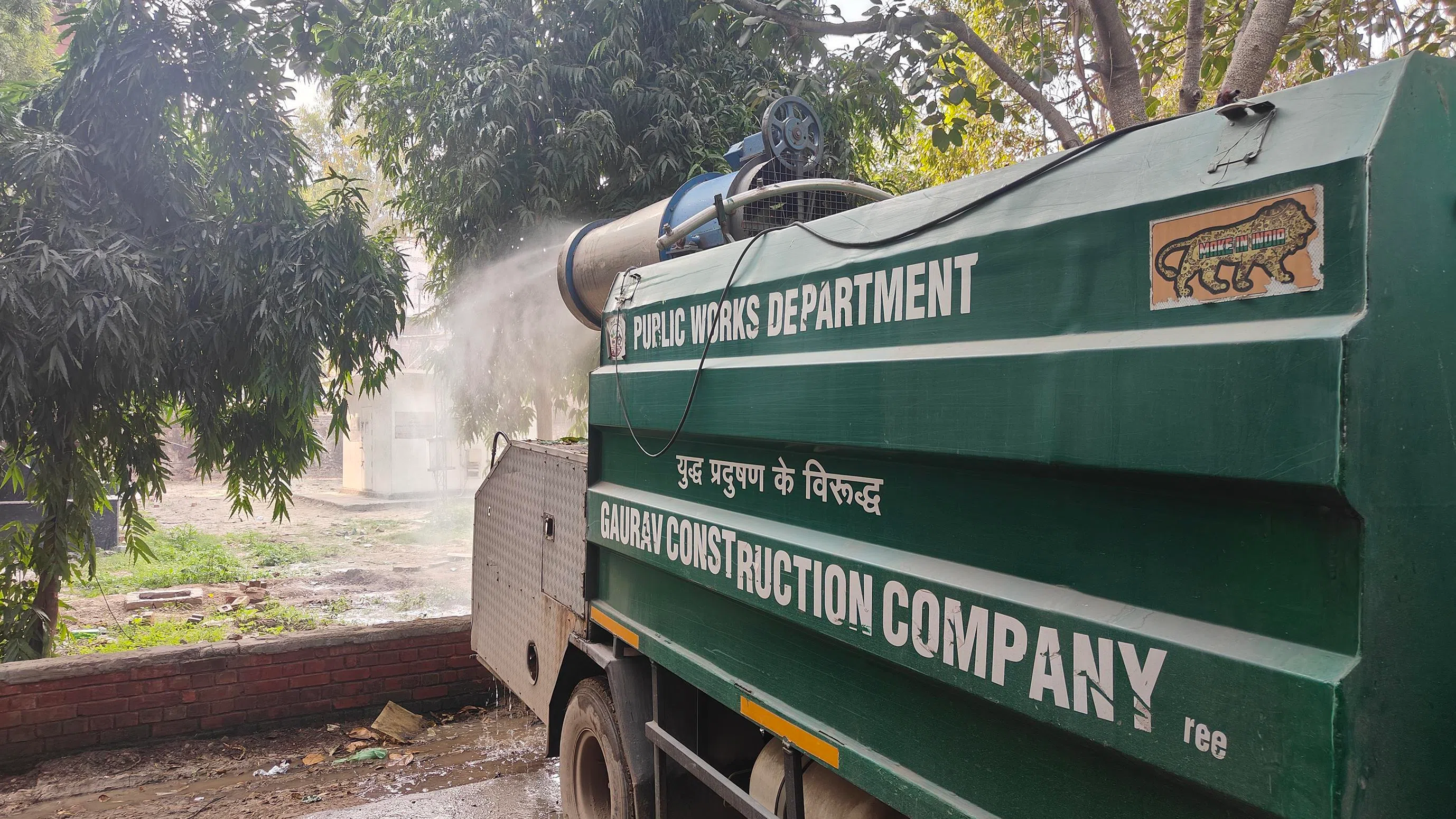
A truck spraying water in the direction of the pollution monitoring station at the Industrial Training Institute campus in Jahangirpuri.
ST PHOTO: DEBARSHI DASGUPTA
The amount of PM2.5 – fine particulate matter that is a key component of air pollution – recorded at the station that day was 180 micrograms per cubic metre, more than 10 times the daily World Health Organization limit. Pollutants smaller than 2.5 micrometres in diameter can penetrate deep into the lungs and impair their function over time.
Staff deployed with the truck, who did not wish to be identified, told ST they had been on duty here for more than a month, working 16 hours a day and spraying around 28,000 litres of water daily in the neighbourhood. This schedule included four rounds each day with the 7,000-litre capacity truck, and a dedicated 10-minute spraying session at the campus during each round.
Mr Sunil Dahiya, founder and lead analyst at EnviroCatalysts, a Delhi-based think-tank, told ST that such spraying can lower pollution readings because it washes down pollutants in the ambient air around the equipment. It also increases the moisture content in the air, making pollutant particles stick together, become heavier and settle down more quickly.
“In both these ways, the readings recorded by the monitoring station are reduced,” he said.
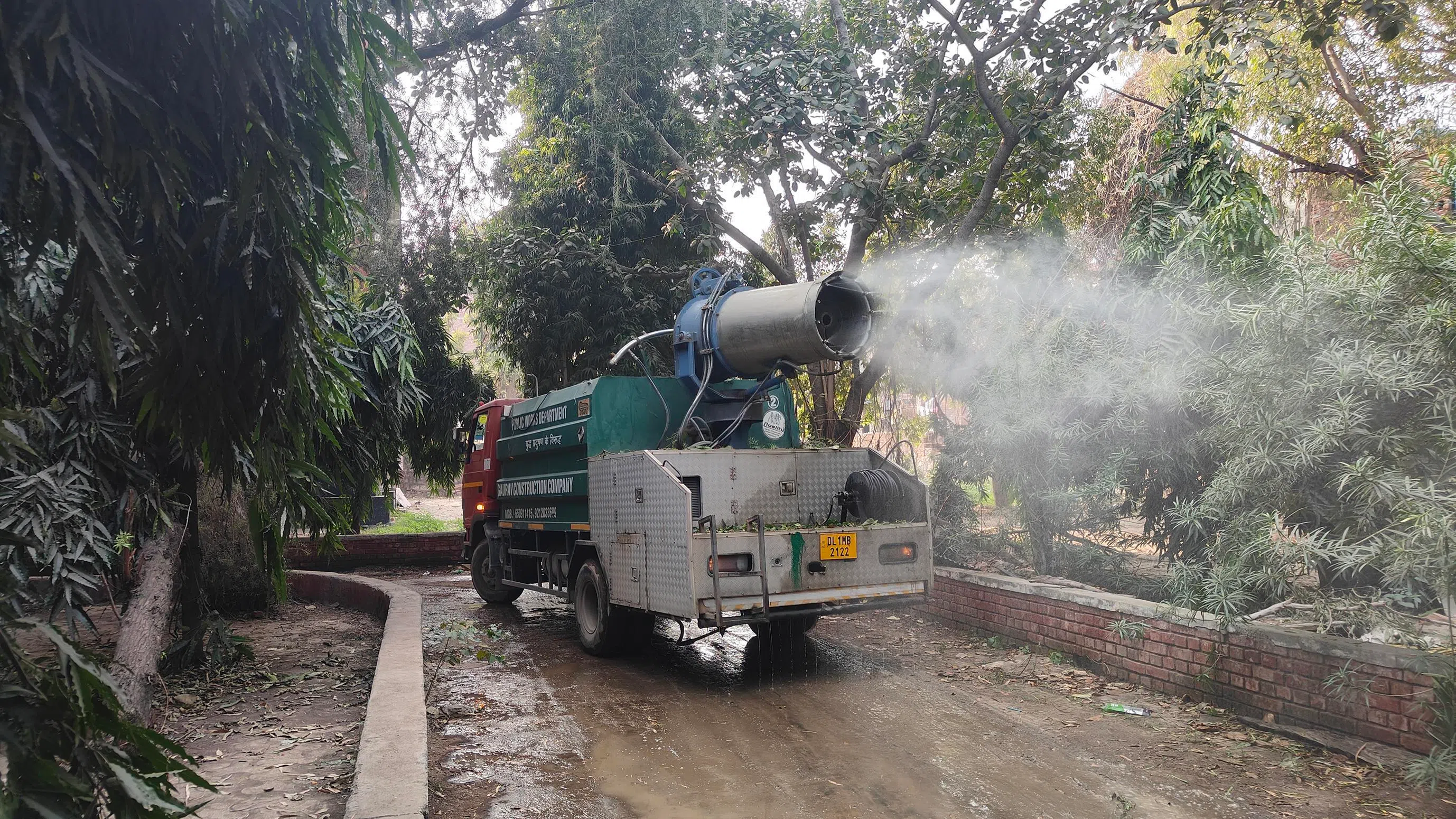
A sprinkler truck was making repeated rounds of the leafy Industrial Training Institute campus that houses the monitoring equipment.
ST PHOTO: DEBARSHI DASGUPTA
The media in India has reported such spraying around at least three monitoring stations in Delhi. “This means pollution readings at those stations and even the city average would be slightly lower than they would have been had this practice not been adopted,” added Mr Dahiya.
The government has also been accused of manipulating readings in its favour by switching off its air-quality monitoring stations during peak pollution phases or not publishing their data.
This was the case on the night of Diwali on Oct 20. The Times of India reported that by 1am on Oct 21, only 19 of the 39 stations were functional as firecrackers added to the city’s pollution load. Two hours later, this number dropped to 12.
It was only around 8am on Oct 21 – when much of the cracker pollution had cleared – that most of these stations went live again. In total, 163 hours of Diwali AQI data from peak pollution periods were wiped out in 2025, compared with only 34 hours in 2024, which served to lower the average daily pollution reading. Several similar instances of missing data have been reported in the city since then.
Government officials have dismissed the charges of doctoring data as “politically motivated”, and argued that sprinkling happens across the city.
These alleged attempts to manipulate pollution data have even caught the attention of the Supreme Court, which on Nov 17 asked the Delhi government to file an affidavit detailing the nature and efficiency of its pollution-measuring equipment.
The city government claimed that Delhi recorded its cleanest first half of November in three years, with its daily average AQI during this period at 348, lower than the 367 in 2024 and 376 in 2023.
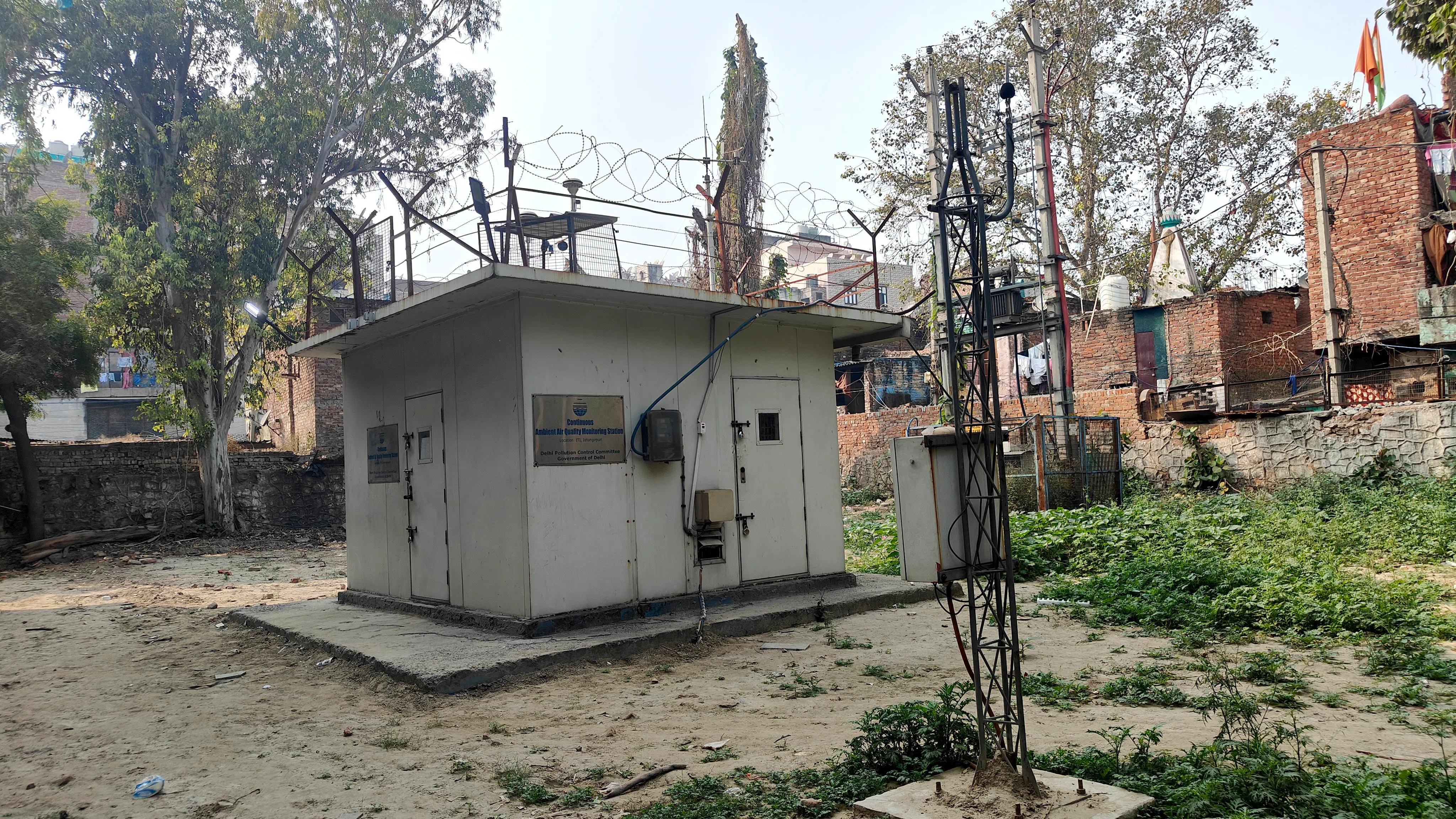
The pollution monitoring station at the Industrial Training Institute campus in Jahangirpuri.
ST PHOTO: DEBARSHI DASGUPTA
Most residents probably thought nothing of this November claim. As many as 87 per cent of residents in and around Delhi have either little or no trust in the air quality data from the government’s monitors, an October survey found.
Data, when accurate, enables a better understanding of the extent and nature of Delhi’s pollution and helps protect the health of residents, as public advisories are issued based on pollution severity.
Delhi follows a Graded Response Action Plan (GRAP), a structured mechanism that mandates progressively stricter restrictions as air pollution rises through the various AQI classifications.
When GRAP4 – the most severe category – is in force, construction activities are halted and the entry of trucks into Delhi is banned, except those carrying essential goods. Several other restrictions, including online schooling and working from home, also come into effect.
Delhi-based clean air activist Bhavreen Kandhari said the city could be doctoring its pollution data to avoid going into the severe GRAP4 phase, which signals worsening pollution levels and comes with restrictions that impact the city’s economic activities. “Obviously, they are working towards the right goal but not in the right way,” she added.
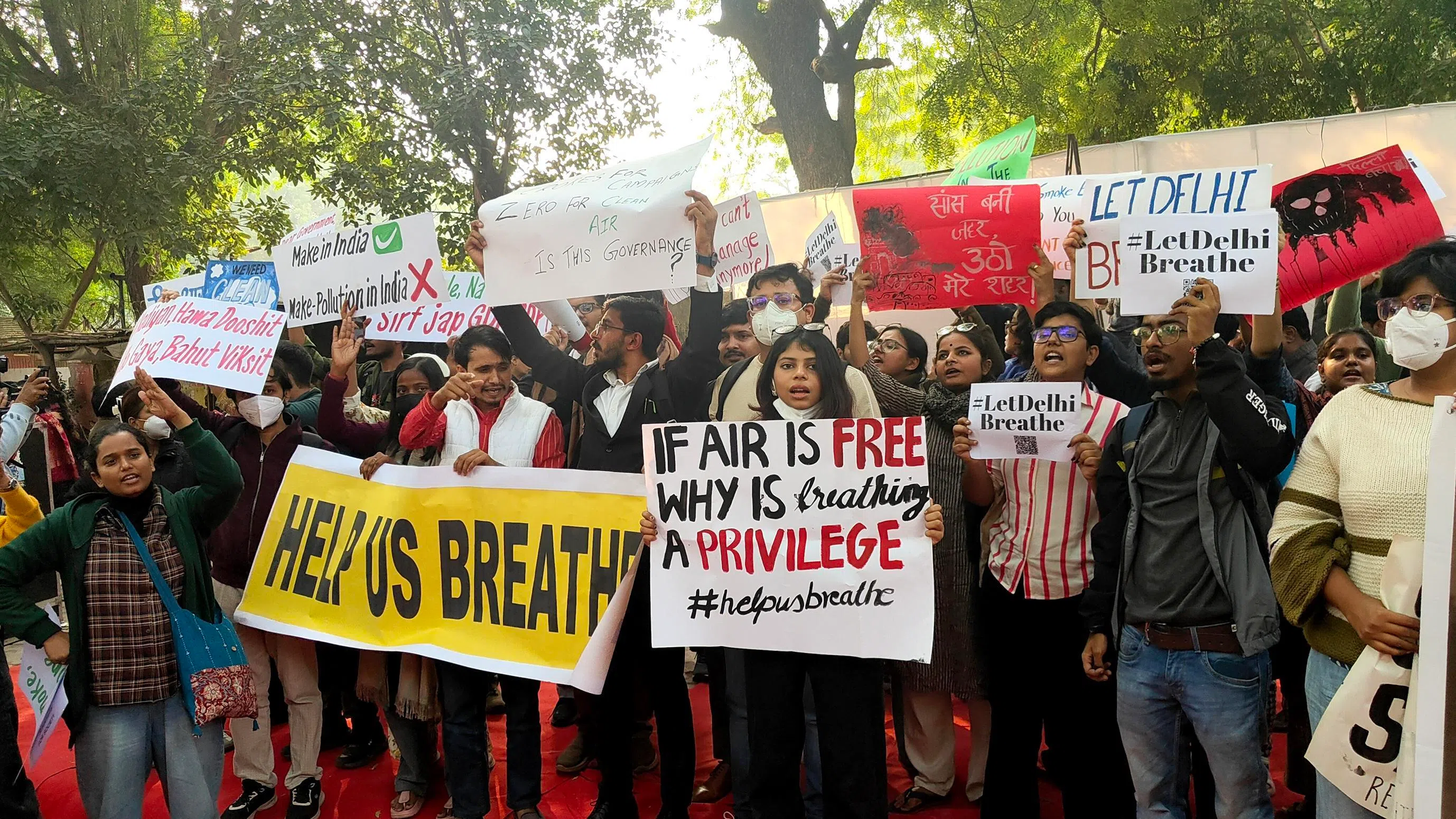
Citizens protesting against rising pollution levels in Delhi on Nov 18.
ST PHOTO: DEBARSHI DASGUPTA
These alleged manipulation efforts have also angered the public, who have organised at least three anti-pollution protests recently, including one at Jantar Mantar in central Delhi, where around 200 people gathered on Nov 18.
“I’m a student who’s been residing in this country, in this city, for a long time. I am entitled not just to correct data, but also to correct information,” said Ms Neha, a 27-year-old doctoral student in theatre and performance studies, who goes by one name.
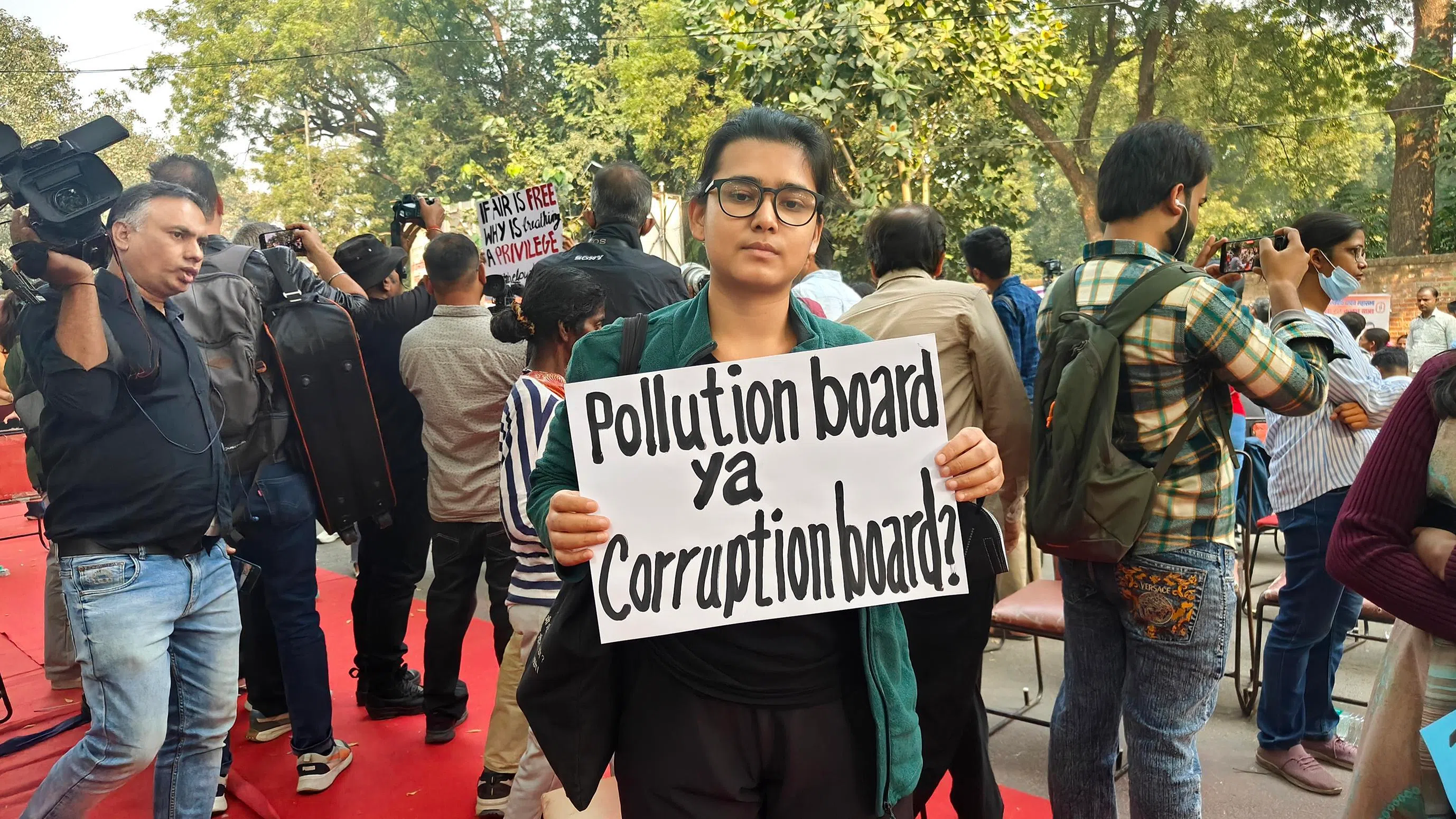
Attempts to alter pollution data have angered many citizens in Delhi, such as Ms Neha, who showed up at a recent protest in the city.
ST PHOTO: DEBARSHI DASGUPTA
A hand-held device brought by one of the protest attendees at the venue in central Delhi indicated an AQI of 377, which falls under the “Very Poor” category, a level below “Severe”. Using such devices, the media and citizens have reported much higher levels of pollution at monitoring stations in different parts of India’s capital than the official readings.
“You’re actually deceiving the public,” said Ms Kandhari, referring to the city government. “The public may be running marathons or going to school on a day when they shouldn’t be doing these activities.”
But official government data remains crucial as it forms the basis for informed action against pollution and public interventions in court on this matter.
“We don’t have a choice but to trust the government data, which is all the more reason why this data must be beyond doubt,” she added.