
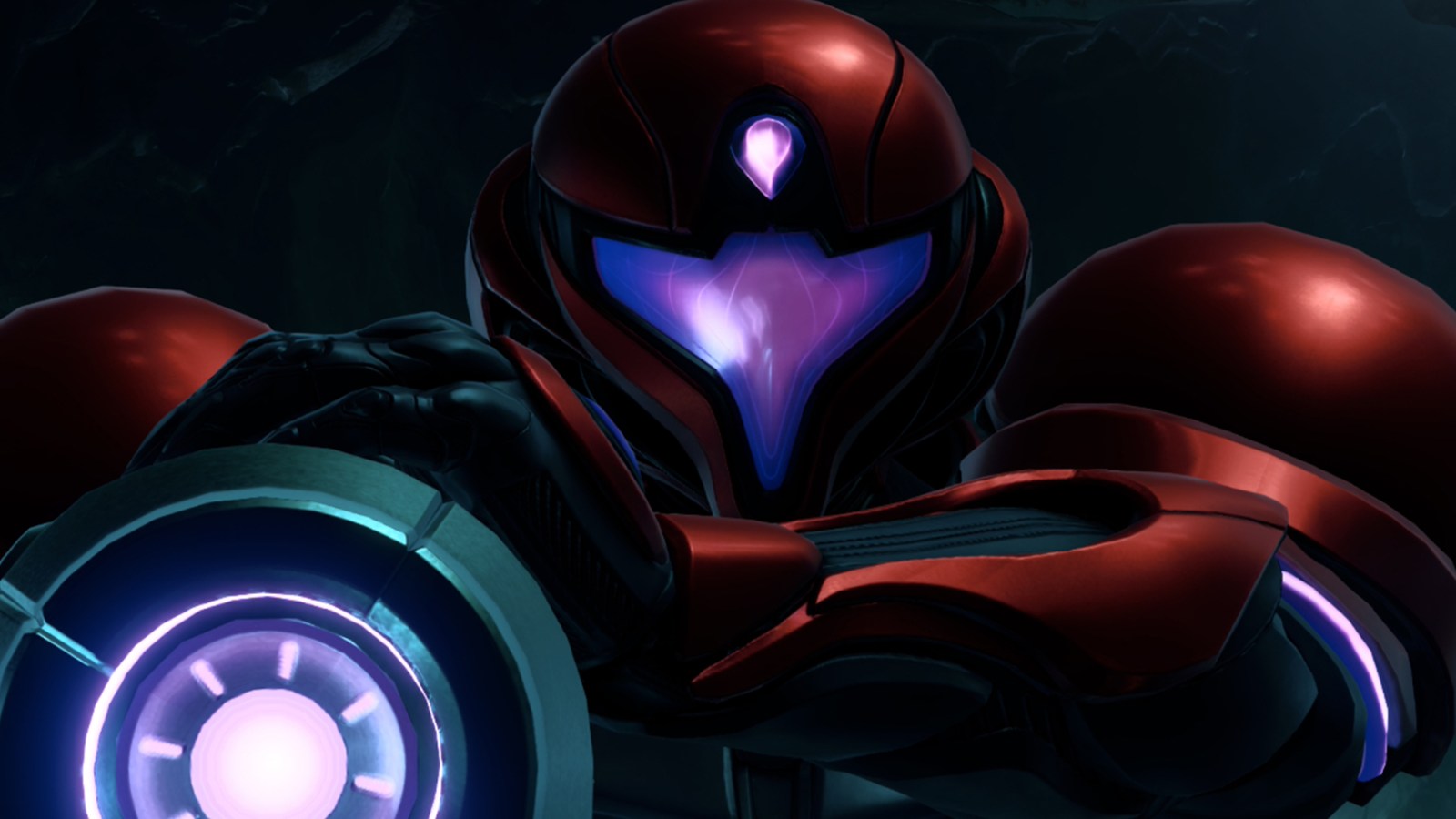
When I was a kid, Super Metroid was everything. Weaned on Nintendo’s haunting, Alien-inspired side-scroller, I spent countless hours watching my father trudge through the depths of the planet Zebes as bounty hunter Samus Aran, doodling maps and rudimentary sketches of the armored heroine in a composition book. The game’s atmosphere and ambiance were so potent, it could goad into silence a loquacious and energetic six-year-old without even putting a controller in their hands.
Those formative memories mean that I’ve got a pretty good idea of what I think Metroid should be — as do many others. It’s a foundational text in gaming, one of those golden age touchstones for action-adventure and exploration systems that built a formula that could be followed for generations.
Playing Metroid Prime 4: Beyond (out Dec. 4), it’s easy to pick up on the echoes of the franchise’s past. Audio cues and musical motifs from the older games (especially the first Prime from 2002) creep up now and then to trigger a Pavlovian response. Samus loses all her coolest powers and must start from scratch, this time collecting a different suite of skills (which the pattern dictates she’ll lose again next time around). The basic structure is reminiscent of the classics; on paper, it’s Metroid through and through.
But very early on, it’s clear that something isn’t quite right. There’re too many other people involved in the mission, with galactic soldiers and technicians chiming in with directions and quips. There’s an occasionally creepy aura in some subterranean places, but it’s wedged between sprawling vistas of a mountain range and a literal desert to traverse by motorcycle. By the time a wave of riff-heavy rock hits your ears, there’s a tonal whiplash that divides just about every aspect of the game’s story and systems.
In an effort to make Metroid Prime 4 a fresh start for bringing in newbies, Nintendo and Retro Studios have tried to cook up something different, but the recipe pages are all mixed up. There are hints of Halo and a zesting of Zelda, and occasionally the familiar flavor of Metroid, but instead of getting something cohesively bold, the result is a bunch of mismatched bites.
Editor’s picks
Back to formula
Although there’s been some slight divergence in the past, most Metroid games follow a rubric. Samus arrives to clean up some mess (usually revolving around the vampiric Metroid creatures) and is forced to survive in an inhospitable alien world, kicking over every stone and x-ray scanning for trinkets to help guide her path.

Sylux is the game’s big bad, arriving with the titular Metroids in tow.
Nintendo
Prime 4 kicks off much the same, beginning with an action-heavy tutorial that sees Samus arriving in the nick of time to help the Galactic Federation withstand an assault by an opposing force led by rival bounty hunter Sylux. During the fray, some kind of ancient relic is triggered, leading to a temporal rift that zips Samus and various soldiers to the world of Viewros, home of the extinct alien race called the Lamorn.
What follows is the basic framework of a Metroid game: Samus’ suit is damaged, leaving her without all her cool toys, and she must trek through various biomes to find keys and weapons both old and new to get off the planet, unearthing the lore of the mysterious alien civilization along the way.
In action, it plays a lot like the previous Prime games. Nintendo’s take on the first-person shooter has always been just different enough to separate it from the pack, with an emphasis on lock-on aiming for gunfire and information scanning rather than all-out blasting. Combat is more of a dance than cover-based warfare, where the cadence revolves around reading an enemy to learn their weakness, then dodging around them in circles while using whatever specific sequence of abilities will negate their defenses.
Related Content
Combat relies on lock-on aiming, although the Switch 2’s Joy-Con can be used as a mouse.
Nintendo
In this regard, Prime 4 plays great. Samus is nimble, and the scanning visor has been updated to allow shooting (although not with her base weapons) and quick swapping of modes, so that the whole game doesn’t entirely devolve into the perpetual use of x-ray vision that’s plagued gaming since 2009’s Batman: Arkham Asylum. It’s still a huge part of the loop; basically every chamber requires scanning for ways through locked doors and secrets, but there’s greater agency in its pacing.
Each installment also introduces some kind of gimmick that dictates what new power suits and weapons Samus will obtain. In previous Prime games, that could be weapons that swap between Light and Dark power, or a corrupted arm canon imbued with the fictional substance Phazon, but there’s mostly just variations of the abilities cemented in 1994’s Super Metroid. There’s versions of an Ice Beam, a heat-based beam, and one that can shoot through surfaces — on top of the standard Charge Beam and Missiles.
It’s in this weaponry where Prime 4 begins to show cracks. The Big New Thing is supposed to be psychic powers, which mostly amount to letting Samus pull triggers with telepathy or see invisible platforms. These abilities are doled out sparingly throughout the game, requiring players to constantly return to old areas to reach that one spot they couldn’t before (which is the norm), but an introduction of an entire second set of powers makes this all feel moot.
Some areas evoke the eerie vibes of Metroid games past, but others feel far derived.
Nintendo
A few hours into the game, the hook becomes tracking down elemental chips that grant players the power of ice, fire, and lighting — all simply named like nobody wanted to bother checking the thesaurus for synonyms again. These, on top of all of Samus’ classic abilities like the Morph Ball and Grapple Beam, constitute most of the gameplay systems needed to solve puzzles and fight baddies, almost immediately nullifying the psychic abilities outside of a handful of spots.
The speed at which the game eschews its primary gimmick indicates that the developers needed something new but never really figured out what to do with it, instead falling back on the most obvious ideas (ice, fire, electricity) to fill in the gaps. It’s not the only place where the game feels at odds with itself.
The dilution of Metroid
Going back to the beginning, the first major pivot Prime 4 inserts is with the Lamorn themselves. After getting her marching orders from a hologram of a long dead elder, Samus is told she’s part of a prophecy that declares her the chosen one. Although previous games wove in the protagonist’s history with ancient races like the Chozo, she’s generally depicted as a benevolent gun-for-hire who’s opting to do the right thing because she’s got a grudge against the galaxy’s biggest assholes, the Space Pirates, who killed her family. Here, to achieve a more epic scope, there’s now some divination involved that’s frankly out of place.
Samus’ abilities are plentiful, but the game doesn’t always feel built around creative usage.
Nintendo
That impetus of creating scope out of tired cliches extends to just about every facet of the game. On the first real mission in the jungle region of Fury Green, Samus encounters a Galactic Federation technician named Myles Mackenzie who, from his reveal in the pre-release previews, became a sticking point for fans due to his hackneyed sidekick trappings. Myles is a nervous little nerd who fanboys over Samus over an escort mission but is thankfully relegated to being the remote tech support she’ll need to return to in order to upgrade weapons. But by the time players meet the rest of the supporting cast, they’ll wish they were stuck with just Myles.
Each of the game’s major areas — with milquetoast monikers like Flare Pool and Volt Forge — saddles the player with a new Federation members who’s been trapped on Viewros. These characters come in all the usual stock archetypes: the weary sniper, the grizzled sergeant, and the fresh-faced rookie. They mostly serve as the in-game directory, frequently reminding Samus of where she needs to go and occasionally flailing around helplessly in combat. They also function as a shorthand to let newcomers know just how big a deal Samus is, constantly fawning over her celebrity status as a godlike warrior.
This isn’t the first time Metroid has deviated from its solo survival mission roots; both Metroid Prime 3 (2007) and the garbage heap that was the third-person action game Other M (2010) pushed a tertiary cast into Samus’ inner sphere — and to be fair, this lot fares much better. The issue is that they’re just so boring. Like the weapons and even the areas players explore, the support team are flat stand-ins pulled from the top of the imagination to fill a role. Here’s a thunder gun, a fire place, a no-nonsense soldier guy — all with next to no effort put into imbuing anything with deeper personality.
The supporting cast is more boring than annoying, designed around flat archetypes.
Nintendo
The same level of non-effort is applied to the overworld, which is Prime 4’s biggest change to the formula. Rather than the intricately designed interconnected labyrinths that the series is known for (which literally defines the subgenre of Metroid-inspired games), players are instead dropped into an open desert that constitutes an explorable hub with each of the important areas tucked into the four corners. If that sounds familiar, it’s because it’s identical to how The Legend of Zelda: Breath of the Wild operates, except at a fraction of the size and density.
Speaking of Breath of the Wild, that game’s big wow moment is unintentionally inverted here. In Zelda, the player’s first step out onto the Great Plateau is awe-inspiring — unveiling a vast world filled with opportunity and regal beauty. Here, the initial foray into the expanse of Viewros lands with flop: It’s an empty desert with nothing to see for miles into the distance.
But surely, there must be more! (There isn’t.) Once players unlock Vi-O-La — a motorcycle created by the Lamorn during their industrial revolution that somehow became the focal point for all their technological and architectural design — the desert can be traversed at high speed; but there’s nothing to find. Short of a few birds and occasional baddies, it’s a wasteland that houses a pittance of easily found secrets and the major dungeons. Somehow, Prime 4’s world is built to ape the most complex of Zelda games by delivering environments less sophisticated than the Nintendo 64 era.
The desert hub is empty and lifeless, with only a handful of things to find while cruising around.
Nintendo
That chintzy feeling falls to the wayside a bit in some of the better dungeons. There are points where the underground science labs and subterranean depths feel like a true Metroid game. There’re even sections where, without someone constantly chiming in your ear, you might actually get lost or have head scratching moment about where to go next. But they’re few and far between given Prime 4’s constant insistence that it become more action and plot based — cribbing the tone and cadence of other franchises in an attempt to morph into a diet Halo game.
The thing is, this could all work if the developers leaned further in any one direction rather than constantly half-stepping into other franchises’ territory. The (different) team behind 2021’s fantastic Metroid Dread figured out that the best way to make a mute superhuman interesting was to leave her completely out of fucks to give, responding to the threats of the world with mild irritation and nonchalance or borderline unhinged levels of violence. In Prime 4, Samus is humorless, simply nodding along while others try their best at second-rate comedy.
The narrative that wraps around it is flavorless and rote; the best effort made to bring any personality or spectacle comes from short sequences like an area where Samus bombs down a roadway on her magic motorcycle to hard rock riffs while lighting shoots through the sky. An entire game built around this energy could at least have some schlocky B-movie vibes by way a hair metal album cover, but they’re just peppered in between a sea of blandness.
There are shades of a bolder game here, but Prime 4 never commits to anything audacious.
Nintendo
It’s hard to ignore the pervasive feeling that nobody really knew what this game was supposed to be. Prime 4 had an infamous (and very un-Nintendo-like) troubled development, announced in 2017 before being fully scrapped and started anew with a different creative team. In the years since, it doesn’t really seem that anyone settled on a cohesive vision, opting to cobble together the must-haves for Metroid with concepts taken from other franchises. Every gimmick introduced serves one or two functions before being discarded and the game never really finds its footing.
Trending Stories
In some ways, this watered-down vision of Metroid feels more like a dry run for what an eventual movie adaptation could be. Its rapid-fire introduction and shorthand for Samus’ in-world mythos, omitting all the baggage of previous games, is akin to first act setup of a middling summer blockbuster — complete with a vanilla cast of characters primed for spouting exposition. With Nintendo’s new initiative of going full multimedia, it makes sense. Except for the fact that Metroid is built on Alien, which would’ve been a better blueprint for any cinematic ambitions and Prime 4 as a whole.
Metroid Prime 4: Beyond launches for Nintendo Switch and Switch 2 on Dec. 4.