
The draw will be broadcast live on Stan Sport, 9Gem, and 9Now in Australia, and streamed globally via RugbyPass TV and the World Rugby YouTube channel on Wednesday from 8pm AEDT (9am Irish time).
Australia will get things underway in the opening game at Perth Stadium on October 1, 2027, kickstarting a new era for the Men’s Rugby World Cup.
In previous tournaments going back to the 2003 Rugby World Cup, there have traditionally been 20 teams, split into four pools of five teams each. The top two teams from each pool would then progress to the quarter-finals, which was the first round of the knockouts.
At Australia 2027 there will be an additional four teams, and therefore the tournament requires a new format and one big change – a round of 16 as the first knockout stage.
What is the format?
There will now be six pools with four teams in each. The top two teams from each pool will progress to the round of 16, while the four best third-place teams will also progress.
Those four teams will be determined by competition points firstly, and if that does not separate the sides then points difference and try difference will be the next factors used respectively to determine which teams make it out of the pool phase.

With an extra round of knockouts, does that mean more games?
For the fans, yes. Instead of 48 matches like there was at the last Men’s Rugby World Cup in France, there will be 52 games Down Under. But crucially, it does not equate to more games for the players.
With player welfare at the forefront of decisions made around the tournament’s structure, World Rugby has adopted this format to ensure maximum jeopardy, drama, and excitement for the teams as well as spectators, while not compromising on the health of those who play the game. Five minimum rest days will be observed between matches in Australia.
While there will be more knockout matches, the change from five teams in each pool to four has meant one fewer fixture for each team in the pool stages.
For example, when South Africa won the 2023 Rugby World Cup, they played seven games – four in the pool phase, and a quarter-final, a semi-final, and a final.
If they were to reach the final of the 2027 Rugby World Cup, they would still only play seven games – three games in their pool, then the round of 16, a quarter-final, a semi-final, and a final.
But fans still get four extra matches, and as an added bonus, having an even number of teams in each pool means no team has to sit out a round while the others play each other.
So, despite adding four extra teams, the pool stages will now in fact shorter. While the 2023 World Cup lasted 50 days in total, the World Cup in two years’ time will take place over 43 days (6 weeks). It will therefore be a more condensed and exciting tournament, without adding to the players’ workload.
How will the round of 16 work?
In previous formats, the quarter-finalists would just be the winners of each pool against the runners-up of another pool. With six pools feeding 16 spots in the first round of the knockouts, that requires some changes. First, have a look at this graphic which shows the road to the final:
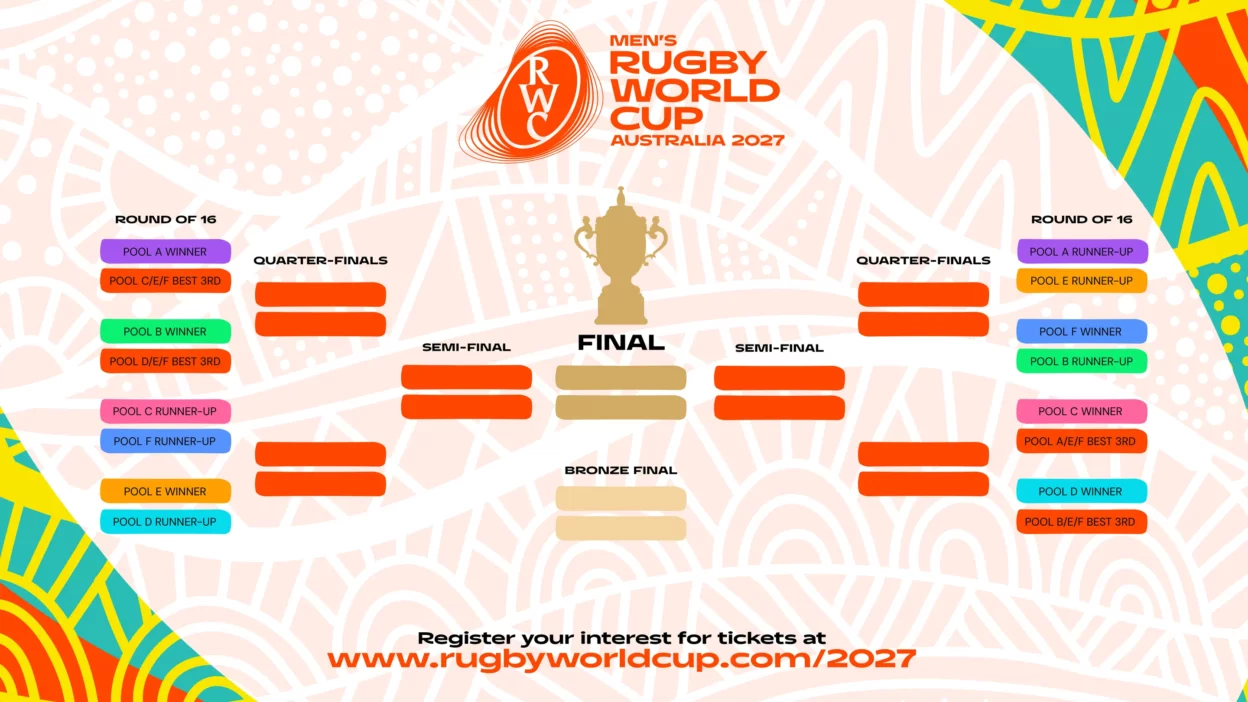
As you can see, the teams that finish top of Pools A, B, C, and D will face a third-place team in the round of 16, while the teams that finish top of Pools E and F will face teams that finished second in their pool.
Likewise, some teams that finished second in their pool may face the winners of another pool, while some will face the runners-up.
While on the surface that may seem slightly unfair, that imbalance is addressed in the next round. Let us take Pool A and Pool E as an example. The team that wins Pool A will face a third-place team in the round of 16, but in the quarter-finals could potentially meet the winners of Pool B if that team wins their round of 16 clash.
On the other hand, the team that wins Pool E will face runners-up rather than a third-place team in the round of 16, but in the quarter-finals would face the winners of a quarter-final between two other runners-up.
So, while the winners of Pool A would face a third-ranked team and then potentially a top-ranked team in their games, the winner of Pool E would face second-ranked teams in both games.
There is therefore no advantage or disadvantage to be gained or lost regardless of your team’s ranking at the end of the pool phase. It will all even out in the end.
Who will my team face in the pool stages?
That will all be decided on Wednesday. The draw will take place in Sydney, and will be broadcast live on Stan Sport, 9Gem, and 9Now in Australia, and streamed globally via RugbyPass TV and the World Rugby YouTube channel from 8pm AEDT (9am Irish time).
The draw presenters will be World Rugby Chair and former Australian international Brett Robinson, All Blacks legend and two-time World Cup winner Dan Carter, former Wallabies captain and Australia’s most-capped player James Slipper, and Olympic gold medallist and former Australian Sevens star Alicia Lucas.
Which teams have qualified?
The 12 teams that finished in the top three of their pools at the 2023 Rugby World Cup have automatically qualified for the 2027 tournament. Those teams are France, New Zealand, Italy, Ireland, South Africa, Scotland, Wales, Fiji, Australia, England, Argentina, and Japan.
The 12 remaining places were reserved for teams that qualified through various regional tournaments, including this year’s Rugby Europe Championship and Rugby Africa Cup. These teams are Georgia, Spain, Romania, Portugal, Tonga, Canada, United States, Uruguay, Chile, Samoa, Zimbabwe, and Hong Kong China.

How does the draw work?
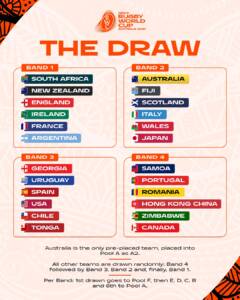
The World Rugby Men’s Rankings at the end of the November internationals were used create four bands of six teams. Ireland are in Band 1, along with South Africa, New Zealand, England, France, and Argentina. Each band will be drawn randomly into Pools A, B, C, D, E, or F.
There is only one exception to all this – Australia already know they are in Pool A as they are the host nation and will therefore contest the opening game in October 2027.
The Wallabies are in Band 2, which means a team from Band 1 will be drawn and placed in Pool A, and will automatically be joined by Australia.
Where will the games be played?
With the new format, there will be 52 matches at the 2027 Rugby World Cup, an increase from the 48 from two years ago. The games will be shared between seven iconic Australian cities – Adelaide | Tarntanya, Brisbane | Meeanjin, Melbourne | Narrm, Newcastle | Awabakal-Worimi, Perth | Boorloo, Sydney | Gadigal, and Townsville | Gurambilbarra.
When can I buy tickets?
The RWC 2027 Ticket Presale is fast approaching. It will open on Wednesday, February 18, 2026 at 12pm AEDT, giving fans the first opportunity to secure tickets before they go on general sale.
Presale access is limited to fans who have completed their by 12pm AEDT on Tuesday, February 17, 2026. All matches and all price categories will be available during this Presale. Click here for ticketing information.
Previous Story
#EnergiaAIL Women’s Division: Round 7 Review
Next Story
Join The Next Women’s Rugby Online Networking Event – Focusing On Club Development