
When the time arrived to make sense of a frenetic Test to open the Ashes, chief among the topics of discussion was whether Australia had stumbled upon a sliding doors moment, with Usman Khawaja’s future firmly in the spotlight.
Not for the first time in a career stretching 14 years and seven Ashes series, Khawaja now finds himself in an uncomfortable predicament with his position in peril after being ruled out of the second Test at the Gabba beginning Thursday.
Watch The Ashes 2025/26 LIVE and ad-break free during play with FOX CRICKET on Kayo Sports | New to Kayo? Join now and get your first month for just $1.
His future lies beyond the bat in his hands, for if Australia succeeds in Brisbane, there may no longer be a spot come Adelaide.
After searching far and wide for an opener capable of ticking the run rate along, the elevation of Travis Head to the top of the order due to Khawaja’s back injury in Perth proved illuminating.
On the day Khawaja trudged slowly from the slips cordon at Perth Stadium, every step a painstaking one, Head inflicted his thrill-a-minute version of grievous bodily harm on England’s attack to seize the advantage for Australia.

It is the type of innings Australian selectors have been searching for from an opener since the retirement of David Warner, but until now, that position was at the other end belonged to Khawaja.
Not now. If Head succeeds again at the top of the order, presuming he will hold the spot, and Jake Weatherald carries on from his promising Perth performance, his future will be sealed.
No matter the eventual call made by the selectors, be it to back in a man who has scored more Test runs than any other Australian over the past four years, or to end the career of a trailblazer, it is certain Khawaja will make peace with the decision. For that is his ethos.
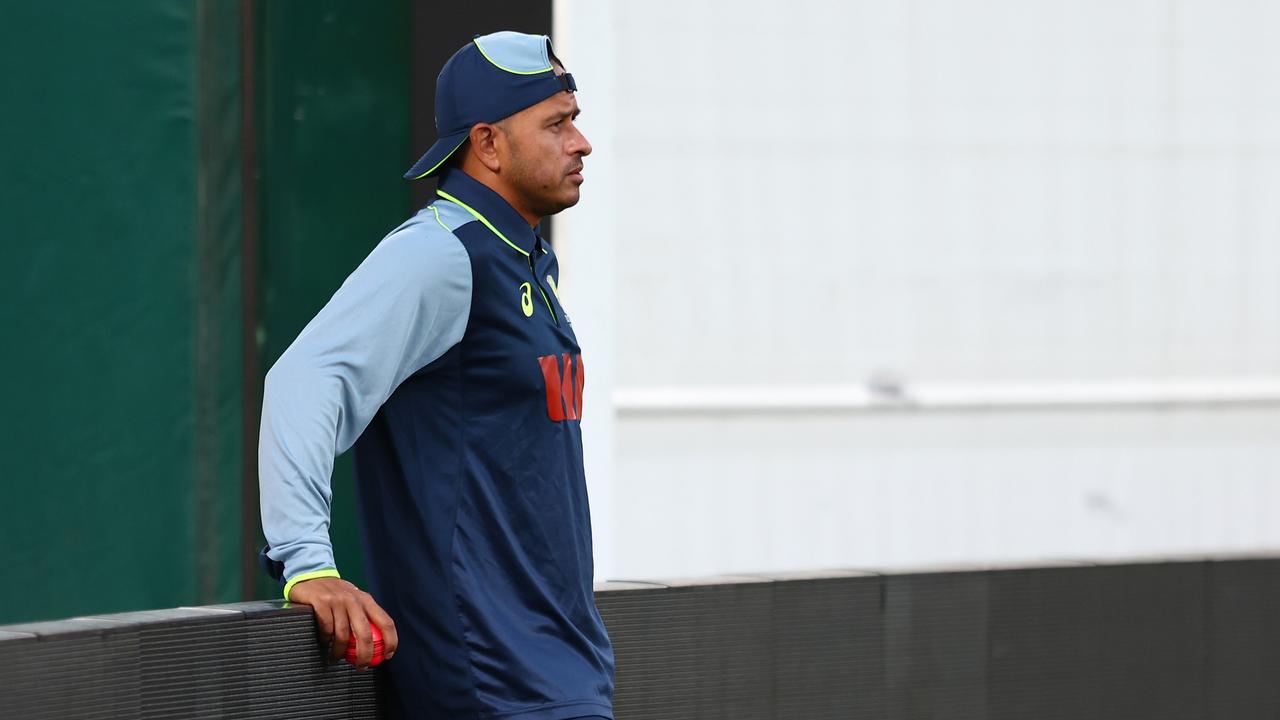
BRISBANE, AUSTRALIA – DECEMBER 02: Usman Khawaja during an Australia nets session at The Gabba on December 02, 2025 in Brisbane, Australia. (Photo by Chris Hyde/Getty Images)Source: Getty Images
When interviewed by foxsports.com.au before the summer, the 38-year-old made clear there is no room for sliding doors scenarios in a faith-based life and that his attitude to cricket had always been what will be, will be.
The first Muslim and Pakistani-born cricketer to represent Australia, Khawaji explained how Tawakkul, an Arabic word that translates to “Trust In God”, had guided his life and career.
“It’s pure trust in God. So if something bad happens, or if something good happens, I always believe there is a better thing for me later in life,” he said.
“And even when bad things happen, that’s why I never get … too down, because I always have trust, and that trust always brings me back up really quickly after any setbacks I have had.
“The journey that I’ve had has been up and down, up and down. I feel like I probably should have played more Test matches than 80 or so after all this time. But I wouldn’t change my journey for any other reason or any other thing, because it was my journey.
“It’s meant to be the way it was meant to be. I don’t believe in sliding doors. So that is faith itself. I wouldn’t be here with faith in general.”
Usman Khawaja opens up career rise | 16:05
NEVER WRITE A TOP GUN OFF
The timing of the back spasms experienced by the Queenslander during the first Test was far from ideal for several reasons and shed an even brighter spotlight on his position.
A double-century against Sri Lanka in February aside, Khawaja is among the top order batters to struggle to find his best form over the past 18 months.
But the cliche about never writing champions off stands for good reason. So often they find a way to succeed against the odds, as Khawaja has done time and again.
Khawaja found a way back from the lament of homework gate in 2013 in India when coach Mickey Arthur was pointed in his criticism of him, making him feel like an outsider.
He was banished from the Ashes back in 2013 after following a first innings duck with just 21 at Durham at No.3, having made just two 50s from 17 innings after strong domestic form.
Six years on and he was banished from another Ashes series abroad after three appearances, unable to find his groove when batting at first drop once again.
But he persisted. And the most glorious award came when he put England to the sword in the opening Test at Edgbaston two years ago, an effort critical to Australia retaining the Urn.
Importantly Khawaja will remain with the Australian squad to continue his rehabilitation. It leaves the door ajar for one last grand hurrah against the old rival.
TIME TO REGENERATE
The sentiments surrounding Khawaja had been understandably supportive from his teammates in recent days in Brisbane as he battled to prove his fitness and, arguably, keep his career alive.
His state teammate Marnus Labuschagne declared the veteran needed no advice from him and noted that his batting when representing Queensland has been superb this year.
Prior to the failure for Australia in Perth when batting down the order due to back spasms, Khawaja scored 202 runs in four innings in October for his state at an average of 50.5.
“He’s 38. He’s been around the block for a long time. The way he has been batting is awesome,” Labuschagne said.
Marnus backs Uzzie amidst uncertainty | 04:08
It is scarcely surprising, though, that a teammate will support an incumbent and the reputation of this Australian team is to offer another chance for a player to succeed rather than cut them too early.
After Australia lost the World Test Championship decider at Lord’s in June, Australian coach Andrew McDonald stressed the positives Khawaja brought to the team when backing the veteran in for the summer ahead.
“He gives us stability at his best at the top. And we like to look at our players at their best,” he said.
But there was a caveat in that support, for while McDonald said he did not “see an end date”, he did stress the way Khawaja was training and moving was important. And few things are more restrictive to moving than a bad back.
Khawaja started the Caribbean tour in July soundly before tailing off on what proved a difficult tour for Australia’s top order, despite the white wash of the series.
His Shield form was sound and prior to Perth, there was no suggestion he would not be in the Australian team as long as he batted soundly in the infancy of the series.
But back spasms are problematic. Khawaja said he took a mountain of painkillers in order to be able to field in the second innings and a sharp movement sparked the slow trudge off.
Head helped the Aussies get away with it in Perth, but Khawaja’s back was a big factor in the reason the hosts found themselves scrambling for a way out of a hole.
With every wince he offered when facing throwdowns at training on Monday, it made it harder for the Australian selectors to be convinced the same scenario might unfold at the Gabba.
As former Australian captain Ricky Ponting noted, change has to come at some stage in order for the national team to evolve and Khawaja’s injury might prove a pivotal moment.
“The change for this Australian team has got to come at some stage. There’s got to be a regeneration at some stage,” he said, as reported by website Cricket et al.
“Is that in the middle of an Ashes series? Maybe not. But if Travis does go up to the top they can then think about bringing Beau Webster back into the middle order, or blooding a young kid down at No.6.
“As an Australian cricket fan, I would love to see them do it and see if we can actually break England early.”
BRISBANE, AUSTRALIA – DECEMBER 02: Usman Khawaja during an Australia nets session at The Gabba on December 02, 2025 in Brisbane, Australia. (Photo by Chris Hyde/Getty Images)Source: Getty Images
PAVING A PATH
It is four years since Khawaja, having been recalled to the Australian squad for the Ashes but not yet back in the team ahead of the Brisbane Test, touched on what he hoped his legacy would be.
Australia’s strength is its diversity but the opener said it hurt that when he spoke to someone with a subcontinental background, be it second or third generation, they often said they supported India or Pakistan.
Having gone from feeling on the outside of the Australian team in his youth to being on the fringe of a squad of his contemporaries, he wanted to set an example for others to follow.
“That hurts me because I love Australia. I love the Australian cricket team and I really want them to feel the same way,” he told the ABC before the 2021 Ashes.
“I don’t want them to feel like they can’t get involved in that either. When we start seeing that, I think you know you’ve made some good inroads.”
The irony is that Khawaja felt the same as a kid, unable to recognise himself among the “VB-drinking larrikans” he used to battle with when growing up in Westmead.
Adam Gilchrist and Brett Lee, who now feature in Kayo Sports coverage of the Ashes, helped to change his mind when he arrived on the scene in the twilight of their careers.
“It wasn’t until that generation started to come in that I started to actually support Australia,” he said.
“So I kind of understood where these people were coming from that were saying this to me, that they really couldn’t connect to the Australian cricket team because they didn’t really see themselves in the Australian cricket team.”
Ash Chandrasinghe, who featured as a cricketer of promise in the ABC article on Khawaja preceding his recall to the Australian team, has shown promise for Victoria in Shield cricket.
Harjas Singh, who opened for Australia in the under-19 World Cup last year, is another who credits the veteran for opening the door for Aussies with sub-continental heritage.
Khawaja, who runs a foundation that helps spread the sport across the nation in conjunction with Cricket Australia, is pleased things have improved since his arrival 20 years ago.
“I see a lot more cricketers coming up through state levels in Australia, in particular, that are from subcontinent backgrounds, which we really did not see when I came up, even when I played,” he told ESPN.
THE LATE TWIST IN A ROLLERCOASTER CAREER
If the Perth Test was to be the end, the only shame will be that Khawaja went out looking every bit of his age and not as the graceful bat he presented as for much of his career.
In no way does it detract from his career, one where he has recorded 16 centuries and another 27 half-centuries in 85 Tests and more than 6,000 runs at the highest level.
Instead it illustrates the punch that accompanied the panache with which he played when at his peak, one that arrived later than most, and is a testament to his resilience and fight.
Khawaja was in his mid-30s when named the ICC Test Cricketer of the Year in 2023, a year after winning the Shane Warne Award as Australia’’s best Test cricketer, and he has scored more runs than any other batter at Test level after the age of 35.
His first Test hundred came a decade ago against New Zealand at the Gabba. His most recent was a double-century against Sri Lanka in Galle. That demonstrates his versatility and ability to bat from green mambas to slow turners.
In between he scored hundreds against the West Indies and South Africa, a whopper against England at the SCG in 2017 and another big one against Pakistan in Dubai a year later.
The centuries he scored in consecutive innings on his recall at the SCG in 2022 against England when called on to replace Head, who was unwell with Covid-19, was the mark of an opener of the highest order and sparked a career resurgence.
And the hundreds kept coming throughout his dynamic 2023, including the critical century at Edgbaston that serves as a highpoint given his previous struggles in England.
“(The) SCG (in 2022) was special. It was unexpected. My career was over in my head. I’ve said it a million times but it was,” he said.
“(It is) hard to beat that from an individual point of view but from a team point of view, and wins, this is by far my favourite match ever in my life.
“The way it ebbed and flowed, the way they came out, the way we counterattacked, it looked like we’d lost the game probably with an hour to go and to come back and win, by far my favourite game of all time.”
He has played in World Test Championship successes for Australia and captained his adopted state Queensland.
All the while he has been a trailblazer, one who was prepared to speak his mind about his faith and his beliefs, even if that furthered the spotlight on him and drew adverse reactions, as proved the case this week when he bagged the Perth pitch.
Whenever the end comes, be it after the Brisbane Test or at the end of the summer, Khawaja has done it his way. He sits in the top 20 for runs scored and Tests played by an Australian.
It has been a mighty career which is why, as Khawaja said in September, he feels “blessed”.