
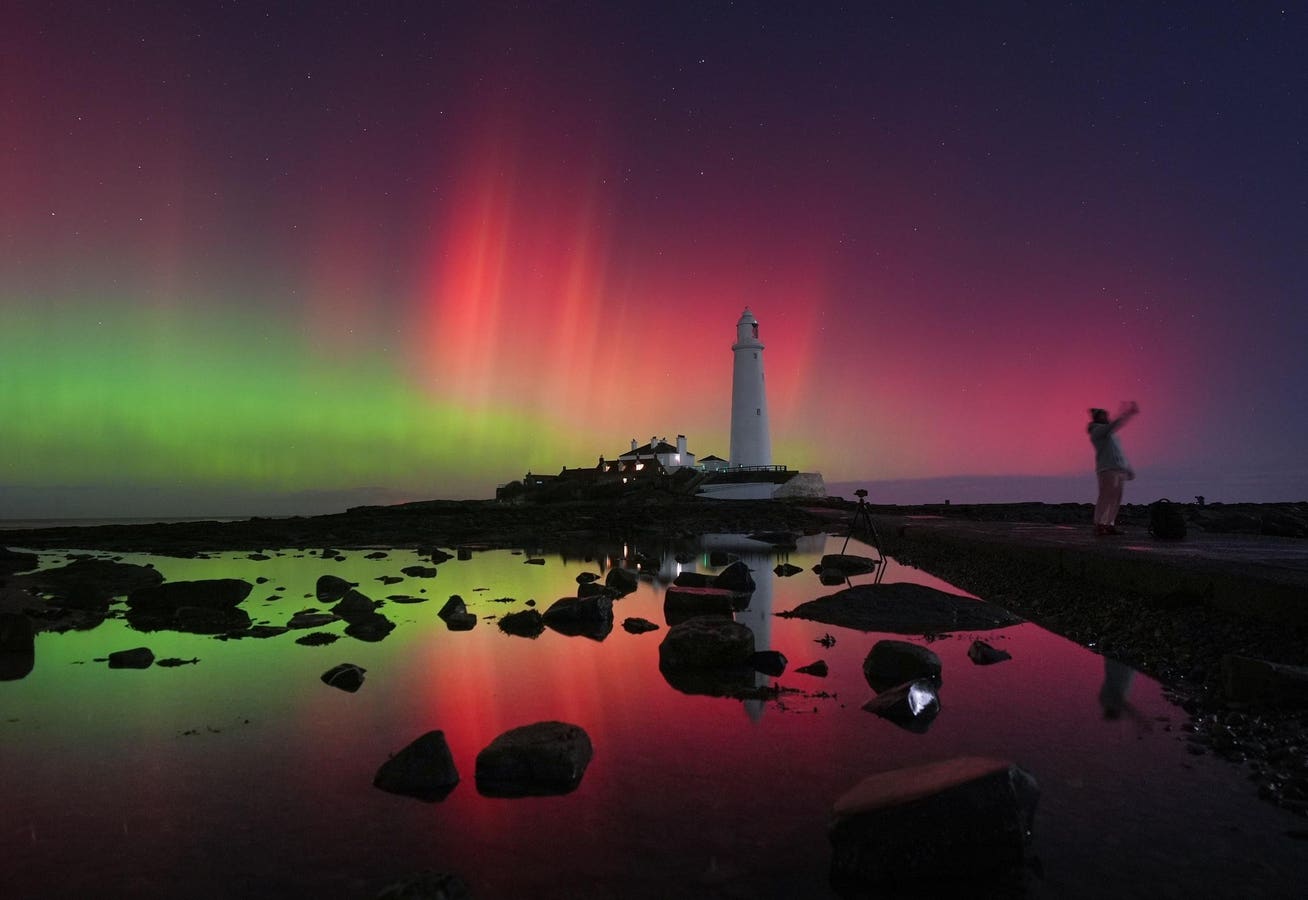
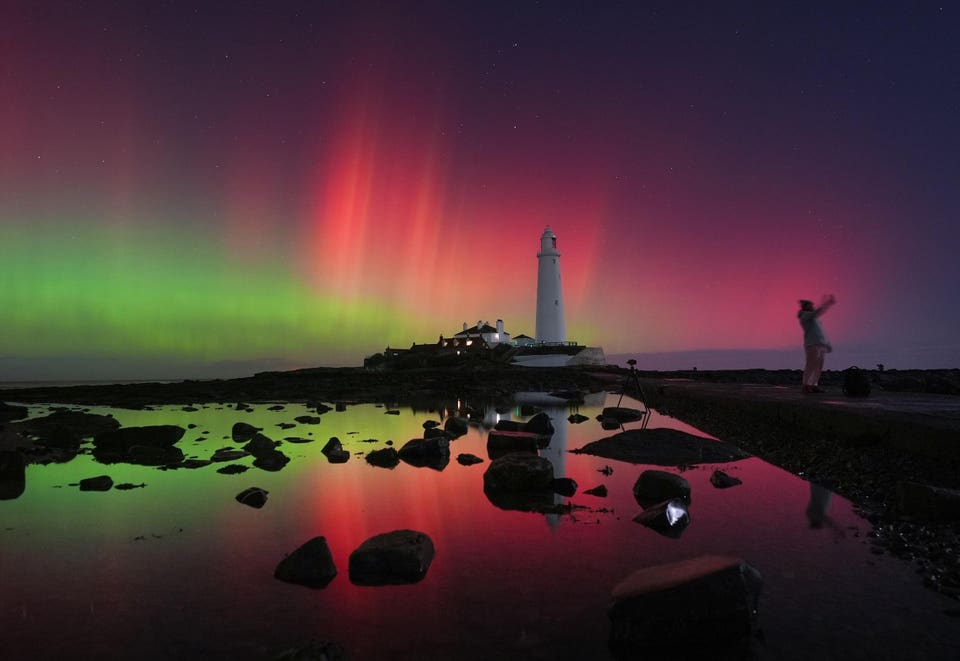
The aurora borealis, also known as the northern lights, glow in the sky over St Mary’s Lighthouse in Whitley Bay on the North East coast, reaching a G4 level geomagnetic storm, putting on an amazing display in the early hours. Picture date: Wednesday November 12, 2025. (Photo by Owen Humphreys/PA Images via Getty Images)
PA Images via Getty Images
Updated, Dec. 2, 2025: NOAA’s aurora viewline map was added showing the potential visibility of the Northern Lights in North America.
The Northern Lights may be visible over some northern and upper Midwest states from New York to Idaho on Wednesday, Dec. 3, into Thursday, Dec. 4, after a possible G3 geomagnetic storm was forecast by space weather experts at the National Oceanic and Atmospheric Administration. It comes in the wake of an X2-class solar flare on Monday, Dec. 1.
After the solar flare, a coronal mass ejection — a cloud of charged particles — left the sun, which forecasters now think is Earth-directed. Together with a more turbulent solar wind, that could trigger a geomagnetic storm — and potentially displays of the Northern Lights — though the presence of a bright, almost full, moon will make fainter aurora harder to see.
NOAA issued a geomagnetic storm watch for Wednesday, Dec. 3, 2025.
NOAANorthern Lights Forecast: What To Expect
The latest forecast calls for a G2-rated geomagnetic storm after dark in North America on Wednesday, Dec. 3, stretching into the pre-dawn hours of Thursday, Dec. 4.
“The storm cloud could graze our planet on Dec. 2,” according to SpaceWeather.com. “Moreover, the CME will scoop up a solar wind stream just ahead of it, adding heft to the potential impact.”
Even if the CME misses, or just grazes, Earth’s magnetosphere, NOAA predicts that the already strong, turbulent solar wind could be enough to cause a G2 geomagnetic storm. “If they arrive at the same time, G3 (Moderate) storming levels are likely with conditions waning towards active to G1 levels thereafter,” states NOAA. “If they are reasonably spaced apart in time, G2 (Moderate) conditions will persist for longer, throughout 04 Dec.”
All this comes as a huge group of sunspots, dubbed 4294, 4296 and 4299, has appeared on the limb of the sun, which rotates roughly every 27 days. One of the biggest seen in a decade, it’s expected to be the source of solar flares over the next few weeks, with NOAA stating that there’s now a 30% chance of a strong solar flare.
NOAA’s aurora viewline for Wednesday, Dec. 3. 2025.
NOAANorthern Lights Forecast: Where And When
Aurora displays are a possibility in northern U.S. states and Canada, with 22 U.S. states having a chance after dark on Wednesday, Dec. 3.
U.S. states that may see aurora include Alaska and (northerly parts of) Washington, Idaho, Montana, Wyoming, North Dakota, South Dakota, Minnesota, Wisconsin, Michigan, New York and Maine. However, if a G3 geomagnetic storm results, that could mean more states seeing aurora, including Oregon, Nebraska, Iowa, Illinois, Indiana, Ohio, Pennsylvania, Massachusetts, Vermont and New Hampshire.
For the best views, locate a dark place using the Dark Sky Place Finder and a light pollution map. The darker the northern sky, the more vibrant the display — even during moderate geomagnetic storms.
The Aurora Borealis lights up the night sky over Monroe, Wisconsin, on November 11, 2025, during one of the strongest solar storms in decades. The geomagnetic event pushes the northern lights deep into the continental United States, with vibrant pink, red, and green hues illuminating rural farmsteads and open fields across the Midwest. (Photo by Ross Harried/NurPhoto via Getty Images)
NurPhoto via Getty ImagesNorthern Lights Forecast: Latest Updates
To check visibility in real time, use NOAA’s 30-minute aurora forecast, or download apps such as Aurora Now, My Aurora Forecast or Glendale Aurora for up-to-the-minute alerts and live solar wind data. Look for data on the interplanetary magnetic field’s Bz component, which determines how easily solar energy enters Earth’s magnetosphere. When Bz points north, Earth’s field resists it; when Bz swings south, the two fields connect, allowing plasma to stream in. A sustained southward Bz of -5 nT or stronger usually signals an imminent display of aurora.
Wishing you clear skies and wide eyes.