
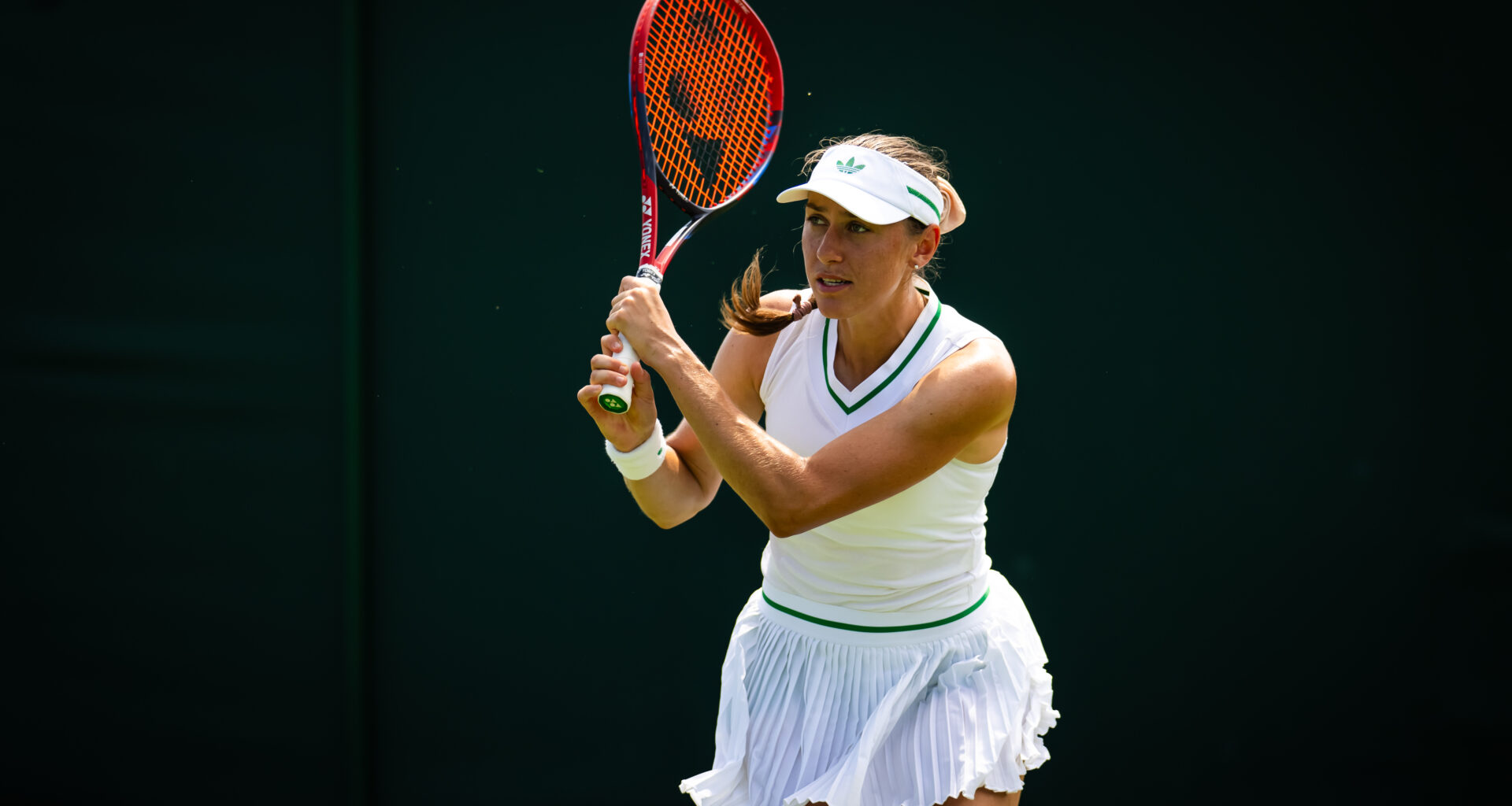
Note: Throughout December, wtatennis.com will be running a series of interviews with players who are poised to make a mark in 2026 after impressive comebacks or breakthroughs in 2025.
This week, Kaja Juvan faces a somewhat nervous wait. The cut-off date for the Australian Open main draw is next week — and, ranked No. 101, the Slovenian is on the cusp of direct entry. She’s not playing this week, so whether she gets in or not will be dependent on the results of those around her in the rankings.
But Juvan’s decision to shut her season down after spearheading Slovenia’s successful Billie Jean King Cup Play-Offs campaign in India last month, rather than continue grinding through WTA 125 and ITF tournaments, was one she knows she needed to take. If the 25-year-old has learned one thing from the ups and downs of her career to date, it’s to prioritize her mental and physical health first and foremost. And her season has already been a remarkable success. After a rare neurological condition sidelined her for almost all of 2024, Juvan was unranked when she returned to action in January — but after compiling a 52-20 record, including two WTA 125 titles, she ended the season in the Top 100.
“I feel a bit frustrated because I’m doing the good thing for mental burnout, and it might cost me the Australian Open spot,” she said via WhatsApp from her home in Ljubljana. “If you want to do a vacation and a good preseason, it’s very important you have that time to prepare — optimally, you do five weeks of preparation.”
Juvan’s confidence in her decision is reflected in her eloquence as she expands on what she’s learned over the past two years. While away from tennis, she soaked up knowledge about psychology and neurology — “I got to know my brain in a completely different way,” she enthuses — and ultimately used it to free herself from a toxic coaching mentality and rediscover what truly matters in her career.
“You can’t separate the brain from the body”
When Juvan’s father, Robert, died from stomach cancer in late 2022, she took a short break from the tour the following year in order to mourn. She was back playing full-time by the end of 2023, but still forcing herself to fight through an underlying lack of enjoyment.
“When you love a person so much, the grief is tiring,” she said.
The physical symptoms of her condition — a nervous system issue called functional neurological disorder that took months to diagnose — cannot, she thinks, be separated from her mental fatigue. Juvan recalls a practise session in which, overwhelmed by anxiety, she was unable to control her body and broke down in tears.
“You can’t separate the brain from the body,” she said. “Our whole nervous system is controlled by the brain. A lot of injuries stem from that.”
Headaches and dizziness followed; Juvan even lost the function in one hand, which she describes as “scary.” To aid her recovery, she was assigned a team from a Madrid hospital that specialized in the condition: psychiatrist Dr. Marta Sanz Amador, neurologist Isabel Pareés Moreno and neuro-physiotherapist Pilar Rada Romero. Among the questions Sanz Amador kept asking was why Juvan believed she had to push herself to her physical and mental limits in order to succeed.
“There are lots of narcissists in the world”
The answer lay in Juvan’s past, and in a coaching mindset that she believes is still all too commonplace in tennis.
“One of my coaches in the beginning wanted to break me mentally,” she said. “He thought he was making me stronger by changing my whole personality. He kept saying I’m too nice to people, my personality is bad. It was like a manipulation. When you listen to that every day — even me, from a very secure family — it slowly gets to your head. I just really started to believe you have to be unhappy to have success.
“There are lots of narcissists in the world. They try to build you up, but in terms of ‘I made that happen, you’re good because of me.’ Then if you lose, it’s because of you.”
The coach/player dynamic is a psychologically complex one. Juvan notes that the coaches — despite being paid to be in a position of authority over a younger player — are simultaneously in a precarious position as the player’s employee, and sometimes feel replaceable. Underlining their own worth can be a means of securing their job for a longer period.
“You’re supposed to make these big decisions about who you employ, who you trust and who you take on tour — and you pay the expenses — but they’re the ones leading you,” she said.
Moreover, all of this comes against a cultural backdrop in which female athletes are often told that they’re second-best from a young age.
“When we’re growing up, we always hear, ‘Women’s tennis is worse compared to men,'” Juvan said with a grimace. “Blah blah blah, all of these things. If you’re Top 100 in the women’s, you hear, ‘Oh, that’s not so great.’ But in the men’s, it’s like you’re already a god. I think our self-worth can be a little bit shaky. And a coach can take advantage of that.”
Comfort zone, challenge zone … panic zone
One of the most ubiquitous clichés in tennis is that of getting outside of one’s comfort zone. But what does it actually entail?
“There are three zones,” Juvan explained. “You have a comfort zone, a challenge zone and a panic zone.”
Competition takes place in the positive headspace of the challenge zone, she continues, but regularly returning to the comfort zone is necessary as a reset. Constantly forcing oneself to exist in the challenge zone means that the brain enters the panic zone as a stress response — and in Juvan’s case, this was exacerbated by her grief.
“Basically, what happened to me is that I was in the panic zone all the time,” she said. “What was once a challenge became a panic. I’m not prone to depression or anxiety genetically, but for almost 10 to 12 months I woke up and I couldn’t calm my system down. I was getting more and more anxious every day, but I kept saying I have to push it, if I just push myself a bit more, it’s good to be out of my comfort zone and it’s normal that I’m stressed all the time. I needed to reprogram my nervous system.”
“At the end, it’s about your relations with people”
Sanz Amador provided an invaluable counterpoint to the school of suffering that Juvan had internalized. She kept pointing out that Juvan played better when she felt relaxed rather than when she was pushing herself to her limits.
“I didn’t know that the brain relaxes when you have more fun,” Juvan said. “But if you’re feeling fear, your nervous system will tighten up. Which is quite logical, but I didn’t think about it in that way.”
Sanz Amador also emphasized empathy and kindness, in contrast to the coach who had once told Juvan she was too nice for tennis. This, it turned out, was borne out by all the people around her. As she embarked on her indefinite hiatus, Juvan was worried that her sponsors would drop her and her team would need to find work elsewhere. Neither came to pass. Both Yonex, her racquet sponsor, and Adidas, her then-clothing sponsor, sent her supportive messages and told her to take as much time as she needed. And her team — coach Nik Razborsek and physical trainer Miran Kotnik — not only stood by her, but saw it as an opportunity for them to expand their knowledge alongside her.
“They both accepted lower pay than they usually would have and said they’d be with me through the whole recovery process,” Juvan said. “At the end, it’s about your relations with people.”
What Juvan, Razborsek and Kotnik learned together now informs their approach to training. Pushing her to the extremities is no longer the goal; instead, they put effort into prevention exercises and maintaining her base while constantly adjusting what, when and how much they add. It’s a system that requires an immense amount of trust on all sides — she has to be honest with herself as to whether she is unable or unwilling to push harder. In turn, her team have to believe her and hold her accountable.
“There was one example where I said, ‘Look, I need five days,'” Juvan recalled. “My coach was like, ‘If you want to go to the next tournament, we need to practise at least one day.'” The ball was thus in Juvan’s court: resting wouldn’t just entail five days off practising, but pulling out of her next event.
“They had to trust that I wasn’t lazy and going to go shopping, but I really needed to take the mental load off,” Juvan said. “But they trust that my goal isn’t to rest as much as possible. My priority is to be one of the best players in the world, or at least reach my personal potential — whatever that is.”
Juvan credits this setup for the speed with which she’s returned to the Top 100, as well as an improved ability to deal with what she calls “the paradoxes of tennis.” There’s the aforementioned psychological dynamic between players and their teams; there’s also the necessity of paying attention to factors that it’s healthier to de-emphasize.
“You have to pay attention to the financial part, but not obsess about it,” Juvan said. “You’re not supposed to think about points and defending them, but you still have to see where you’re ranked.”
With all the knowledge Juvan has gained, is the next step to pay it forward? She’s signed up to the WTA’s partnership with Indiana University East, where she’s studying for a psychology major with a minor in neuroscience. Both of her parents are doctors — Juvan jokes that she’s “the most uneducated” member of the family — and she feels she would like to continue exploring the intersection between psychology and medicine with a view to helping others in her community.
That’s still far down the line, though.
“I think if I learned anything from this, it’s to see how it goes step by step,” she said with a laugh.