
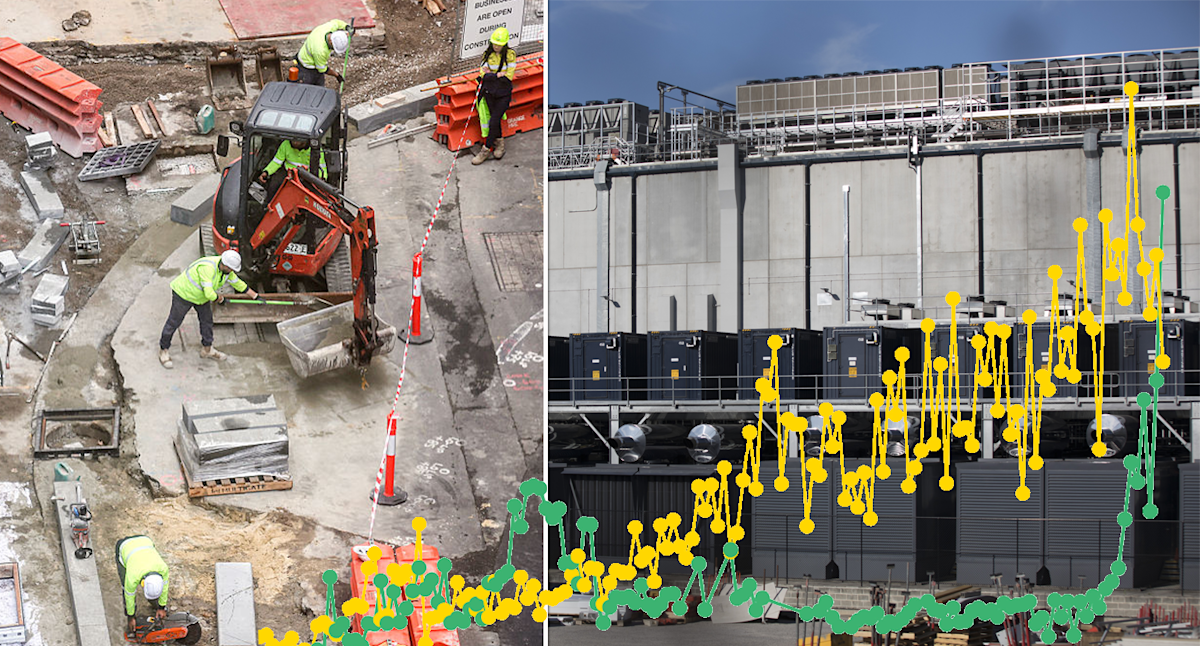
 Australia has plenty of skin in the game for this global AI story. (Source: Getty/Yahoo Finance)
Australia’s economy has become caught up in the AI bubble. I’m not talking about your super and it’s exposure to AI investments. This is no longer just about the financial side of the economy.
Real world resources are being plowed into serving AI models at a rate we have never seen before. Data centres are being slapped up all over the country and filled with rack upon rack of servers, fed by millions of miles of copper wire and cooled by enormous air conditioning systems.
The latest ABS data has the precise values and they are astonishing.
Equipment spending in the IT sector has exploded to levels that make the 2000 dot-com boom look like a cute little molehill.
(Source: Private New Capital Expenditure)
That is just investment in equipment, the ABS also tracks investment in buildings and structures. The IT sector’s investment there has also shot to a record of more than $2 billion a quarter, although from a higher baseline.
That humming noise you can hear is the AI pipeline running hot.
RELATED
The companies making these investment are behemoths. Amazon for example. A US$2.5 trillion dollar company, far larger than Australia’s largest company, it is spending billions on AI on our shores. That is barely enough for a footnote in their annual report, but the sums land with a giant splash in our economy.
Amazon’s investment will be $20 billion over the next few years, which is a significant project in a country like Australia – we don’t invest all that much outside mining. Amazon’s energy hungry data centres in Sydney and Melbourne will be big enough to need much more power, and so they will build several new solar farms. That doesn’t necessarily mean more of our existing energy needs are met by solar, mind you.
Smaller Australian companies are also crowding in on the trend. Macquarie Technology Group was boasting on Tuesday that it has finished a $350 million project in Sydney’s north. The big new server farm will gobble up water and power for years as it serves the needs of artificial intelligence users. There were 2,400 jobs in its construction, design and fitout but the ongoing operation will be much leaner.
The question is whether the investment in AI is valuable for the country.
The building phase moves people away from the construction of homes – a commodity Australia desperately needs right now. Every tradie parking their Ranger outside a data centre is one that isn’t working on an new homes. It’s like the famous question of whether a country should invest in steel or butter. Do we need server racks or apartment blocks?
Story Continues
The following chart shows just how big the IT investment trend has become: the IT sector is suddenly spending more on equipment than the construction sector. A massive reversal from even just a couple of years ago when construction firms were spending four times as much on cranes, etc, as IT firms were on CPUs, etc.
(Source: Private New Capital Expenditure)
The trend is visible in the import data too, the official trade statistics show computer parts crossing our borders at unforeseen rates, while we are bringing in slightly less of the equipment you need a hard hat to use.
(Source: ABS)
Australia’s resources are being devoted to feeding the great AI maw. Much of the financial capital for that comes from the big tech companies. Their money is at risk and they will take the profits – or the losses, if the whole thing turns out like the 2000 dot com boom and bust. But the land and the labour for putting this AI infrastructure together is all Australian.
Should we be building AI data centres when Australians are so desperate for homes? Perhaps AI will prove to be so useful we will be glad we have data centres onshore. Perhaps we learn that the early forays into consumer AI are dead-ends and the real value will crop up for enterprises.
We don’t seem to want AI slop to read, AI illustrations, or AI customer service, but perhaps AI can work best behind the scenes, improving corporate operations. For example, maybe it streamlines audit processes for major accounting firms, allowing better spotting of errors and fraud. And a million other back-office use cases. That’s the optimistic view.
The negative view is that in the race to be first, the major tech firms have forgotten to check whether all this is useful.
With much of the AI spending being funded by debt, the big tech firms will need to find revenue sources fast. The 2000 dot-com bubble was not like this – it was funded by startups and IPOs, whereas this boom is being led by huge firms that probably won’t go broke, but could still suffer under the weight of bad investments.
A future where America’s economic growth engine is suffocating under bad debt while Australia’s energy has been poured into making data centres does not sound like a future of great economic potential. We now have a great stake in hoping the AI investment pays off.
Get the latest Yahoo Finance news – follow us on Facebook, LinkedIn and Instagram.