
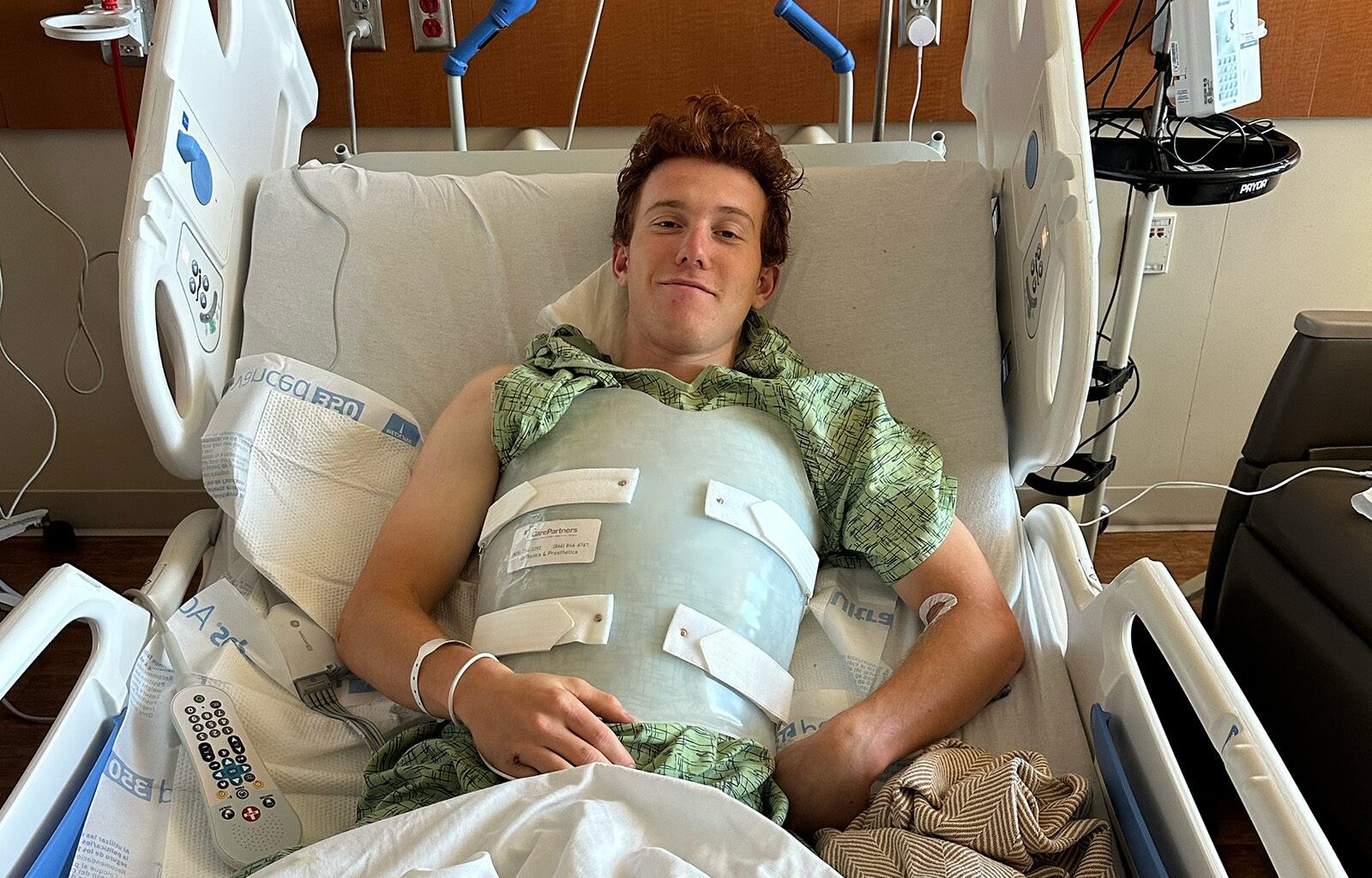
Two weeks ago, Owen Clark was exactly where he wanted to be.
The XC rider from King City, Ont., had just wrapped up his final year in under-23 with what he calls “an amazing season.” Racing for Pivot Cycles-OTE and carded with Cycling Canada, he pieced together his most consistent World Cup campaign yet.
His year started strong with a run of top-10s in the U23 men’s XCO World Cups, including 10th at the opener, sixth at round two, then 10th and 11th at rounds four and five. Late in the season he pushed even closer to the podium, taking fourth in XCO at Lake Placid and 13th in XCO at Mont-Sainte-Anne.
It was the kind of steady progression he has been building for years. Back in April he told me, “each year you learn a bit more. Especially at the world cups. It’s a different style of racing. It’s chaotic. You go from racing one or two guys in a Canada Cup to racing ten or more at once.”
By the end of 2025 he had proved he belonged in that chaos. He took sixth place at the Canadian Championships in XCO.
“Absolutely,” he said in the spring when I asked if going pro was the goal. “That’s the dream.”
Then a normal training ride in North Carolina changed everything.
A familiar road, a motorist he never saw
Clark is finishing his media and business degree at Brevard College in North Carolina, a school known for its cycling program. The crash happened there, on a road loop he has ridden “a million times.”
“It’s a normal training ride. It’s a straight section of road,” he says. “I was going like 42 kmph, I was going pretty quick. The road was kind of a false flat downhill.”
There was a car sitting patiently behind him, waiting for traffic to clear. Behind that car, an older driver in his 70s.
“The car directly behind me made this pass as normal cars would and just crossed over into the left lane and went around me,” Clark says. “The car behind that car just maybe accelerated forward straight. He didn’t realize I was there until the last minute and ran into me.”
Clark never saw it coming.
“I’m just riding and then all of a sudden I am bucked like I’m on a horse or something. I go kind of flying into the road,” he says. “I didn’t even see the car, because he was behind me.”
The impact launched him onto the hood. His bike went underneath.
“He said that I went up on his hood,” Clark says. “I got some really gnarly road rash on my butt and side up to my shoulder, so I think I just like launched off the car, landed in the seated position. I never rotated or rolled. Just landed on my butt on the pavement and slid for a good amount of time.”
The road bike did not survive.
“I fractured two vertebrae”
At first, adrenaline hid the damage.
“The adrenaline was so strong that I didn’t feel much, for the first 30 minutes,” Clark says. “First thing is like making sure my arms are still working, make sure my legs are still working, and then I was like, OK, all the major stuff is fine.”
He even stood up, then sat in the back of the driver’s car while they waited for the ambulance. In hindsight he laughs at the decision.
“Once I laid down on the stretcher, I didn’t move from that position for four days,” he says.
Scans at the hospital in Brevard revealed what he already suspected.
“I actually fractured two vertebrae,” Clark says. “The first one was T7. It was a compression fracture, but it was small, it was 10 per cent compression, which they considered to be insignificant.”
The second fracture was far more serious.
“And then I fractured my T12. The fracture went all the way through,” he says. “It wasn’t displaced, but because the fracture went all the way through, it meant it was extremely unstable.”
At first doctors debated whether to brace and wait or operate.
“You could not do surgery and then wear a brace for like two or three months,” Clark says of those early conversations. “And then hope it heals. But if it turns out at the end of those two-to-three months it didn’t heal properly, you’d have to do surgery anyways, and it could be much worse.”
After an MRI, the decision was made.
Rods, screws and walking the next day
Surgeons fused his spine two vertebrae above and two below the break.
“Yeah, they put in rods and screws. So basically they go in and they attached rods and screws to just kind of secure those bones together and then they put in the bone graft,” he says. “Over time, probably like three-to-six months, the bone will fuse into one bone, and then once that finishes, those rods are actually kind of useless.”
He is only two weeks out from surgery, but recovery has already surprised him.
“I was actually walking on day one after surgery, which was pretty, crazy,” he says. “Every day since then, it’s gotten easier and easier to do stuff.”
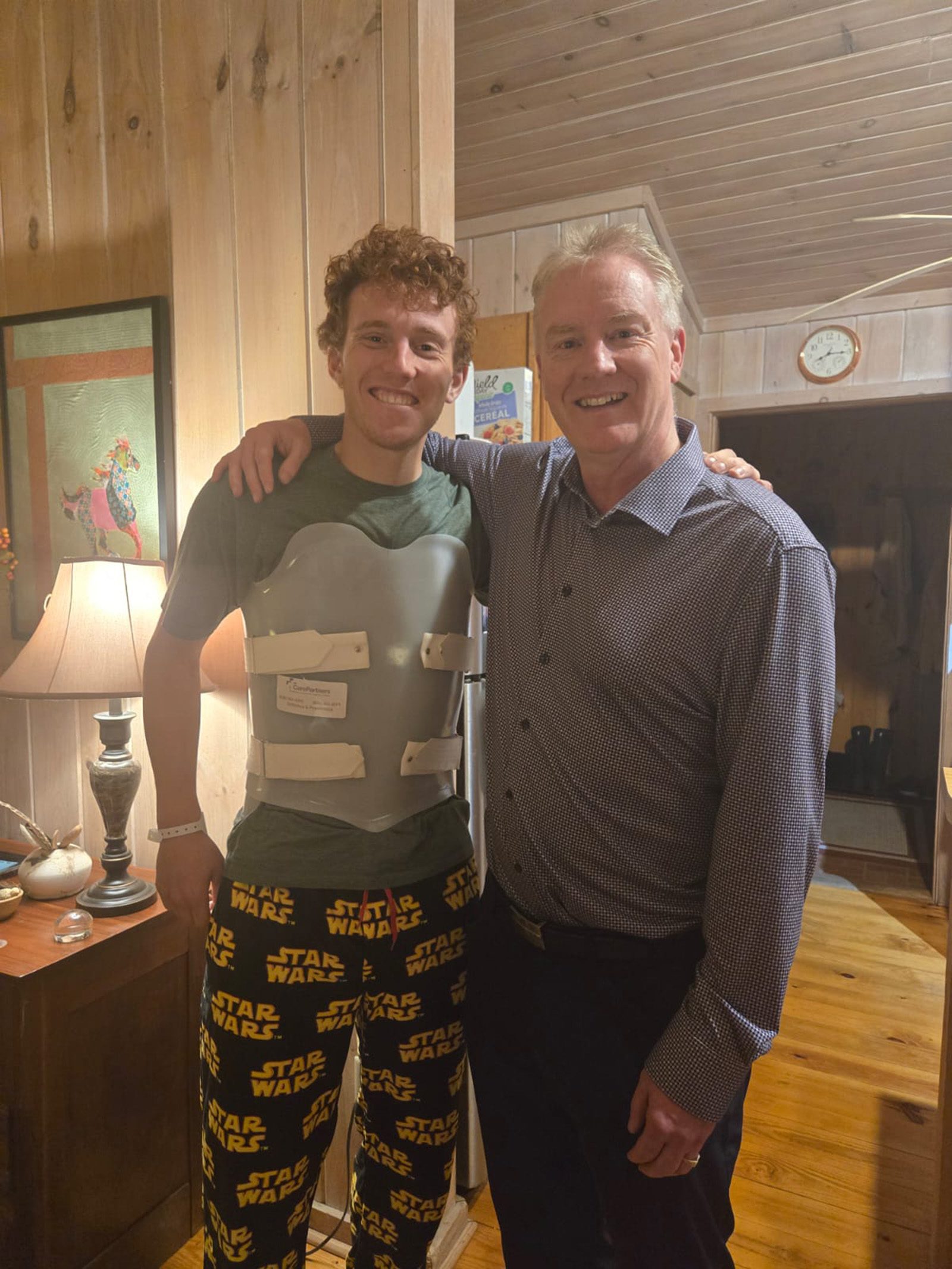
Now he wears a bulky brace all day and sleeps without it at night.
“I’m not on any painkillers, able to fully walk around. I can walk quite a bit. I can walk two hours in a day,” he says. “I’m not allowed to bend over, lift anything over ten pounds, and any kind of twisting.”
Sleeping is the hardest part.
“I’m the kind of person who normally moves around a lot when I sleep and I just can’t do that,” he says. “I’ll wake up in the middle of the night, kind of sore, so I’ll have to put the brace on, get up, and I’ll literally just walk around the house for ten minutes and then go back to sleep.”
Fear, perspective and the long road back
Being hit by a motorist is every cyclist’s nightmare. Clark is honest that the mental side is still a question mark.
“A couple of people have asked me that, and I mean, yes, for sure,” he says when I ask if he’ll be scared to ride on the road again. “I’m definitely gonna be planning routes a little differently and avoiding busy roads.”
“I think I’ll probably avoid riding alone as much as possible,” he adds. “Being two wide as much as possible forces cars to only pass when they actually can, be more visible, get a better light, stuff like that.”
On the mountain bike side, he is less worried.
“It’s not like my crash occurred during a mountain bike race, so I think I’d be totally fine to get back on the trails,” he says. “It wasn’t my mistake on a feature or anything like that.”
He expects to be on the indoor trainer as soon as the brace comes off, possibly four weeks after surgery. Riding outside will depend on how quickly the fusion sets and what his doctors allow.
“I think I’ll be able to return for the second half of the season pretty confidently,” he says. Even if it means six months inside. “I’ll have to mentally prepare myself for that, if it is the case where I’m locked inside for six months.”
“I’ve just kind of realized how fortunate I have been”
Through it all, Clark sounds remarkably calm for a rider whose last U23 year, ended on a straight stretch of asphalt.
“I’ve just been kind of dealing with it since. It was scary at first, but I’ve since just kind of realized how fortunate I have been about the whole thing,” he says. “I’m in a good place about it, I think.”
He knows the outcome could have been far worse.
“Knowing that eventually in not that long, I’ll be basically the same person I was before. That’s just helpful mentally,” he says.
His mom drove 13 hours from Ontario to North Carolina as soon as she heard. Friends, teammates and the wider community have checked in non-stop.
“I kind of have no choice but to make the effort to be positive about it or else you’re just moping, around,” he says.
For now, Clark is finishing his final semester online, shuffling between doctor’s appointments and short walks in his brace. The World Cup circuit and his first elite season will have to wait.
But if there is one thing his U23 career has shown, it is that he knows how to play the long game.
“The further up you move, the less chaotic it gets,” he told me back in April. “Then you can actually find your rhythm.”
He is starting from the bottom again. Different kind of chaos, same plan.