

 Transformation of 530 dwellings / Lacaton & Vassal + Frédéric Druot + Christophe Hutin architecture. Image © Philippe Ruault
Share
Or
https://www.archdaily.com/1035900/the-role-of-architects-is-shifting-from-solitary-visionaries-to-collective-activists
For a long time, architecture was understood as an essentially individual activity, dependent on the figure of a creative genius and centered on the ability to solve problems through drawing. Over time, this image began to fade. The protagonism once concentrated in a few names reached its peak during the era of the starchitects and gradually became distributed among offices, collectives, and multidisciplinary teams. Today, architects are expanding their boundaries into other fields such as gastronomy, music, design, and the corporate world, applying spatial thinking to address challenges of various kinds. As social, environmental, and political crises deepen, the role of the architect continues to evolve from a solitary author to a mediator, activist, and collective agent of transformation. This shift reflects an ethical awakening and a recognition that design, regulation, and care are inseparable dimensions of contemporary practice.
 Still from the documentary To Build Law, 2024 © CCA_STILL
“When architects work collectively, they move from being isolated authors to becoming part of a shared process of transformation”, says Alina Kolar, campaign manager of HouseEurope!, a citizens’ initiative that received the 2025 OBEL Award for its advocacy of the Right to Reuse across the European Union. The campaign argues that existing buildings should be prioritized over new construction, reducing unnecessary demolitions and promoting the rehabilitation of the built environment. This year marked a turning point for the Foundation, as it was the first time the OBEL Award was granted to a movement rather than a single office or project. As stated by the Foundation, “This angle is exciting for us because it is the first time we have awarded a movement and a call to action that extends beyond architects, urban planners, or people in the building sector. It speaks to every European citizen and invites everyone to play a role in shaping the future. Awarding HouseEurope! truly embodies what OBEL stands for.”
Architects are not just service providers. They are mediators between policy, space, and society. Activism in this field means translating values into structure, into contracts, codes, and timelines. Pragmatism begins where ideals are made operational. – Alina Kolar, Campaign Manager on HouseEurope!
 Demolition Protest © houseeurope.eu
HouseEurope! emerged as a collective act of advocacy, founded by a group of architects, urban planners, activists, and economists. It represents a shift in how architects engage with public life. Faced with the urgency of climate goals and the increasing loss of existing buildings, the group mobilized their professional expertise beyond the boundaries of the discipline, translating spatial thinking into political action, drafting legal frameworks and public campaigns that argue for the Right to Reuse across Europe. The proposal seeks to make the reuse of existing buildings a legal presumption, ensuring that what already stands is considered first, both as a cultural and carbon resource. HouseEurope! demonstrates how architects can act as civic agents, shaping not only spaces but the systems and policies that define them.
This arrives at a decisive moment. Climate goals demand not only technological innovation but also a profound change in how we measure value and impact. “If we truly want to reduce emissions, we must extend life cycle assessments to include the CO₂ already spent. The impact of yesterday must become the value of tomorrow,” says Kolar. By redefining renovation as both an environmental and economic opportunity, the campaign positions reuse not as an exception but as a right, while emphasizing the need for architects to act as translators between disciplines, aligning design intelligence with fiscal and legal frameworks.
 Transformation of 530 dwellings / Lacaton & Vassal + Frédéric Druot + Christophe Hutin architecture. Image © Philippe RuaultCollaboration as a New Form of Authorship
This expanded role of the architect requires new forms of collaboration with other fields. “Architecture has never been an individual act,” Kolar reminds us. “Everything we build is the outcome of many forms of knowledge, labor, and, at best, care.”
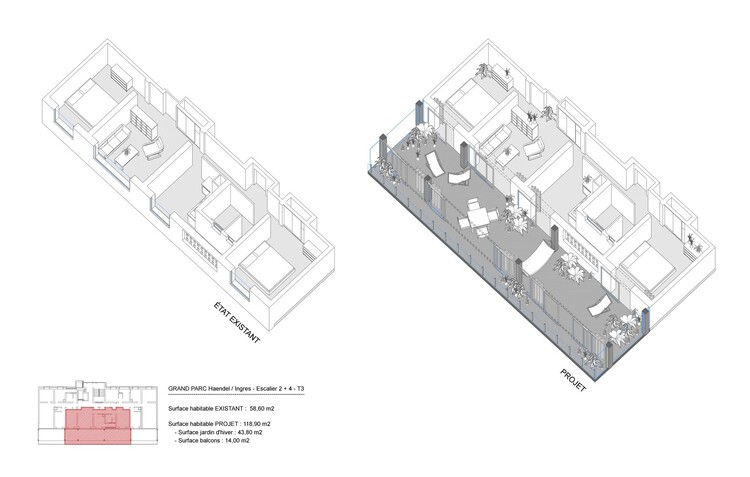 Transformation of 530 dwellings / Lacaton & Vassal + Frédéric Druot + Christophe Hutin architecture. Image © Philippe Ruault
 Transformation of 530 dwellings / Lacaton & Vassal + Frédéric Druot + Christophe Hutin architecture. Image © Philippe Ruault
The renovation of the Cité du Grand Parc in Bordeaux, designed by Lacaton & Vassal, Frédéric Druot, and Christophe Hutin, perfectly embodies this principle. Completed in 2017, the project avoided the demolition of three social housing blocks from the 1960s, preserving and improving 530 units. The architects adopted a strategy of generous addition instead of replacing the existing structures: new balconies and winter gardens were integrated into the façades, increasing living space, enhancing thermal comfort, and allowing residents to remain in their homes throughout construction.
 Transformation of 530 dwellings / Lacaton & Vassal + Frédéric Druot + Christophe Hutin architecture. Image © Philippe Ruault
By revaluing what already existed, once stigmatized and seen as no longer meeting the demands of contemporary life, the team demonstrated that social, environmental, and financial goals can converge in a single architectural gesture. The project became a manifesto showing how renovation can be a democratic, ecological, and economically intelligent alternative to demolition. As the architects describe it, the Grand Parc is “a scalable reference,” a model capable of inspiring public policy and design practices that view existing buildings not as constraints but as opportunities for urban and human regeneration.
 European Quarter Bruxelles, 2025 © houseeurope.eu
What unites these approaches is a redefinition of care as something actionable. “The task is to make care executable, to turn sustainability into procedures and imagination into public good.” This shift from ideal to implementation reveals a broader transformation in the profession: architects as stewards of existing value, facilitators of collective intelligence, and advocates for the longevity of what has already been built. Perhaps the greatest contribution of architecture today lies not in creating the new, but in learning to see and act upon what is already before us.
HouseEurope! continues to work toward making this idea a public policy, inviting architects, citizens, and governments to join the Power to Renovation movement, which seeks to make reuse a requirement before demolition. Learn more and sign the petition at houseeurope.eu.