
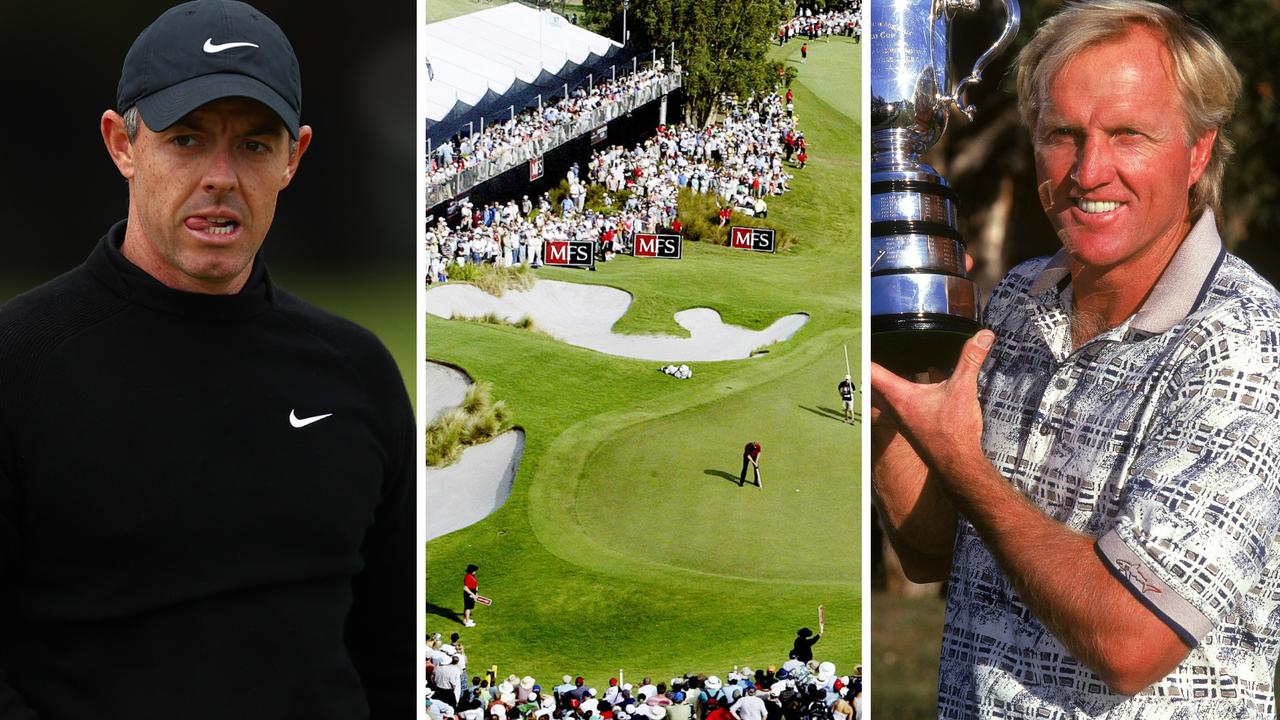
Australian Open week kicked off on Monday with a 30-second piece of art to send shivers down every golf fan’s spine.
The setting sun shimmers over Royal Melbourne’s breathtaking undulations. The fairways are pristine. The bunkering is exquisite. The images simply iconic.
All this while a band performs a dramatic cover of Bitter Sweet Symphony, with drums pounding and violins stirring.
Watch the 2025 Australian Open LIVE on Kayo Sports 4-7 Dec | New to Kayo? Join now and get your first month for just $1.
Think US Open TV previews at Shinnecock Hills and Oakmont, or even the Masters at Augusta National.
This event simply has major written all over it, too.

AUS OPEN LIVE: Worth the wait! Rory stuns in epic return; Masters champ’s opening hole horror show
***
Except, it doesn’t. Never has. Not literally anyway.
The reality of the Australian Open is that, for the better part of half a century, it has been drastically underappreciated by golf’s US elite.
The Australian Open’s heyday saw legends from home and abroad eager to duke it out on these shores for the Stonehaven Cup.
Engraved on the coveted silverware are the names of international golfing royalty in Jack Nicklaus, Arnold Palmer, Gary Player, Tom Watson, and Australian heroes Peter Thomson and Greg Norman.
In 1971, Nicklaus walked off the 18th green at Royal Hobart with a third Australian Open won and — in total admiration for the event — crowned it as the world’s ‘fifth major’.
With fields as strong as they were, and the courses among the world’s best, it’s little wonder it was so highly revered.
But today, lip service on how great Australian courses are, and how nice the country is, is about all we have come to expect from the world’s top players not from Down Under.
MORE AUSTRALIAN OPEN
RM FEATURE: The world is obsessed with this ‘special’ Aussie treasure… which terrifies legends
‘I THINK ABOUT IT A LOT’: Legends re-live iconic duel as Rory opens up on Aussie ‘crossroads’ moment
TEE TIMES: Rory joins Aussie superstars in blockbuster group as Aus Open tee times revealed
Rory McIlroy could be the catalyst to take the Australian Open back to its glory days.Source: Getty Images
As for putting their money where their mouth is with an actual appearance?
Coming back for the Australian Open has long been a bridge that is, quite literally, too far.
Nicklaus, Player and Palmer’s involvement was largely tied to an endorsement deal with Dunlop and Slazenger, which held a large portion of the golf equipment market in Australia.
When that arrangement ended, it was left to Norman to headline the event in the mid-to-late 80s and into the 90s. That trend of Australians being forced to lead the way has continued since, with it becoming less and less appealing for international stars to make the trip, notwithstanding the incentive of a large, government-backed cheque.
LIV ace Joaquin Niemann was the only high-profile international player on the mens side of the tournament, while not even Adam Scott — soured by the convoluted format — could stomach the trip back.
The Australian Open was undoubtedly wounded, but never lost its pulse.
Organisers listened to the overwhelming negative feedback, particularly from players, and have acted in emphatic fashion.
Big names? The chequebook was thrown at securing Rory McIlroy, golf’s biggest drawcard since prime Tiger Woods. The megastar tees it up alongside a returning Scott, other Australian drawcards like Cameron Smith and Min Woo Lee, plus the likes of world No.54 Si Woo Kim add to a greater international feel.
A fitting venue? Royal Melbourne, considered by some as the greatest golf course in the world, is back to host the Australian Open for the first time since 1991.
The next one? Kingston Heath, which McIlroy says is even better.
A return to Royal Melbourne has been seen as pivotal.Source: AAP
Meanwhile, both the mens and womens events have reverted to the stand-alone tournaments they both deserve.
And there are some serious stakes involved with, for the first time ever, a Masters invite on the line, plus three spots at next year’s Open Championship at Royal Birkdale.
Make no mistake, this year’s event is marks the first meaningful step back towards the Australian Open’s glory days.
Could it ever be seen as the ‘fifth major’ again?
“I think it can move in that direction,” Adam Scott told foxsports.com.au this week at Royal Melbourne.
“I think there’s a thirst for international golf at the moment and we’re lucky to have a guy at the top of the game like Rory, who’s a really international player and believes in that, and he’s carrying a lot of that weight on his shoulders. His support is huge.
“We have the venues to handle it. I wouldn’t be surprised if there were more big names queuing up to come next year after what they see this week.”
‘SHOULD BE A FIFTH MAJOR’
The days leading into this year’s event have made it clear that the Australian Open, particularly one staged at Royal Melbourne, commands respect worldwide.
PGA Tour insider Dan Rapaport thrust this year’s event into the US golf news cycle this week when he declared the Australian Open as the game’s “sleeping giant”.
Nonetheless, he lamented that more superstars aren’t joining McIlory in the trip to the Melbourne sandbelt.
“One of the best golf courses on Earth. It’s a historic event in an amazing golf area… and just three of the top 50 players in the world are teeing it up,” he wrote.
“As change continues across tours, the Australian Open is a sleeping giant that must be elevated in world golf.”
Golf YouTube star Rick Shiels also spotlighted the event, writing: “Rory McIlroy has arrived at Royal Melbourne, one of few places in the running for best golf course on earth.
“Jack, Arnie, Player, Watson, and Norman all won the Australian Open. Can Rory help bring this historic event back to its deserved stature?”
As far as starting points go, the arrival of McIlroy at Royal Melbourne is about as good as it gets.
Granted he’s being paid an undisclosed — yet, surely, sizeable — appearance fee to play, but this is McIlory walking the walk.
The talking came last year when McIlroy spoke about the potential for the US stranglehold on world golf to be broken up with more international events.
In his wide-ranging chat, he dropped a suggestion that no Australian fan has been able to forget.
“The Australian Open, for example, should almost be the fifth major,” he said.
“The market down there is huge with potential.
“They love golf. They love sport. They have been starved of top-level golf. And the courses are so good.”
Cameron Smith and Adam Scott are among the big names back.Source: Getty Images
On Wednesday, he doubled down on his love for Australia, saying: “It feels like this country is kind of starved of top level golf.
“Of course you’ve had Presidents Cup and you’ve had a lot of good players still come through, but maybe on a consistent basis, a market like this with amazing fans and the history that it does have probably deserves more of a consistency of big players and big tournaments.”
McIlroy isn’t alone in spruiking the immense potential of the Australian Open.
Both Scott and Smith on Tuesday paid credit where it was due, praising the decision to listen to players by reverting to a stand-alone tournament at a revered venue.
In turn, they believe that the buzz about the Australian Open is back among players.
“Everyone’s talking about the Aussie Open again, which is what we wanted,” Smith said
“We wanted it back at Royal Melbourne, and we wanted it to be an event where international stars come down and compete and make it the event that it once was, so I think we’re on the right track.
“It’s a tournament that I desperately want to win, and then you get the course vibe with it as well. It’d be a pretty special thing to win an Aussie Open around Royal Melbourne for sure.”
Scott said that Golf Australia deserved credit for trying something different with its mixed format, but also deserved recognition for scrapping it.
“Hopefully this is a sign of things to come to the Aussie Open and living up to the history that it already has,” Scott said.
Of the tournament, he added: “It probably is more appealing, certainly for international players, to come down to play.
“Obviously, Rory is on board, and he’s coming off the back of an incredible year, so that’s very timely for the event, and coming to this venue is creating a lot of hype as well.
“Certainly outside Australia, it’s been a talking point on tour most of the year, and you’ll see some players who have obviously asked for invites and are coming down to play.”
Arnold Palmer tees off in the Australian Open in 1966.Source: News Corp Australia
THE US ISSUE
With McIlroy committing, the Australian Open has suddenly exploded.
General admission tickets for the weekend are sold out, with 100,000 people expected to attend across all four days.
Tournament director Antonia Beggs told Front Office Sports that “everything that was last year has probably multiplied by about 5 or 10 times.”
This falls in line with the 2019 Presidents Cup in which rowdy galleries witnessed a Tiger Woods masterclass in a thrilling 16-14 US triumph.
The Internationals may have lost, but fans did not leave Royal Melbourne that weekend feeling defeated.
Furthermore, the course — 15,000 kilometres from PGA HQ in Florida — heaved and did not even remotely look out of place as the centre of the golfing world, even if for just one week.
But this isn’t about the appetite of fans, or the quality of venue. It never has been.
It’s about the players.
And in a new golfing landscape, in which the emergence of LIV Golf has exploded prize pots on either side of the game’s great US-international divide, neutral markets like Australia are left with only a knife at a gun fight.
There are many reasons why a trip to Australia in December is unpalatable for most of the world’s best golfers, and most of them are commercial.
Between January and September every year, both the PGA Tour and LIV Golf offer players wealth that would’ve went beyond their wildest dreams when they first turned pro.
Adding in a trip to the other side of the world for a relative pittance — the Australian Open prize pot is A$2 million compared to A$30m for a PGA Tour signature event — is simply not needed financially.
World No.1 Scottie Scheffler spoke for many earlier this year when he explained that there are no hard feelings towards playing golf outside of the US, but it just isn’t a priority.
“I think the greatest competition we have right now in the game of golf is the PGA Tour and playing in the States,” Scheffler said.
Adam Scott v Rory McIlroy in 2013 | 03:00
“I’m starting a young family, and travelling across the world to play golf would be great, but at the end of the day, that’s not my priority nor my responsibility.”
And fair enough.
Making the Australian Open’s battle for strong fields even steeper is the fact that, despite taking place in December, it still faces fierce competition from rival events.
In fact, this week has been described by Dylan Dethier of Golf.com as “the strangest week of the pro golf schedule”.
That’s because conflicting with the Australian Open is Tiger Woods’ tournament in the Bahamas featuring Scheffler, the Hero World Challenge, and South Africa’s Nedbank Golf Challenge, which features Viktor Hovland and offers a prize pool worth more than four times what’s on offer in Melbourne.
“What does all of this mean?” wrote Dethier. “Mostly it’s a reminder that there are more competing interests than ever from across the globe for these guys’ time and talents.
“Sure, we’re in a PGA Tour off-season lull, but there’s more of everything else than ever.”
Greg Norman with his third Australian Open at Royal Melbourne.Source: Herald Sun
CAN THE DOMINOES FALL FOR AUSTRALIA?
So, is there a world in which the Australian Open’s resurgence can take it all the way back to its place as world golf’s unofficial fifth major?
Granted, such a lofty standing still feels an age away from here, but the rapidly shifting landscape of golf and the massive power shift towards players offer a plausible route that didn’t exist four years ago.
Before LIV Golf arrived, the PGA Tour schedule was exploding. In fact, it didn’t even end with a wraparound schedule pushing players towards playing more golf, more often, in America.
Now, with players presented with an alternative to the US circuit, there suddenly exists the potential for the opposite — less golf, for more money, and in other places should players desire.
New PGA Tour chief Brian Rolapp used his first public address to make a statement that hinted towards fewer events and a simplified schedule.
US star Harris English last week hinted that a new schedule may not start until more than a month later, after the Superbowl.
“(Rolapp is) seeing the PGA Tour in a different light,” English said. “Sometimes change is good.
“I get that they want all the best players playing together more often, and the talk of the Tour potentially starting after the Super Bowl I think is a pretty good thing because we can’t really compete with football. So we’ll see where it goes.”
Why is this important for the Australian Open?
A wider PGA Tour off-season would, in theory, allow more calendar space for the biggest international tournaments to find their spots without conflict.
Granted doing so would require collaboration between competing organisations, but given the DP World Tour co-sanctions both the Australian Open and the Nedbank Challenge, it’s not out of the realm of possibility that a compromise is struck.
That leaves Woods’ Hero, which — being an invitational and not an official Tour event — does not technically need to hold a rigid place in the schedule. With Woods being a golfing behemoth in and of himself, should he fancy a new slot, it would be so.
McIlroy said that as a result of the conflicts, all three tournaments don’t get the attention they deserve, particularly the Australian Open.
Smith ‘frustrated’ ahead of Aus Open | 02:33
“I think this tournament, in particular, because of the history, because of the tradition, deserves to be a stand-alone tournament,” he said. “A week on its own.
“Hopefully, one day the powers at be can put together a schedule where the biggest and best tournaments in the world, the oldest and the ones with the most heritage can be elevated and stand on their own.”
If the Australian Open was to find clearer air, organisers keep luring at least one superstar through a handsome appearance fee, and pathways into the majors continue, then other dominoes could topple.
There’s a feeling that if it’s good enough for McIlroy, then why not for others?
“McIlroy’s appearance, combined with recent developments in the golf world, makes the prospect of restoring Australia’s place in global golf feel much more realistic than it has in years,” Joseph LaMagna of popular podcast Fried Egg Golf wrote.
“Reports of a shrinking PGA Tour schedule, along with a recent announcement by Augusta National and the R&A to reward national open winners, should help rebalance a sport increasingly dominated by an American footprint.
“A few years from now, we could very well find ourselves back in the familiar position of wishing more top talent would venture to Australia, without any practical solution in sight for bringing that ideal to fruition.
“But whatever the future of Australian golf brings, this week marks a clear and significant victory for the sport.”
— Additional reporting Dane Heverin