
Aileen Moynagh,Health reporter,
Jessica Lawrenceand
Rory O’Reilly,BBC News NI
 PA Media

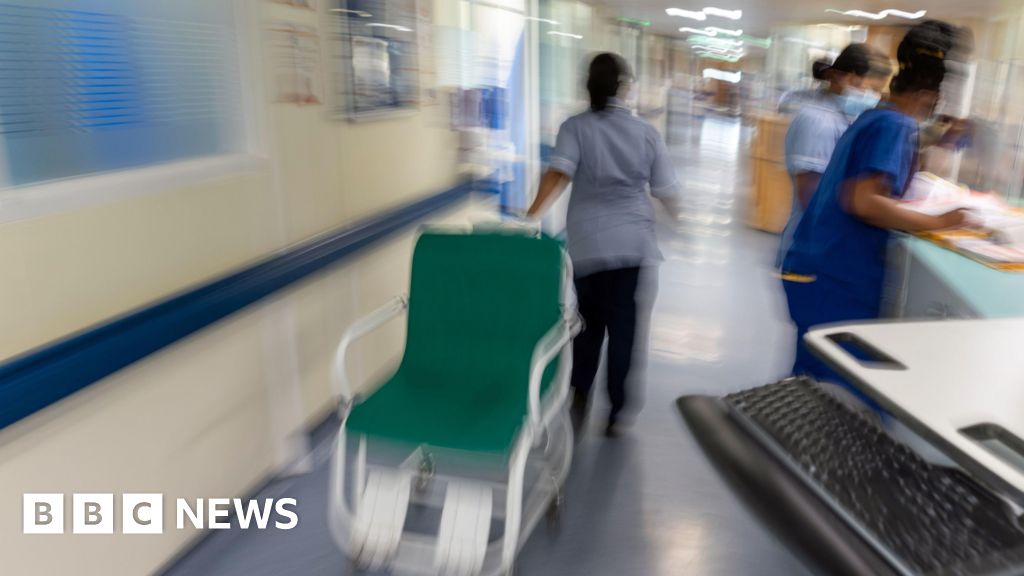
Patients at the emergency department at Craigavon Area Hospital faced average waits of almost 19 hours
A senior health official has apologised after patients faced average waits of almost 19 hours at Craigavon Area Hospital’s emergency department (ED) on Wednesday morning.
Emergency department average waiting times released at 09:00 GMT show the Royal Victoria and Ulster hospitals also experiencing waits of about nine hours.
Dr Gareth Hampton, divisional medical director at the Southern Trust, said staff were under pressure to balance critically ill patients with those who have been waiting the longest.
“We really are sorry for the patients who wait that long but the staff have a really difficult job,” he said.
The figures come after reports of more than 40 ambulances waiting for release outside hospitals on Tuesday – with the longest wait in excess of 13 hours.
In October, a target to reduce maximum ambulance waits outside EDs from four hours to two by 1 December was announced as part of a plan to tackle winter healthcare pressures.
‘Serious pressures’ on emergency departments
Speaking to BBC Radio Ulster’s Evening Extra programme, Dr Hampton said a 19-hour wait was “not something we want to have” but staff were waiting for beds to become free in wards so patients could be admitted.
“Over the last three years we’ve seen serious pressure on our emergency departments,” he added.
“Whenever we get to the winter time increased respiratory issues such as Covid and flu just put that extra bit of pressure.
“We really struggle to cope with peaks of demand.”

Dr Gareth Hampton from the Southern Trust apologised for the time patients had to wait in Craigavon ED
Dr Hampton thanked staff who were working “above and beyond”, but said the issue was not isolated to Craigavon’s ED.
He urged younger people who are normally fit and well and develop flu-like symptoms to stay at home, to not come to EDs unless absolutely necessary, and to use services like Phone First.
The Public Health Agency (PHA) said there had been a large increase in flu cases in the past two weeks – with the highest amongst the 0-4 age group
Dr Peter Naughton, a health protection consultant with the PHA, said the flu season started earlier this year, and there had been a higher number of cases.
“Last week, we saw about 900 new cases of flu, which was about double what we had seen the previous week,” he told BBC News NI.
“Of those [900], about 250 people ended up in hospital because of flu, which again was about a 50% in what we had seen in the previous week.”
BBC News NI understands that there are 30 adults hospitalised in Craigavon Area Hospital with flu.
Demoralised staff

Dr Michael Perry said the current conditions were not acceptable
Royal College of Emergency Medicine Vice President, Dr Michael Perry, said staff were demoralised and angry over the current pressures.
“I’m a clinician and I want to be treating the sickest patients that come into our department,” he added.
“We’re being asked to make the least worst decisions at the minute.”
Dr Perry said the demoralisation among nursing staff was also causing problems around retention.
“If you can get out of this environment, what’s to keep you here? Because there is no light.”
Dr Clodagh Corrigan, deputy chair of the British Medical Association NI council and emergency medicine doctor in the Southern Trust, said she wanted to help patients as quickly as possible.
“The thing that I hate most about my job is when my hands are tied,” she told the BBC’s Evening Extra.
“I’m looking at a waiting room full of patients, and then I’m looking at a department full of patients and I literally have no where to go and nothing that I can do to ease the pressures.
“When you’re in that absolute gridlock there’s absolutely nothing you can do, and it is completely soul-destroying.”
Ambulance delays
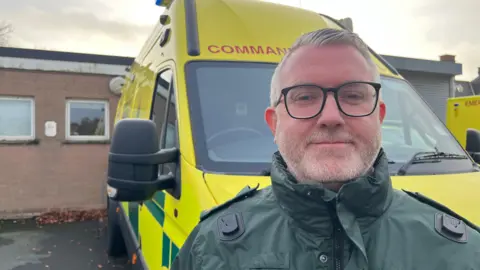
Seasonal illness, such as flu and Covid, are increasing pressures on ambulance services, Neil Sinclair said
Neil Sinclair, Northern Ireland Ambulance Service (NIAS) director of operations, said that it was experiencing “increased demand which is outstripping our capacity”, mainly emanating from seasonal illnesses.
He said on Wednesday afternoon, there were 80 patients waiting for an ambulance and 66 in attendance at incidents – 32 of which are at emergency departments.
Mr Sinclair said the service’s plans were “not working as effectively as they could” due to the increased demand.
“I think at present we are experiencing more flu and Covid than anticipated, and therefore demand is outstripping capacity.
“If things do not improve, then our response times to patients will become longer, they are already in a very challenging situation and it’s going to be very difficult to manage if things become worse.”
Earlier, the NIAS said delays were “a result of challenges being felt across the entire HSC system and the impact of trade union action short of strike”.
NIAS said it recognised the impact these delays have on patients and families and “regrets the lengthy waits that some have experienced”.
It said “significant work” had been undertaken across the health and social care system in recent months to reduce handover delays.
“While these actions have contributed to some stabilisation, the system continues to operate under very high pressure,” a NIAS spokesperson said.