
You can count down the hours, almost to the minute, until Formula 1 will learn the identity of its 2025 world champion.
This isn’t always the way in grand prix racing. In fact it’s the exception rather than the rule.
It’s rare for the F1 world title to make it all the way to the final round. It’s happened only twice in the last decade and 31 times in the sport’s 75-year history.
This year’s 76th drivers world title will be just its 32nd final-race decider.
Fox Sports, available on Kayo Sports, is the only place to watch every practice, qualifying session and race in the 2025 FIA Formula One World Championship™ LIVE in 4K. New to Kayo? Join now and get your first month for just $1.
It means we can say with near certainty that at around 1:30am Monday (AEDT) the points will be tallied for the final time this season and a world champion will be crowned — assuming no 2021-style post-race controversy ensues of course.

But the rarity of this year’s showdown is enhanced by the composition of its protagonists.
While the title makes it to the final round just 41 per cent of the time, only 11 seasons in F1 history — around 15 per cent of all titles — have featured three or more drivers still in contention at the death.
With leader Lando Norris, reigning champion Max Verstappen and rising star Oscar Piastri separated by just 16 points after 23 rounds of racing, this weekend’s grand prix is already a historic occasion.
There is one other remarkable statistic that comes with the peculiarity of having three or more drivers in the mix at the final round.
At more than half of those deciders — six occasions from the previous 11 — the driver leading the championship at the start of the weekend has lost the title.
The last two of those, in 2010 and 2007, serve as cautionary tales for McLaren and Norris — and potential boosts for Piastri.
On both occasions it was the driver ranked third who walked away with the prize.
PIT TALK PODCAST: McLaren manages to turn an easy Oscar Piastri victory into a Max Verstappen cruise, hurting the Australian’s title campaign and cutting Lando Norris’s lead to 12 points over the Dutchman. With three drivers now in contention, what are the permutations for this weekend’s Abu Dhabi Grand Prix?
VETTEL STUNS SHORT-SIGHTED WEBBER, ALONSO IN 2010
Abu Dhabi hosted its first championship decider in 2010, just its second season on the calendar.
It had been a chaotic season featuring six different championship leaders and 10 changes in the title lead.
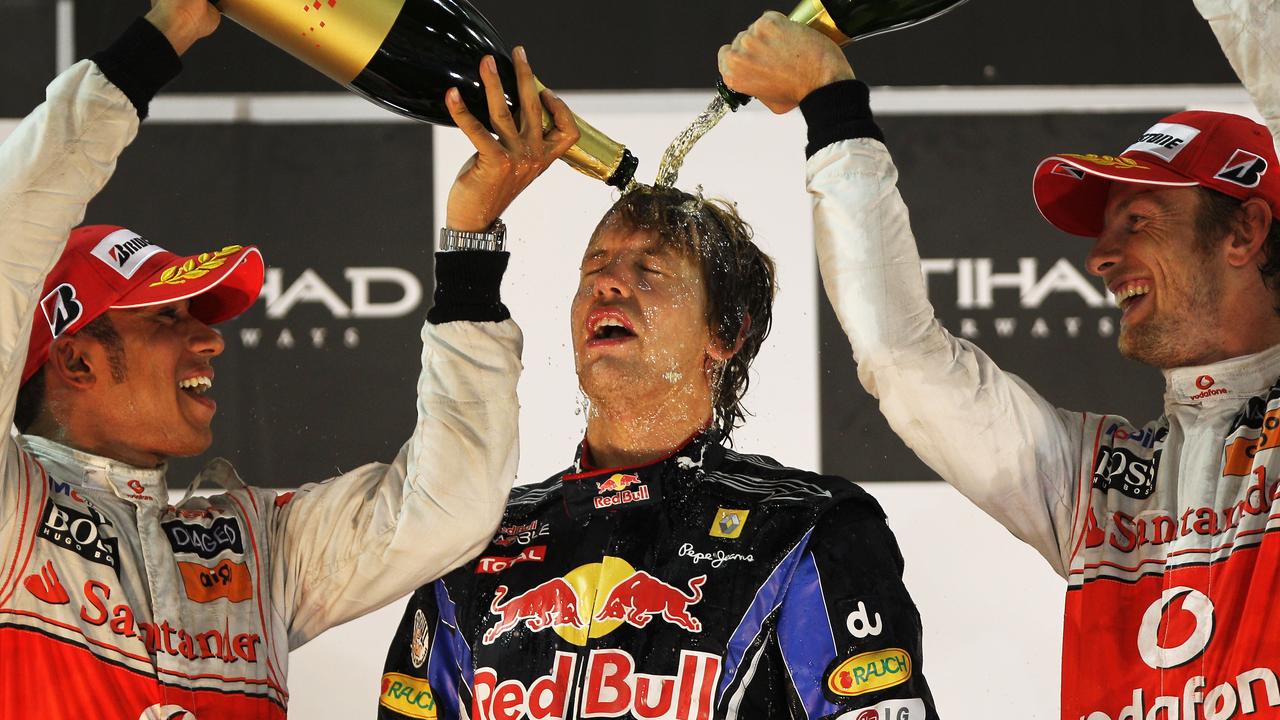
Those six drivers boiled down to an F1-first four contenders at the final race: Fernando Alonso, Mark Webber, Sebastian Vettel and Lewis Hamilton.
Title standings, 2010, one round remaining
1. Fernando Alonso: 246 points
2. Mark Webber: 238 points (-8 points)
3. Sebastian Vettel: 231 points (-15 points)
4. Lewis Hamilton: 222 points (-24 points)
Hamilton’s challenge was really only theoretical. Despite leading the series for five rounds in the middle of the year, his campaign faded late, and his 24-point deficit needed all three drivers ahead of him to suffer some sort of catastrophe.
Alonso, Webber and Vettel, however, were all considered genuine threats.
Webber had led the standings late but went winless in the last seven rounds, and a disastrous crash in the Korean Grand Prix saw Alonso take top spot for the final two weekends, having won three of the previous four grands prix.
Vettel, though, was the form man heading to Abu Dhabi. He’d won two of the previous three races, with only an engine failure at the third-last grand prix in Korea breaking the streak.
He’d been on track to win in Yeongam when his engine popped, costing him 25 points that would have seen him, not Alonso, lead the championship for the final two races.
His good form played a role in Red Bull Racing refusing to back Webber as its preferred champion heading into the decider, though it seemed clear ahead of the weekend that the Spaniard and the Australian were the feature battle, with Vettel an outsider.
How much that narrow focus played into the outcome of the race is up for debate.
ABU DHABI FINALE
Secret order Piastri may need to follow as hidden landmines laid bare — Every F1 title scenario
McLaren’s Piastri rap sheet laid bare — and the murky waters it was never going to avoid
The call that could cost McLaren the title — and how Red Bull plans to exploit it
Max’s fourth teammate in two seasons as Red Bull swing axe, new driver joins F1
Vettel took pole with Hamilton second, Alonso third and Webber fifth, behind Jenson Button.
The championship deciding move, however, was executed by none of the main players.
Michael Schumacher spun his Mercedes at the first chicane, and he was collected by Force India’s Vitantonio Liuzzi in a frightening over-under crash on the first lap.
Given the lack of tyre degradation, the ensuing safety car prompted several drivers to pit, including Renault’s Vitaly Petrov, who rejoined at the back of the pack with a strategy that would see him gain places as others pitted.
Webber, racing in fifth, from where he stood no chance of winning the title, stopped early, on lap 11, after reporting struggles with his tyres. It was more hopeful than calculated, and it dropped him behind Petrov.
Ferrari, its eyes only on Webber, responded four laps later. It pitted Alonso, who rejoined just ahead of the Australian but also behind Petrov.
It was a disastrous outcome for both.
The Renault was quick in a straight line, and the original Abu Dhabi layout was dire for overtaking before the introduction of the DRS. They were stuck behind Petrov for the rest of the race, Alonso and Webber’s positions topping out at seventh and eighth respectively.
Vettel, meanwhile, bided his time in the lead. When he made his stop on lap 24, he rejoined second behind only Button, who hadn’t yet pitted. He retook the lead when the Briton took his service on lap 39.
Victory was enough for him to clinch the championship by four points while Alonso toiled three places and 13 seconds behind fourth place, which would have been enough for him to win it.
Title standings after Abu Dhabi 2010
1. Sebastian Vettel: 256 points
2. Fernando Alonso: 252 points (-4 points)
3. Mark Webber: 242 points (-14 points)
4. Lewis Hamilton: 240 points (-16 points)
Red Bull axe Tsunoda in favour of Hadjar | 00:33
It’s a fascinating story to consider on the eve of this year’s title showdown, the first since 2010 to feature three or more drivers in the mix.
The first lesson is a reminder of Abu Dhabi’s poor layout, barely becoming of a venue that is guaranteed to host any last-race title deciders.
The advent of DRS and layout changes made in 2021 have helped matters somewhat, but overtaking still comes at a premium, and a high-grip, low-degradation surface means a one-stop strategy is usually guaranteed without unusual circumstances.
It highlights the importance of nailing the strategy. Even without pointing to McLaren’s fumbling in Qatar, the team’s task is complicated by having to strategise for two drivers in a way that’s both fair and also gives both a shot at winning.
Red Bull Racing will simply look to get the most from Verstappen’s weekend.
But it’s also a lesson in where to look from the pit wall.
Alonso lost the title because Ferrari was too fixated on Webber and lost focus on Vettel.
It’s a cautionary tale for Norris and Verstappen. They’re each other’s biggest threats, but they’re not the only ones in the mix.
If they get too distracted by each other — a risk for Norris, who showed in Vegas that the Dutchman is always top of mind for him — Piastri could find conditions ripe to repeat Vettel’s feat in 2010.
He is, after all, a similar number of points behind — 16 to Vettel’s 15 — and, like the German, is in just his third full-time Formula 1 season.
The odds are against him, but history tells us he cannot be counted out.
‘She got it right’ Schmitz celebrated | 01:10
FERRARI STUNS McLAREN IN BRAZILIAN SHOWDOWN IN 2010
While it’s been 15 years since the 2010 four-way decider, that year’s climax came only three years since the sport’s previous three-car fight in 2007.
The 2007 season has been held up repeatedly as a close parallel for this season — a year in which the close competition between the McLaren drivers has allowed a third party to catch up late and make a lunge for the prize.
That year it was Hamilton and Alonso who were teammates at McLaren, while the interloper in what was expected to be a straight fight between them was Ferrari’s Kimi Räikkönen.
Title standings, 2007, one round remaining
1. Lewis Hamilton: 107 points
2. Fernando Alonso: 103 points (-4 points)
3. Kimi Räikkönen: 100 points (-7 points)
It’s hard not to immediately spot the parallels between that year and this season.
Hamilton had his first chance to clinch the championship at the penultimate round in China, but a strategy error saw his squib the chance, keeping the title live until the final round.
That strategy error, believe it or not, was the Briton being pitted early enough, albeit in wildly different circumstances and with a far more significant outcome — his wet tyres, worn down to the canvas on a drying track, locked up as Hamilton turned into pit lane, beaching his McLaren at pit entry and putting him out of the race.
Räikkönen won ahead of Alonso to send the season to its Brazilian Grand Prix decider.
This was under the old points system, which awarded 10 points for victory. We can multiply the gaps by 2.5 to come up with a rough approximation of what the standings would look like in today’s money: Alonso would have been 10 points behind and Räikkönen 18 points adrift.
It’s remarkably similar to today’s gaps of 12 points and 16 points for Verstappen and Piastri respectively.
Brown and Piastri’s awkward moment | 00:17
Hamilton qualified second ahead of Räikkönen and Alonso, but the title leader got a dreadful start that dumped him to eighth, while a gearbox-related electronics problem subsequently had him tumbling down to the back of the field.
Ferrari turned out to be the race’s dominant car, and Räikkönen, behind teammate Felipe Massa, sprinted away to a comfortable lead. The Finn took first from the out-of-contention Brazilian in the second stops to maximise his points haul, but Massa held second comfortably ahead of Alonso in third.
Those positions would be enough to ensure Räikkönen would vault Alonso in the standings so long as Hamilton recovered to no higher than sixth.
His electronics problem solved, Hamilton switched to an aggressive three-stop strategy and climbed rapidly up the order, but he fell short by two places and 10 seconds.
Räikkönen, who had come within three points of being eliminated from contention just two rounds earlier, walked away with the title from third on the table. To this day he’s Ferrari’s most recent world champion.
Title standings after Brazil 2007
1. Kimi Räikkönen: 110 points
2. Lewis Hamilton: 109 points (-1 point)
3. Fernando Alonso: 109 points (-1 point)
Piastri reacts to Qatar chaos | 01:25
McLaren CEO Zak Brown made comparisons between this season and 2007 as early as May, when he declared he would rather McLaren lose the drivers championship again than choose a number one driver between Piastri and Norris.
He’s reiterated that point several times since, including in recent weeks, when Verstappen’s threat turned from theoretical to imminent.
But there is one important lesson that has been learnt from 2007.
While the points are similar, the circumstances are not. Hamilton and Alonso were locked in a fractious duel that saw the Spaniard quit the team after only one season. It wasn’t simply the points they lost battling each other that cost them a chance to shut Räikkönen out of the fight; their various toxic skirmishes and lack of co-operation left the door open to Ferrari to pinch the title at the end.
McLaren has gone out of its way, sometimes excruciatingly so, to maintain harmony and ‘fairness’ between its drivers this year.
That’s not only meant the team has held itself together, but it could be crucial in Abu Dhabi if the moment comes that McLaren needs Piastri to sacrifice himself for Norris to win the title — as it surely will do in the final laps if it can prevent Verstappen from walking away with the trophy.
There’s no scenario in which Alonso would have obeyed such an order to help Hamilton in 2007, but in 2025 McLaren could still have that option up its sleeve.
But championship deciders have a habit of laying waste to a team’s best-laid schemes.
McLaren and Red Bull Racing will prepare for as many scenarios as possible, but this weekend it would be best to expect the unexpected.