
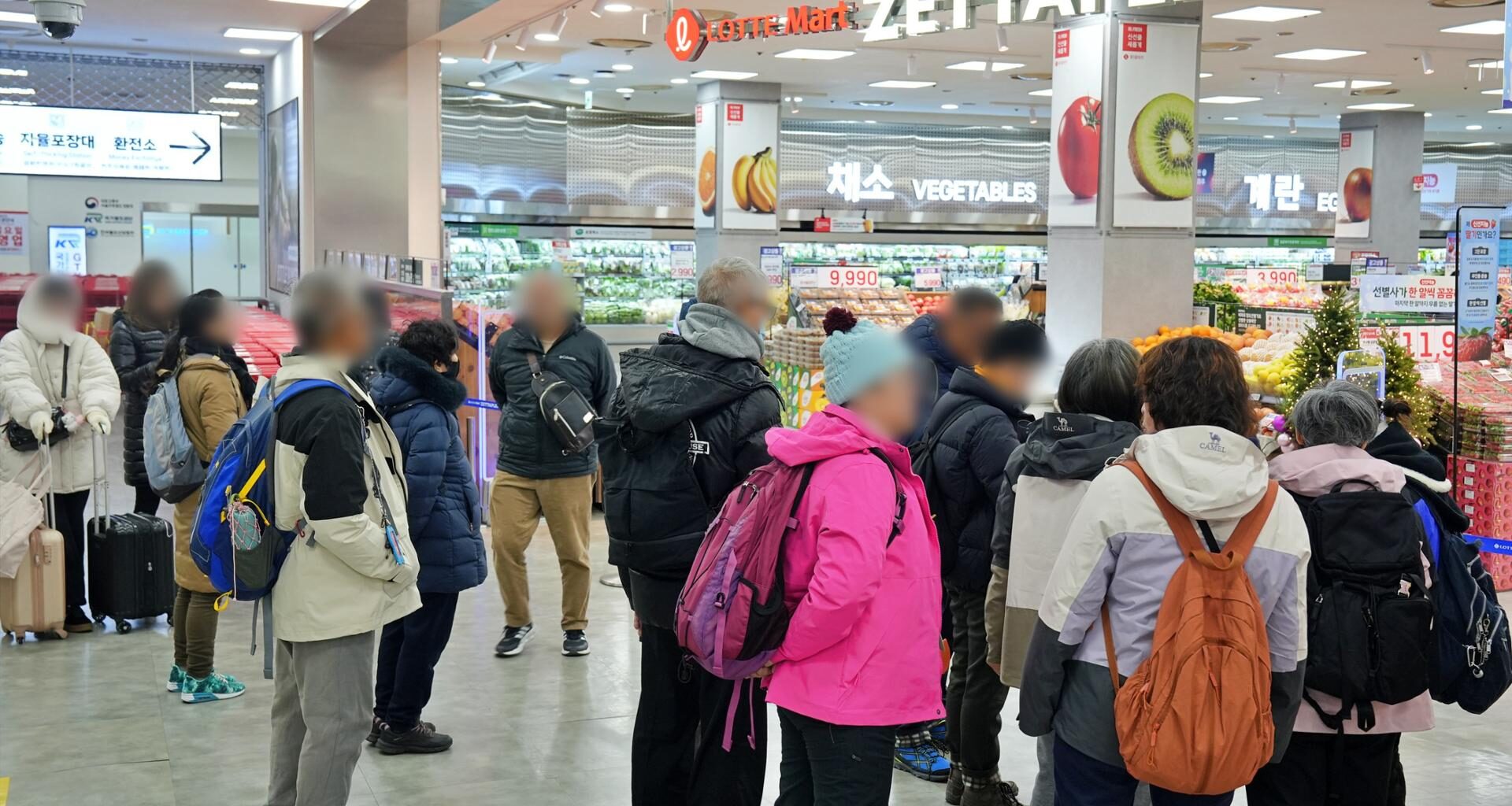
Customers wait for a Lotte Mart branch to open in Seoul, Thursday. Yonhap
Baik Seung-ki, a salaried worker in his 40s, says his monthly income has risen steadily over the past couple of years, but the amount left for spending is growing at a slower pace after covering his basic living costs.
“I guess it’s because of unavoidable costs like taxes, social insurance, utilities and staple foods are rising faster than my income, shrinking the money I have available for savings or other discretionary spending,” he said.
Baik’s view aligns with the data released by the Federation of Korean Industries (FKI) Thursday, which shows that fixed baseline expenses outpaced wage growth from 2020 to 2025, adding to the financial strain on so-called “glass-wallet workers.”
In Korea, “glass-wallet workers” are salaried employees whose income is fully transparent to the government and subject to payroll tax deductions, unlike self-employed individuals or business owners.
During this period, average monthly wages rose at an annual rate of 3.3 percent, from 3.52 million won ($2,380) to 4.15 million won.
By contrast, earned income tax and social insurance contributions deducted from paychecks increased at an annual rate of 5.9 percent, from 448,000 won to 596,000 won.
As a result, the combined share of earned income taxes and social insurance contributions in wages increased from 12.7 percent to 14.3 percent, constraining take-home pay growth to 2.9 percent annually and resulting in a final 2025 monthly net income of 3.55 million won.
“With take-home pay rising just 2.9 percent while wages climb 3.3 percent, it’s no wonder many employees feel their paychecks aren’t stretching as far as they used to,” said Shin Se-don, professor emeritus of economics at Sookmyung Women’s University.
The FKI data also showed that rising prices for groceries and other essential living costs — increasing an average of 3.9 percent annually from 2020 to 2025 — have cut into the money that workers feel they have available for daily expenses.
By category, the biggest increases were in water and utilities at 6.1 percent, food and nonalcoholic beverages at 4.8 percent, dining out at 4.4 percent, transportation at 2.9 percent and housing at 1.2 percent.
At a more detailed level, 17 of 23 items experienced price increases that outpaced the 3.3 percent wage growth, with particularly steep rises in refined oil products at 10.6 percent, gas at 7.8 percent and electricity at 6.8 percent.
“These expenses are difficult to cut back on and therefore leave little room for discretionary spending, adding to the financial pressure on glass-wallet workers,” Shin said.
Additionally, the professor noted that a weakening of the Korean won, along with the government’s fiscal stimulus policy, is further eroding workers’ spending power.
He explained that the local currency has hovered over the concerning 1,400 won per dollar level, increasing the cost of essential imports like crude oil and contributing to price rises across a broad spectrum of goods.
Regarding fiscal stimulus, the professor added that prices are also rising due to an abundant flow of cash, including 13.2 trillion won in voucher-based handouts and coupons meant to spur spending in the second half of the year.