
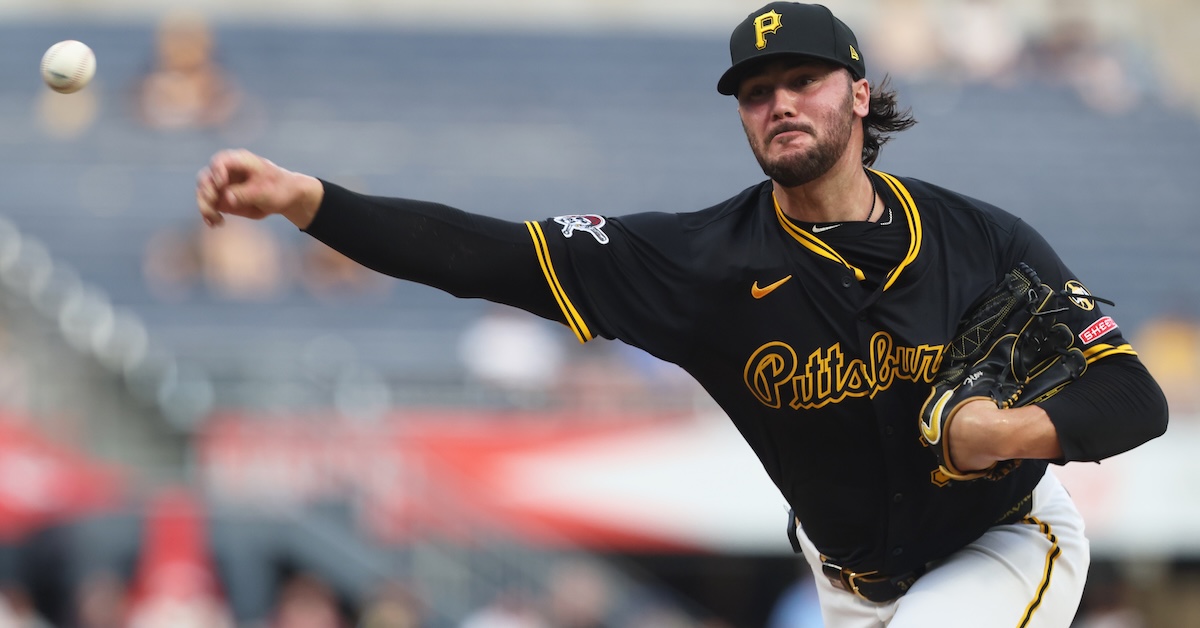
 Charles LeClaire-Imagn Images
Last week, MLB announced the distribution of the pre-arbitration bonus pool. You probably saw roughly one headline from this: Paul Skenes earned a record $3,436,343 bonus for his spectacular sophomore season. That is indeed great news, in my opinion. Skenes was one of the most exciting and best players in baseball in 2025, and a compensation system that more closely aligns skill with salary is a no brainer to me. But while Skenes’ record haul drew the headlines, the vast majority of the $50 million pool was spread widely; 101 players received bonuses, with all 30 teams boasting at least one awardee.
I’m here to tell you that I think this is a wonderful development. The fund, established in the most recent collective bargaining agreement, takes in $1.67 million from each team every year to fund its $50 million payout. It hands some of that money out to award winners, from $2.5 million for Skenes’ Cy Young Award win down to $150,000 for Daylen Lile’s fifth-place Rookie of the Year finish. The rest goes to the top 100 pre-arbitration players in a WAR formula jointly calculated by MLB and the MLBPA according to a set ratio.
This didn’t feel like a huge part of the CBA at the time it was signed, but in my opinion, it’s been an incredible boon for the game. Baseball’s compensation system has always been out of whack. The service time system limits all pre-arbitration players to the minimum salary, more or less. Teams do occasionally award salaries slightly greater than the minimum ($760,000 in 2025), but generally by a de minimis amount: The Pirates paid Skenes $875,000 this year, for example.
That flat structure means that under the old system, Skenes would have earned roughly $1.6 million in 2024 and 2025, instead of the $7.2 million he’s pocketed under the new system. You can’t convince me that that’s a bad thing. Cristopher Sánchez is an even better example, because unlike Skenes, he didn’t have a huge signing bonus as an amateur — not to mention all the ancillary income the Pittsburgh superstar earns through his various endorsement deals as one of the most recognizable players in the sport. Sánchez just eclipsed three years of service time; through the end of 2024, the Phillies had paid him around $2.5 million in salary for his first two-plus major league seasons. He signed a contract extension that paid him $3.55 million in 2025, bringing his career contractual earnings up to roughly $6 million. Thanks to the bonus pool, though, he’s received an additional $3.5 million over the last three years. That’s a huge difference, and in a clearly good direction for money to flow.
You can think of the bonus pool as a subsidy to teams who play young players. By funding the bonus pool evenly across all 30 teams instead of making the club employing each player responsible for paying the bonus, teams who employ a host of great pre-arb players can have it all: They contribute a set amount, but their pre-arb contributors get paid more fairly.
Take the Brewers, for example. Though Skenes got the largest individual bonus, Milwaukee took the most bonus money home as a team. Ten Brewers received a cumulative $4,742,392 in bonuses, led by Brice Turang with $1.15 million. That was only the ninth-highest individual award; the Brewers simply had a ton of plus contributors in the pool. Here’s a list of the bonus pool broken down by team:
You Aren’t a FanGraphs Member
It looks like you aren’t yet a FanGraphs Member (or aren’t logged in). We aren’t mad, just disappointed.
We get it. You want to read this article. But before we let you get back to it, we’d like to point out a few of the good reasons why you should become a Member.
1. Ad Free viewing! We won’t bug you with this ad, or any other.
2. Unlimited articles! Non-Members only get to read 10 free articles a month. Members never get cut off.
3. Dark mode and Classic mode!
4. Custom player page dashboards! Choose the player cards you want, in the order you want them.
5. One-click data exports! Export our projections and leaderboards for your personal projects.
6. Remove the photos on the home page! (Honestly, this doesn’t sound so great to us, but some people wanted it, and we like to give our Members what they want.)
7. Even more Steamer projections! We have handedness, percentile, and context neutral projections available for Members only.
8. Get FanGraphs Walk-Off, a customized year end review! Find out exactly how you used FanGraphs this year, and how that compares to other Members. Don’t be a victim of FOMO.
9. A weekly mailbag column, exclusively for Members.
10. Help support FanGraphs and our entire staff! Our Members provide us with critical resources to improve the site and deliver new features!
We hope you’ll consider a Membership today, for yourself or as a gift! And we realize this has been an awfully long sales pitch, so we’ve also removed all the other ads in this article. We didn’t want to overdo it.
2025 Pre-Arb Bonus Pool by Team
Team
Players
Bonus
MIL
10
$4,742,392
PIT
5
$4,362,309
ATH
4
$3,103,411
PHI
1
$2,678,437
CHC
3
$2,548,721
BOS
5
$2,303,753
HOU
1
$2,206,538
ARI
3
$2,117,416
MIA
6
$1,976,000
TBR
4
$1,963,124
DET
6
$1,914,238
KCR
4
$1,909,309
CIN
4
$1,766,368
SEA
2
$1,762,742
ATL
3
$1,732,122
STL
5
$1,527,976
NYY
5
$1,486,327
TEX
4
$1,300,082
CHW
4
$1,231,452
WAS
3
$978,527
SDP
3
$925,033
BAL
2
$874,269
CLE
3
$860,536
TOR
3
$775,998
LAA
2
$756,247
LAD
2
$761,948
SFG
1
$494,307
COL
1
$460,214
NYM
1
$270,987
MIN
1
$209,217
For the first time, all 30 teams had at least one player receive a bonus. Yet, for the most part, the bonus pool has flowed to teams who fill their roster with young productive players. Those teams are a mixed bag of small-market strivers and big-budget teams with good player development systems:
Pre-Arb Bonus Pool by Team, 2022-2025
Team
2022
2023
2024
2025
Total
BAL
$3,306,145
$7,257,343
$3,838,270
$874,269
$15,276,027
SEA
$3,953,499
$4,098,252
$2,842,742
$1,762,742
$12,657,235
MIL
$821,328
$1,080,357
$4,465,828
$4,742,392
$11,109,905
HOU
$4,714,235
$1,728,513
$1,554,930
$2,206,538
$10,204,216
CLE
$3,825,033
$3,145,116
$2,057,316
$860,536
$9,888,001
ARI
$2,809,839
$2,558,203
$2,127,172
$2,117,416
$9,612,630
PIT
$643,435
$1,489,432
$2,882,298
$4,362,309
$9,377,474
KCR
$926,241
$1,525,402
$4,948,427
$1,909,309
$9,309,379
ATL
$2,915,872
$2,662,099
$632,821
$1,732,122
$7,942,914
TBR
$2,455,631
$2,924,147
$0
$1,963,124
$7,342,902
ATH
$439,755
$1,011,273
$2,564,069
$3,103,411
$7,118,508
DET
$293,739
$2,271,815
$2,259,378
$1,914,238
$6,739,170
STL
$2,811,595
$778,171
$1,433,521
$1,527,976
$6,551,263
CIN
$947,108
$2,143,712
$1,390,620
$1,766,368
$6,247,808
CHC
$824,606
$2,199,080
$667,851
$2,548,721
$6,240,258
BOS
$245,152
$1,015,788
$2,462,659
$2,303,753
$6,027,352
TOR
$4,035,334
$516,590
$487,594
$775,998
$5,815,516
NYY
$1,539,831
$246,549
$2,319,056
$1,486,327
$5,591,763
PHI
$304,294
$1,438,281
$1,141,671
$2,678,437
$5,562,683
TEX
$855,683
$2,205,744
$702,019
$1,300,082
$5,063,528
LAD
$2,459,017
$986,983
$586,051
$761,948
$4,793,999
MIN
$795,132
$2,085,595
$1,564,758
$209,217
$4,654,702
CHW
$2,979,410
$356,317
$0
$1,231,452
$4,567,179
MIA
$622,043
$1,303,326
$653,453
$1,976,000
$4,554,822
LAA
$1,657,217
$536,825
$705,665
$756,247
$3,655,954
SFG
$900,540
$666,778
$1,577,638
$494,307
$3,639,263
WAS
$517,840
$608,194
$1,114,321
$978,527
$3,218,882
SDP
$679,340
$0
$1,191,534
$925,033
$2,795,907
COL
$0
$809,831
$1,212,391
$460,214
$2,482,436
NYM
$0
$350,284
$615,947
$270,987
$1,237,218
From a qualitative perspective, this bonus pool has been a huge success. It’s paying the most underpaid class of major league contributors, and the way it’s allocating the money seems broadly intuitive. Is it the right amount of money, though? To do that, I had to do a little bit of math. I took salary and WAR data for 2019-2025 and grouped players by their contractual status. I used both Cot’s Contracts and RosterResource to harmonize my sources; contract data can be difficult to come by.
The proportion of WAR created by pre-arb, arb, and post-free-agency players has been fairly constant over the past seven years. (Note: I excluded the abbreviated 2020 season from my calculations because it was just so weird.) Dividing the era into old CBA and new CBA, you can see that the overall proportion of WAR coming from players who haven’t yet reached free agency has remained roughly the same, though with more pre-arb and fewer arb players:
Share of WAR by Service Time Group, 2019-2025
Group
Old CBA
New CBA
Pre-Arb
38.40%
40.70%
Arb
33.44%
30.46%
Free Agent
28.16%
28.83%
In terms of contractual salaries, the share of money going to pre-arb players hasn’t increased much:
Share of Contracted Salary by Service Time Group, 2019-2025
Group
Old CBA
New CBA
Pre-Arb
14.20%
14.48%
Arb
25.16%
24.18%
Free Agent
60.64%
61.35%
That means that in terms of dollars paid per WAR accrued, pre-arb players have seen their salaries increase at a lower rate, relative to the WAR they rack up, than free agents. Here’s that formula turned into dollars per WAR; the pre-free-agent group combining pre-arb and arb has seen its $/WAR increase by about 19% in the new CBA, as compared to 17.9% for free agents:
Contracted Salary per WAR by Service Time Group, 2019-2025
Group
Old CBA
New CBA
Increase%
Pre-Arb
$1,500,135
$1,711,416
14.1%
Arb
$3,012,109
$3,832,994
27.3%
Free Agent
$8,690,899
$10,245,360
17.9%
These numbers don’t include the new bonus pool. On-field value is still measured the same way, but after adding the bonus money to pre-arb players, total outlay looks more balanced:
Share of Salary Plus Bonus by Service Time Group, 2019-2025
Group
Old CBA
New CBA
Pre-Arb
14.20%
15.36%
Arb
25.16%
23.93%
Free Agent
60.64%
60.71%
In terms of dollars per WAR, things look even better. With the bonus money taken into account, players who have yet to reach free agency have seen their $/WAR increase by 22% under the new CBA, much better than the 19% that they would have realized without this addition:
Salary Plus Bonus per WAR by Service Time Group, 2019-2025
Group
Old CBA
New CBA
Increase%
Pre-Arb
$1,500,135
$1,834,735
22.3%
Arb
$3,012,109
$3,832,994
27.3%
Free Agent
$8,690,899
$10,245,360
17.9%
In other words, the bonus pool is doing exactly what it was supposed to, increasing salaries to the players who have historically been less compensated per contribution than their tenured compatriots. I think it could be expanded even more, in fact, or broadened to include players already eligible for arbitration. The exact mechanics are open to change, and I’m not particularly tied to the WAR calculation or the structure of award compensation, but it seems clear to me from the salary data that the general goal of the pre-arbitration bonus pool is being fulfilled.