
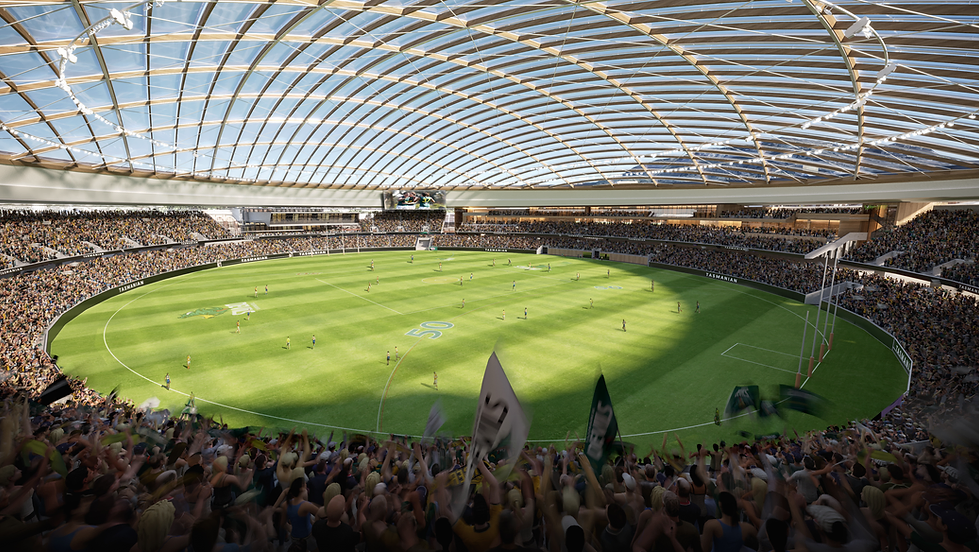
Tasmania’s parliament has voted to approve a new waterfront stadium, which paves the way for the Devils to join the AFL and AFLW competitions in 2028
A render of the proposed new stadium at Macquarie Point in Hobart. Picture: Macquarie Point Development Corporation
A $1.13 BILLION AFL stadium has been given the official tick of approval by Tasmania’s parliament, green-lighting the Devils entry into the AFL and AFLW.
The Macquarie Point 23,000-seat roofed venue was voted through the island state’s upper house of parliament at 11pm AEDT on Thursday following two days of debate.
Key independents on Wednesday declared they would support the project, ending years of speculation about how the vote would play out.
Construction of a stadium at the site is a condition of the Devils’ licence to join the national competitions in 2028.
AFL CEO Andrew Dillon hailed it ‘a historic day’ for Tasmania and the competition.
“This is an incredibly important outcome for everyone who has worked tirelessly to see a Tasmanian footy club compete on the national stage, and for the hundreds of thousands of Tasmanians who have stood behind the Devils with such passion and pride,” he said in a statement on Thursday night.
Hobart’s proposed AFL stadium at Macquarie Point. Picture: Macquarie Point Development Corporation
“Creating a new AFL/AFLW club from scratch is no small task, there is much still to be done by the club to be ready for 2028. However, given the progress to date we could not be more confident that the Devils will make an immediate impact on the AFL/AFLW in 2028.”
Premier Jeremy Rockliff, who inked the contract with the AFL, has championed the venue as once-in-a-generation and an economic driver.
“The Tasmanian Devils and aspiration for young people has brought it to this point where we’re going to get the job done,” he said in the lead-up to the debate.
The vote was 9-5, with four independents, three Liberal and two Labor MPs voting in favour.
Tasmanian Premier Jeremy Rockliff speaks with media during the AFL Tasmanian Team Announcement at North Hobart Oval on May 03, 2023. Picture: AFL Photos
Critics have said the stadium isn’t the right priority amid ballooning budget debt, while a peak planning body recommended it not go ahead because its costs outweigh its benefits.
The government has agreed to cap its spend at $875 million as part of a deal for the support of key upper house independent Bec Thomas.
Ms Thomas was briefly in tears during the debate, saying community opposition was valid.
“I am genuinely sorry to those who desperately did not want me to support this,” she said.
A concept design of how the stadium and associated developments might look. Picture: Macquarie Point Development Corporation.
“I really hope that you can come to understand the reasons for my decision and you can see the work I have put in to try to make the best of a bad situation.”
The government also agreed to boost local sporting funding and increase oversight of the project as part of the deal with Ms Thomas.
Independent Dean Harriss, also considered a crucial vote, gave his support after getting commitments from the government that it was “fair dinkum” about budget repair.
An estimated 15,000 people turned out to a pro-stadium rally on Sunday, while the Devils have pushed on with building a club during the political turmoil.
The Tasmania Devils’ inaugural jumper during the club’s launch at Paranaple Convention Centre on March 18, 2024. Picture: AFL Photos
Upper house Greens MP Cassy O’Connor, who voted against the stadium, said Australia’s smallest and poorest state had been shafted by the AFL.
Mr Rockliff said the stadium design could be tweaked to keep the stadium within the $875 million budget.
The stadium’s cost has already blown out from an initial $715 million estimate. Mr Rockliff once pledged the state wouldn’t contribute “one red cent more” than $375 million.
Additional state funding for the stadium would require the approval of both houses of parliament.
The AFL is contributing $15 million to the build, while the federal government is chipping in $240 million for the site.