
On the banks of the Lhara Pinta (Finke River) in Central Australia in 1940, Western Arrarnta landscape painter Albert Namatjira began building a two-room home of sandstone and lime with an iron roof, planting watermelon crops around it. The house stands today, and artist Tony Albert, who only recently discovered its existence, says it is a “fantastic destination” that anyone can visit.
“I couldn’t believe this house Albert had built,” he says. “I’ve lined up in the street just to visit Frida Kahlo’s house [La Casa Azul, in Mexico City] and likewise Albert’s house needs to be much better recognised.”
Albert Namatjira’s house on Lhara Pinta/Finke River, Ntaria/Hermannsburg. Photograph: Reproduced with permission from Tjuwanpa Outstation Resource Centre
The famous watercolourist was permitted to build his modest home on his Country at Ntaria/Hermannsburg, in which he lived until 1950, but he was later denied applications to purchase a Northern Territory grazing lease and to build a home in Alice Springs because he was Aboriginal.
Now, at the National Gallery of Australia, the Namatjira house has been remade almost to scale in multicoloured stained glass depicting the artist’s story and Country, as part of the 5th National Indigenous Art Triennial, which has been curated by Albert and opens this weekend.
Artists from the Hermannsburg Potters and Iltja Ntjarra Art Centre, with House of Namatjira. Photograph: National Gallery of Australia
The glasshouse is “lit from within, almost like this breath or this heartbeat”, notes Albert as he walks past it and through the exhibition, declaring this home the show’s heart and soul.
A collaboration between Canberra Glassworks and the Iltja Ntjarra Art Centre in Mparntwe/Alice Springs, the glasshouse is part of a bigger multigenerational project here that represents 57 artists from Namatjira’s family and community in one room. They include the Hermannsburg Potters, who have recreated objects from Namatjira’s house in painted clay: his boots, usually left at the front door; his brushes and his easel; his handwritten letters.
House of Namatjira inside the triennial. Photograph: National Gallery of Australia
Such cultural and political regeneration is reflected in work throughout the triennial, expressing hope despite the failed Indigenous voice to parliament bid. “It feels, after the referendum, as if everything has been burnt down,” says Gumbaynggirr artist Aretha Brown who, at 25, is one of the youngest artists ever invited to exhibit. “But now the seeds are going to come back stronger and greener.”
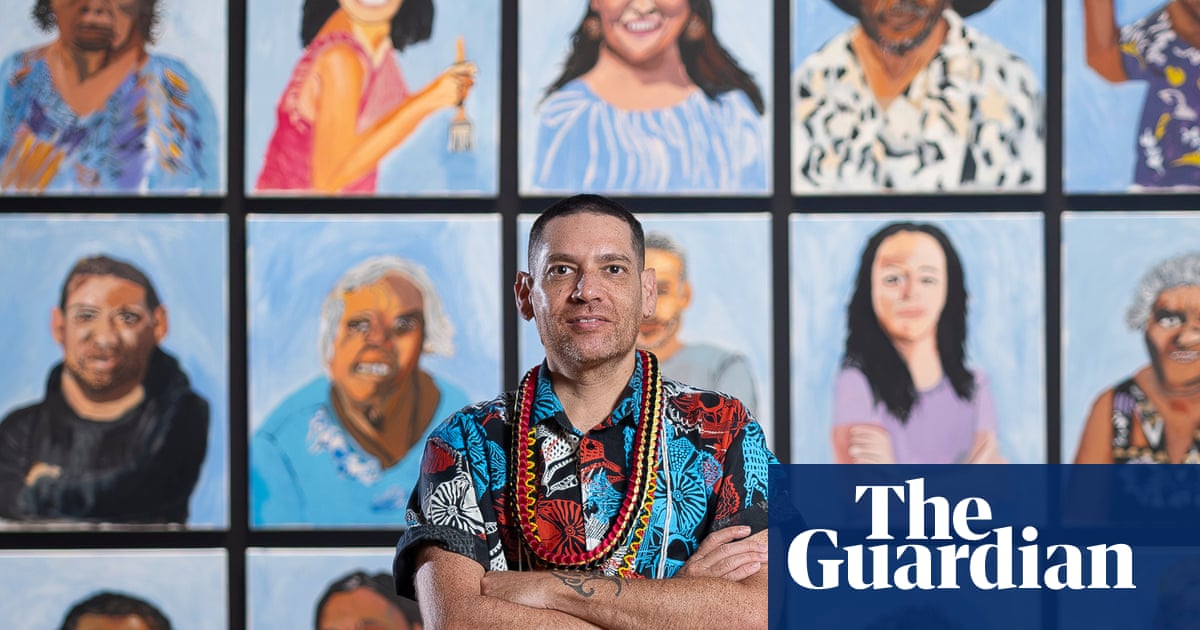
Brown’s massive semicircular black and white mural greets visitors to the triennial, with a timeline from the British ships arriving in Australia in the late 18th century to the referendum in 2023. Vincent Namatjira – great-grandson of Albert Namatjira and the first ever Indigenous winner of the Archibald prize – has painted 15 individual portraits of the triennial artists (as well as a large canvas of his famous great-grandfather on Country wearing a robe and crown topped with the Aboriginal flag).
Vincent Namatjira with his painting Royal Albert, (2025). Photograph: National Gallery of Australia
When he first discussed curating the triennial, Albert says he questioned the NGA’s commitment to it with gallery director Nick Mitzevich: why was a show billed as a triennial being held only every five years? (Previous iterations were held in 2007, 2012, 2017 and 2022.)
“This is the first triennial starting three years since the last one,” Albert says. “As First Nations people, I feel it makes us look a bit silly, the fact we’ve got this triennial that never happens every three years [until now].”
Mitzevich, appointed in 2018, has committed to hold the triennial every three years, says a NGA spokeswoman, adding a planned 2020 iteration was delayed for two years by the Covid pandemic.
In choosing the fifth triennial’s theme After the Rain, Albert says he opted for “poetics over the academic”, with artist responses ranging from “absolute optimism and positivity” to acknowledgment that rain “can be flood, devastation and chaos”.
Warraba Weatherall with his work Mother-Tongue. Photograph: National Gallery of Australia
Kuz/Peiudu artist Jimmy John Thaiday’s video work Just Beneath the Surface meditates on unpredictable rain patterns and rising tides, in a plea to save the Torres Strait Islands from erosion. Filmed from a bird’s eye view of the waters off Erub, “ghost nets” abandoned by fishing vessels prove a menace to marine life but are salvaged by Erub artists to make artworks such as Thaiday’s totem, the waumer (frigatebird), which are suspended from the gallery ceiling.
In one sombre room, Kamilaroi artist Warraba Weatherall’s installation links environmental destruction to the suppression of cultural knowledge, with a film depicting deforestation projected from a height on to nine gray autopsy tables adorned with Kamilaroi kinship designs, with shallow troughs that would normally catch a corpse’s blood.
Weatherall at work. Photograph: National Gallery of Australia
The title of Weatherall’s work, Mother-Tongue, alludes to Kamilaroi language often sharing words between the anatomies of a tree and a human. “Skin is yulay, and bark is the same word,” Weatherall says. “[But] I don’t want to be too didactic and spell it out [in the installation] because our knowledge systems have been so bastardised [by linguists] that many people within community have a different perspective.”
skip past newsletter promotion
Sign up to Saved for Later
Catch up on the fun stuff with Guardian Australia’s culture and lifestyle rundown of pop culture, trends and tips
Privacy Notice: Newsletters may contain information about charities, online ads, and content funded by outside parties. If you do not have an account, we will create a guest account for you on theguardian.com to send you this newsletter. You can complete full registration at any time. For more information about how we use your data see our Privacy Policy. We use Google reCaptcha to protect our website and the Google Privacy Policy and Terms of Service apply.
after newsletter promotion
At 38, Weatherall is following the cultural legacy of his father, Uncle Bob Weatherall, a leader in repatriating Indigenous ancestral remains. Now a father himself, the artist sometimes questions whether art can create the big, tangible change he seeks for his people. He wants to maintain his art practice, but has a lot of “big ideas and plans” in education, too, having this week submitted his PhD on Kamilaroi kinship, knowledges and language at Griffith University, where he lectures. “If you really want to create change – what is the potential of an Indigenous-led university?” he says.
Thea Anamara Perkins’ Still I Rise. Photograph: National Gallery of Australia
Familial and cultural legacies are another thread through the Triennial. Arrernte/Kalkadoon artist Thea Anamara Perkins, 33, has contributed intimate portraits of her famous family. A granddaughter of activist Charles Perkins, leader of the 1965 Freedom Ride, she previously painted a giant mural honouring her great-grandmother Hetti, a stockwoman who had 11 children and the foresight to send her son Charles away from Alice Springs for his education, leading him to graduate from the University of Sydney.
Thea Anamara Perkins’ Rise 2 (2025). Photograph: © Thea Anamara Perkins, courtesy the artist and N.Smith Gallery
Perkins’s practice is evolving so her human subjects, once painted in a more flattened style, are now subject to thick and lush strokes like she paints her Country. She says the Indigenous Dreaming concept of “everywhen” – past, present and future occurring in a continuum – is reflected in a lot of Aboriginal art, “making Aboriginal culture and worldviews really adaptive because it can change to absorb what’s happening now, [which] isn’t at odds with what happened in creation times”.
Artist Dylan Mooney, who grew up in Mackay in north Queensland learning stories and histories from his Yuwi and Torres Strait Islander mother and South Sea Islander father, has created large, colourful banners of queer couples entwined in Country, a thematic approach that began at art college in Brisbane while he searched for the gay role models he lacked as a teenager. Legally blind, the 30-year-old often uses a Microsoft Surface Studio 2 art computer to make his work, zooming in on detail to reduce eye strain.
Dylan Mooney’s Resilience in Bloom. The artist is legally blind. Photograph: National Gallery of Australia
Mooney says the groundwork for his celebration of queer love was laid by the late G’ua G’ua/Erub/Mer artist Destiny Deacon, who came out as lesbian in the 1970s. Deacon would also coin the inclusive term “Blak”, dropping the “c”, which Bundjalung and Kullilli writer and friend Daniel Browning describes as “a decisive rhetorical act of self-definition” because she “grew up being called a ‘black c’, so there was some satisfaction in taking the ‘c’ out”.
The term Blak is used throughout the After the Rain catalogue in Deacon’s memory because, says Albert, “Blak isn’t a colour, it’s a state of being, and we wanted to honour that.”
For his part, Mooney is contemplating how his work fits globally in a queer, Indigenous context, noting current exhibitions by the late Emily Kam Kngwarray at the Tate Modern in London and the National Gallery of Victoria’s The Stars We Do Not See in Washington DC, the largest exhibition of Aboriginal and Torres Strait Islander art ever presented in North America.
‘I would like to pass on what I’ve learned to emerging gay Blak artists coming up,’ says Dylan Mooney. Photograph: National Gallery of Australia
“I would like to pass on what I’ve learned to emerging gay Blak artists coming up so a younger generation continue that into the future,” he says. He can sense a growing global appreciation of First Nations Australian art practice, his work having been exhibited at the Art Toronto fair in October.
“We are going through a stage of enlightenment,” he adds. “People from around the world are wanting to see truth-telling, art that has meaning and history behind it … and that’s very important and empowering to know.”