
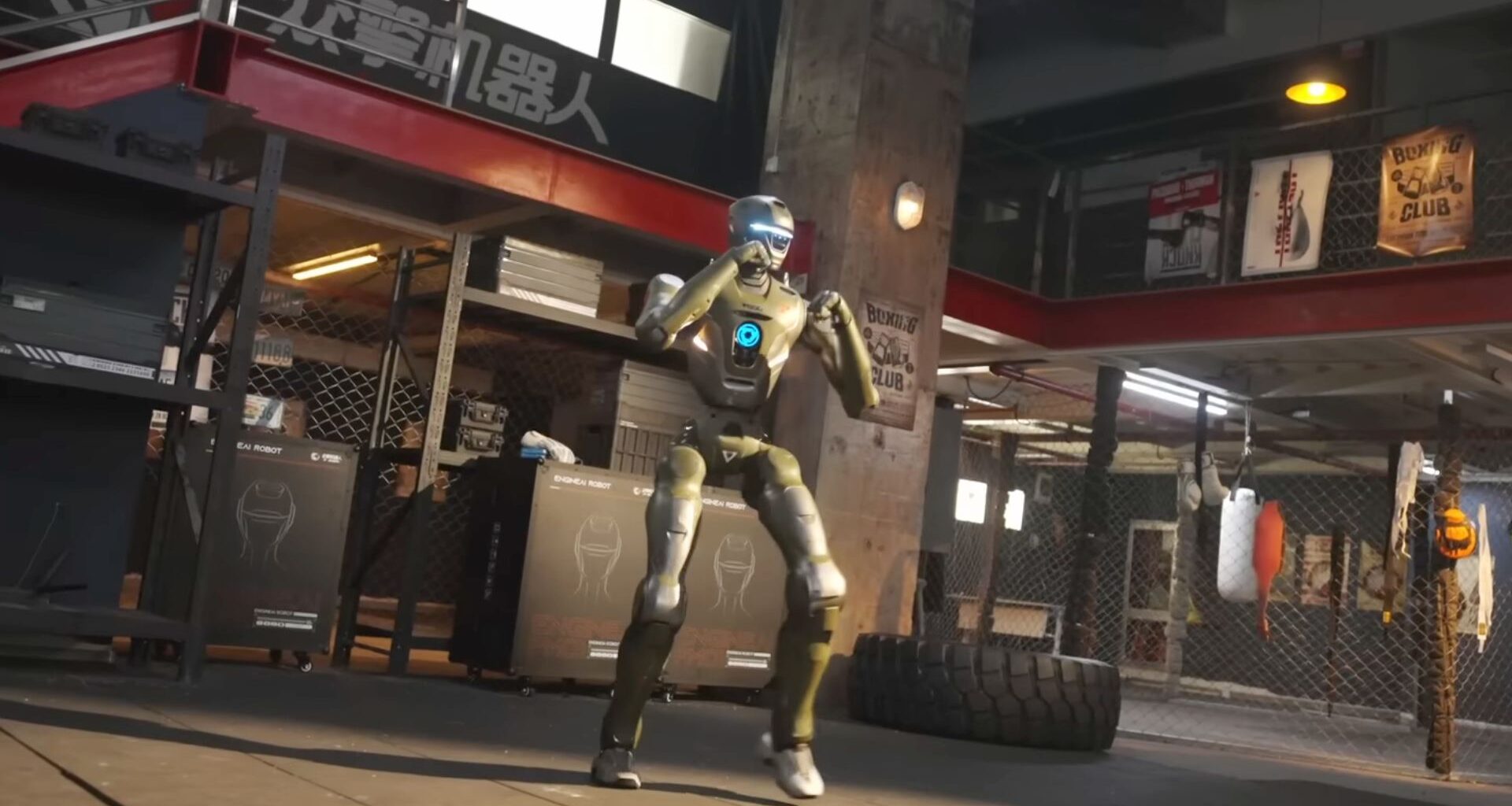
China has unveiled a striking new entry in the race for human-shaped machines: the T800, a full-scale humanoid robot designed for combat.
Unveiled by Shenzhen-based EngineAI at the World Robot Conference in Beijing, the machine matches an adult human in size and weight. It is being positioned as a platform for controlled fighting demonstrations scheduled later this year.
According to the company, these bouts will serve as a proving ground for strength, endurance, and agility before the technology transitions to industrial or service environments.
In February, the Chinese robotics startup claimed its PM01 became the first humanoid to land a frontflip, sharing footage of the robot walking through Shenzhen and continuing to evolve.
Kicks, power, precision
In a field where new humanoid robots are appearing almost weekly, standing out takes more than smooth walking or basic hand gestures.
EngineAI seems to understand that, and its new humanoid robot, the T800, is being introduced with bold style and a strong marketing push. The company is promoting the machine not just as a useful robot but as a high-performance model capable of dynamic actions like flying kicks, and it has plans for a robot fighting tournament.
EngineAI’s T800 is a full-scale humanoid robot built with high mobility, endurance, and multi-role capability in mind. Standing 5.6 feet (173 cm) tall and weighing 165 pounds (75 kilograms) with the battery installed, it features a total of 29 degrees of freedom across its body, plus 7 DOF per dexterous hand.
According to its makers, the robot is constructed with aviation-grade aluminum panels for durability and lightweight performance, paired with a streamlined exterior design. A key highlight is its active cooling system in the leg joints, enabling continuous high-intensity operation for up to four hours, supported by a modular solid-state lithium battery architecture.
The T800 incorporates a multi-modal perception suite including 360 degree LiDAR, stereo vision sensors, and millisecond-level environmental processing for obstacle avoidance and situational awareness. Its high-power joint motors deliver up to 450 Nm of torque, enabling advanced movements such as flying kicks, capoeira-style rotations, and rapid directional shifts.
The computing system includes an Intel N97 base unit and an NVIDIA AGX Orin module, delivering 275 TOPS of AI processing. It supports secondary development and comes with an integrated remote controller. With a top walking speed of three meters per second, the T800 is designed for a wide range of use cases, including logistics, hospitality, human-robot collaboration, and general service environments.
Strength needs software
EngineAI’s T800 may look like one of the most capable humanoid robots released so far, but the biggest question isn’t about its power — it’s about what users can actually do with it.
According to Robohorizon, while the company emphasizes the robot’s athletic abilities and durability, its official materials offer almost no detail on the software ecosystem, programming tools, or development pathway.
There are mentions of “secondary development” and a high-performance compute module, but no clear Software Development Kit (SDK), Application Programming Interfaces (API) documentation, or roadmap. Without that, even the most advanced humanoid becomes little more than an impressive remote-controlled machine.
Meanwhile, the T800 enters a competitive landscape populated by serious players such as Tesla, Boston Dynamics, and Figure AI. Unlike most companies focused on factory and logistics work, EngineAI is leaning into a “combat-ready” marketing style, complete with plans for a robot fighting tournament—a strategy that generates attention but may distract from practical deployment, reports Robohorizon.
Experts highlight that if EngineAI can pair its strong hardware with accessible software and robust tools, the T800 could become a meaningful platform. But until that happens, the robot remains a high-performance machine in search of a clear purpose.