
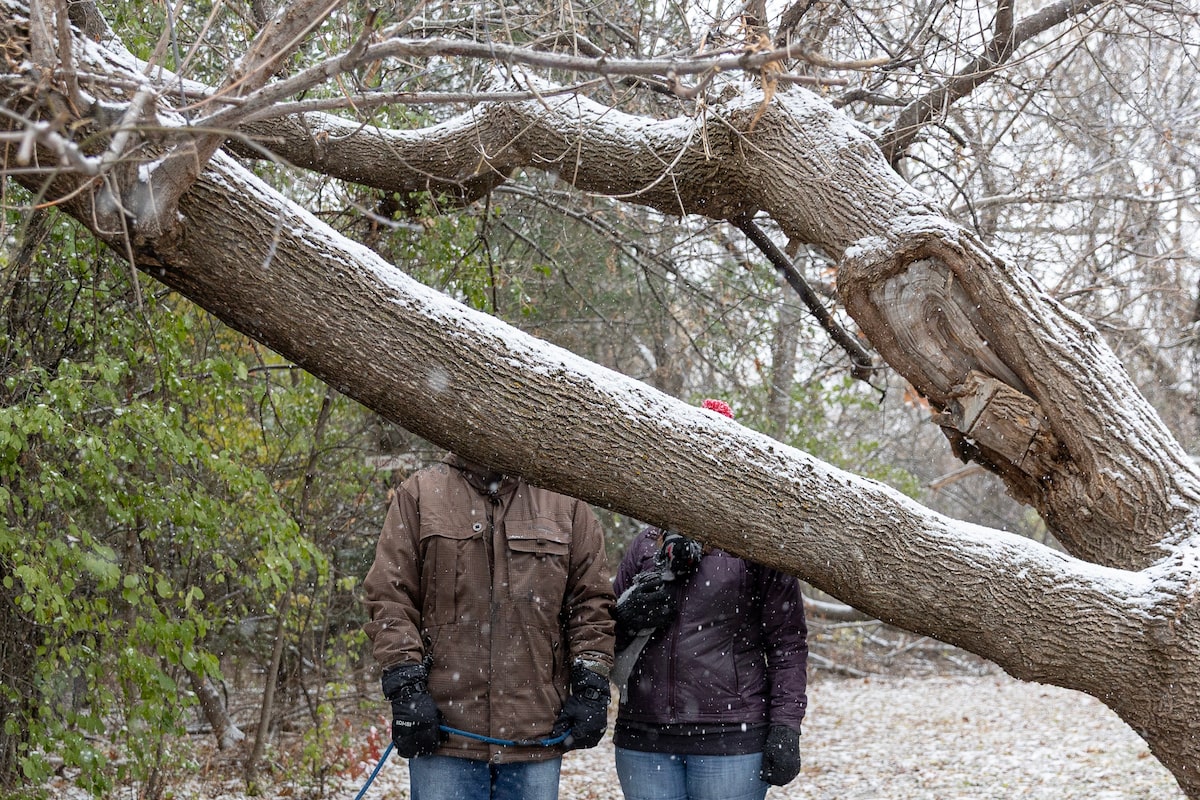
Taye and his wife, Gigi, both 44, have two teenage children and a mortgage-free residence in Ontario valued at about $600,000.Keito Newman/The Globe and Mail
Taye is 44 years old and earns a salary of $142,000 a year working for the federal government, a job he is eager to leave. His wife, Gigi, also 44, was a federal government employee as well but has since taken a less stressful job, earning $42,000 a year.
Both are entitled to defined-benefit pension plans.
They have two teenage children and a mortgage-free residence in Ontario valued at about $600,000.
“Ideally, I would like to retire as early as I can while not sacrificing our financial future,” Taye writes in an e-mail. “Can I retire at 45?” Taye asks, “or at least before 50?”
How should Vince and Mindy wind down their $500,000 corporate account in retirement?
Gigi, who likes her new job, plans to continue working to age 60.
They also want to help their two children pay for their higher education. Their retirement spending goal is $85,000 a year.
We asked Jeff McCartney, a certified financial planner at Objective Financial Partners Inc. of Markham, Ont., to look at Taye and Gigi’s situation.
What the expert says
Taye wants to retire as soon as possible, but we’re using age 55 as a starting point because that’s when he’ll be entitled to an unreduced pension, Mr. McCartney says. Gigi, on the other hand, enjoys her job and envisions working until age 60.
The couple have registered retirement savings plans (RRSPs) of $198,000 and $96,000, while Taye has a tax-free savings account (TFSA) worth $180,000 and a non-registered account worth $222,000. They also have a registered education savings plan (RESP) for the children’s education valued at $67,000. Finally, they have about $71,000 in cash in bank accounts.
Both are eligible for defined-benefit pension plans that will form an important aspect of their retirement success, Mr. McCartney says. Starting at 55, Taye expects to receive an unreduced pension of about $6,476 per month plus a $1,194-a-month bridge benefit until age 65. At age 60, Gigi will receive $1,203 a month plus a $399-a-month bridge benefit until 65 from her previous employer.
Gigi also expects to receive a second defined-benefit pension from her current employer of $2,166 per month starting when she turns 65. In today’s dollars, the couple’s total expected pension benefit at age 65 – after the bridge benefits are eliminated – is $9,845 per month or $118,140 per year, the planner notes. Their pensions are indexed to inflation. “As a result, Taye and Gigi should see their income grow over time to match their cost of living,” Mr. McCartney says.
They spend about $5,500 a month, or $66,000 a year, on living expenses. They are also saving around $3,200 a month to pension and retirement funds.
New car expenses every 15 years until both turn 80 have been incorporated into the projections.
“Over all, they’re in great shape financially,” the planner says. Assuming their living expenses do not increase over and above inflation, Taye will have no difficulty retiring at 55. Gigi can either stop work at that time as well or continue working if she chooses.
They could improve their finances if they were to use up all available TFSA contribution room and add to their TFSAs throughout retirement. They could increase their pre-retirement expenses by about $2,000 a month, and post-retirement expenses by $2,700 a month “and they would still be okay,” the planner says.
There are some other strategies to consider as well, Mr. McCartney says. Taye earns more than Gigi and as a result is accumulating larger investment account balances that will ultimately require more in income tax to be paid because he’s in a higher tax bracket.
“There are opportunities for the two of them to even out their assets to a certain extent and thus split their income more effectively,” Mr. McCartney says. For example, they could move money from Taye to Gigi, who earns less and so is in a lower tax bracket, reducing the overall tax burden on the family.
First, Gigi does not have a TFSA, and she has accumulated $102,000 of TFSA carry-forward room since 2009, when these accounts were created. Taye has $222,000 in a non-registered account. “Normally that money could not be shared with Gigi for investment purposes without attracting the attention of the Canada Revenue Agency’s attribution rules,” the planner says. Attribution applies when the higher-income spouse transfers property to the lower-income spouse and it earns interest, dividends or capital gains. The CRA attributes the income earned on the transferred property back to the transferring spouse.
“Fortunately, with the TFSA, the rules are different,” Mr. McCartney says. If Taye were to gift $102,000 to Gigi, and she were to contribute it to her TFSA, any income earned or capital gains generated from that money while it is inside her TFSA will not be attributed back to Taye.
“Be careful, though.” If Gigi were to take the money out of the TFSA and invest it in a non-registered account, subsequent income then would attribute back to Taye.
Second, Taye has a larger RRSP balance than Gigi, and that difference continues to grow as Taye continues to make contributions. “To even out their RRSP balances, Gigi should open a spousal RRSP, which Taye can then contribute to instead of his own,” the planner says. Spousal RRSPs are used to reduce household taxes by allowing a higher-earning spouse to contribute to a retirement plan for the lower-earning spouse, who can then withdraw funds at a lower marginal tax rate. This can also help equalize retirement incomes and provide more tax-planning flexibility.
Third, a common strategy to free up the lower-income spouse’s funds so that they may be used for investment is for the higher-income spouse to pay all or most of the joint household expenses, allowing Gigi to use her personal income for investing.
Taye has asked if he could retire earlier than 55. Although retiring at 50 results in a reduced pension, if they continue to maintain their current lifestyle and spending habits, this is a viable option, Mr. McCartney says. “Of note, retiring at age 45 was explored and doesn’t appear to be feasible due to the resulting pension reduction and future lost retirement savings.”
The planner’s forecast indicates they should preserve their RRSPs and TFSAs for as long as possible; however, that assessment can change depending on their approach to saving and spending, he says.
“The bottom line is that a set-it-and-forget it decumulation strategy is not the optimal approach. How much they draw from their various retirement sources is something that should be revisited and reviewed from time to time, particularly as circumstances change.”
They also wonder when to start collecting Canada Pension Plan and Old Age Security benefits. Statistically, there’s a very good chance that they will live well into their 80s, the planner says. If that’s the case, then it will make sense to wait to receive CPP and OAS until the age of 70. This will increase their expected payments by 42 per cent and 36 per cent, respectively.
Turning to education, Taye and Gigi have accumulated about $67,000 in RESPs and will continue to save $208 per month with December, 2027, being the assumed end date.
Their first child is in year one of a three-year postsecondary program and Taye and Gigi anticipate withdrawing $9,000 for tuition for the next two years to cover her schooling. She had a summer job last year, so they expect the same again this year, which she will use to cover some of her own expenses. Their second child is expected to start his postsecondary education in September, 2028, and they anticipate he will go for four years and require $10,000 per year in today’s dollars.
“With their current saving strategy and RESP balance, they will not have any difficulty covering these education needs,” Mr. McCartney says.
Client situation
The people: Taye and Gigi, both 44, and their two children, 15 and 18.
The problem: How soon can Taye retire without jeopardizing their financial future?
The plan: Taye works to 55, Gigi to 60. They take steps to equalize their income.
The payoff: A stable footing for retirement.
Monthly after-tax income: $11,100.
Assets: Cash $71,000; his non-registered investments $222,000; his TFSA $180,000; his RRSP $198,000; her RRSP $96,000; RESP $67,000; residence $600,000. Total: $1.43-million.
Estimated present value of their three DB pensions: $3.4-million. This is what someone with no pension plan would have to save to generate the same income.
Monthly outlays: Property tax $375; water, sewer, garbage $75; home insurance $165; electricity $110; heating $75; maintenance, garden $150; car insurance $290; other transportation $405; groceries $1,500; clothing $50; gifts, charity $175; vacation, travel $335; dining, drinks, entertainment $800; personal care $100; golf $100; pets $150; sports, hobbies $100; subscriptions $125; health care $25; communications $225; RRSPs $290; RESP $210; TFSAs $500; pension plan contributions $1,700. Total: $8,030.
Liabilities: None.
Want a free financial facelift? E-mail finfacelift@gmail.com.
Some details may be changed to protect the privacy of the people profiled.