
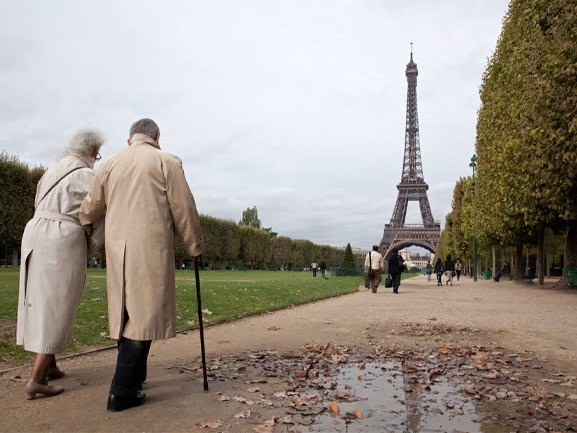
Thousands of Australians who retired to France now find themselves trapped in bureaucratic limbo, cut off from their age pensions, writes Judy Crozier.
AGEING AUSTRALIANS resident in France have a dire situation.
There is no Social Security Agreement (SSA) between the two countries, though there are SSAs between Australia and 22 of the 27 countries of the EU.
It means we can’t apply for our own Australian age pensions. Most had assumed, not unreasonably, that such an agreement existed between Australia and this most influential of EU countries, France — or, at least, that it wouldn’t take long to happen.
We’ve all learned since then never to assume anything.
Our campaign was launched on Facebook back before 2019. Now we have around 1,000 members of Australian Pensions in France. We’ve even got a logo!
An additional problem is that we aren’t, overall, a large group. There are maybe 6,000 Australians living in France, with up to 3,000 of pensionable age. Our many letters to politicians, ministers and public servants are accompanied by hundreds of signatories — we try to look impressive.
We came to France for a wide range of reasons — for some, initially for work; for others, meeting a life partner and building a family. Some have a past that involved travel with family, contact with the French language and culture. Most of us sold up our homes in Australia to fund the move: bridges largely burned.
Our options now are to move to countries with an SSA with Australia. Or back to Australia, where we can gain the pension rapidly, but would have to wait for two years before moving back. It doesn’t take much imagination or life experience to realise that none of this appeals (and for many, is impossible).
Moving to another country involves not only breaking from communities and friends, but also an alien administration and a language we don’t speak. There are also costs, both obvious and hidden. Frankly, very few of us can make the move back to Australia. Those who have French families certainly don’t want to separate from them or make them move to the other side of the world; for most of us, the prospect of finding and paying for accommodation is daunting.
In every case, we really do now have strong attachments to our local communities, our friends and, in many cases, partners and families.
Yes, we have been living on our superannuation, those of us who have some. Not everyone does. But Australian super is unique and the French administration doesn’t appreciate that the point of it is low or no taxation. So that is rapidly vanishing as well.
Meanwhile, after many years and dozens of letters in two languages to ministers and public servants in both countries, some are renting out their homes while living with friends; others are downsizing or selling what valuables they have. Some, now in their 60s or 70s, are looking for work. Others, of course, have found they simply can’t retire. And some, indeed, are moving to countries with an SSA, despite the complications and costs.
We did try some appeals via the press, but I have been made wary of that. In fact, the reaction from some waspish members of the public who managed to track me down, not to mention the tone of at least one article in the media (always write your own), made me realise that there’s a widespread view that anyone living overseas is probably wealthy (“entitled”, it was put to me), with their own yacht and living on a diet of dry martinis.

No, we’re not. And of course, we all know there’s a ceiling beyond which we are, in any case, not eligible for the pension.
I began to make sure that each and every letter emphasised our ordinariness and worsening distress.
Mythologies can do great harm.
This is becoming more and more of a crisis. Whatever action we take involves loss and anxiety.
Incidentally, it affects more than the increasingly impoverished middle-class Australians in France. French people moving to Australia to work are likely also to be affected if, after several years, even decades, they wish to return. Say, to look after an aged relative. They will have no or very little pension from either country — in France, the pension system is pay-in over many trimestres.
Further, in these days of strengthening alliances outside the U.S., none of this makes sense to or encourages Australian investors in France. They are hit with enormous social costs, yet can offer nothing to employees who establish themselves, with their families, in France. It is a major disincentive.
Individuals who have worked in France can also, of course, only look forward to a partial pension from the French system.
We get the sense, however, that Australia is onside.
I personally had high hopes — until the French Election resulted in three French governments and an ever-changing group of ministers to write to.
Still, a delegation of French representatives to Australia is, I understand, currently being led by their ambassador in a tour involving conversations about how to improve relations between the countries. We have thoughts on that and we certainly hope we are part of the agenda.
Judy Crozier writes fiction and some freelance non-fiction, and teaches creative writing in Melbourne.
Support independent journalism Subscribe to IA.


Related Articles