
Feedback to the state’s deer strategy showed Victorians wanted “more emphasis on managing these impacts and less on deer as a hunting resource”.
Despite this, Premier Jacinta Allan and Environment Minister Steve Dimopoulos recently announced in an upbeat Instagram post deer hunting would be allowed in national parks in Victoria, “unlocking 130,000 hectares, and driving more jobs and visitors into our regional communities”, Allan said.
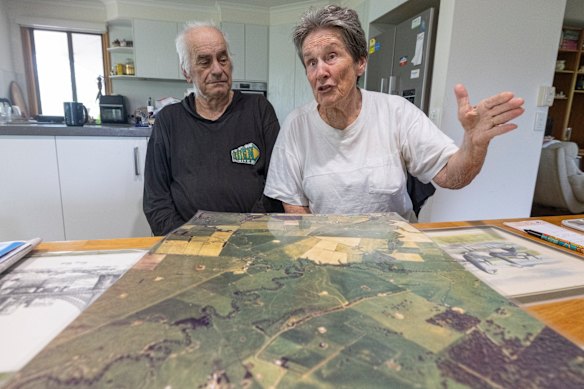
David and Marie Trigg (pictured in their kitchen) are frustrated by the government’s handling of the feral deer problem.Credit: Jason South
A Victorian government spokesman said the state had allocated $27 million on deer management over the past four years, but did not respond when asked how much of this was for culls.
“We’re taking action to safely control Victoria’s feral deer population and reduce the significant negative impacts they have on our wildlife and biodiversity,” he said.
“Deer hunters have an important role to play in curbing the devastating impact of wild deer on our environment.”
Private landholders can shoot deer without a permit on their own land, he said. But as Marie and David Trigg can attest, it is a different story for anyone wanting to trap deer.
Back in Gippsland, the Triggs have spent years locking horns with the Department of Energy, Environment and Climate Change (DEECA) and the Office of the Conservation Regulator (OCR), fighting to have permanent traps installed on their land to catch deer.
Their farm is home to about 100 breeding Angus cattle, and Marie fears the sounds of rifles being fired could spook her cattle and their calves. She also doesn’t want strangers on her property while she has prize-winning Angus breeding and calving.
Loading
“They’re tiny calves, the Angus – I cannot have shooters on the property. I don’t want shooters,” she said.
But letting deer roam is similarly unthinkable. Deer – as cloven-toed animals – could bring in foot and mouth disease, to which cattle are susceptible. They have also tracked hemlock seeds onto the couple’s farm – another invasive pest, which is deadly to cattle.
“I see myself as a very proactive farmer,” Marie said. “I can see deer and keep being told they double every year. And from my 10 or 15 that I could see, I can think, my god, I’m going to have 20 or 30.”
The couple and their friend, Skyline Management Systems executive director Emanuel Vlamis, have spent three years in a bureaucratic tussle with the Environment Department over the right to install large deer traps on the Triggs’ farm.
Vlamis and his colleague Peter Martin designed a large trap on the farm that included smart cameras and a satellite connection, and an automated trapping door system. Within the trap were hay, feed and water stations. Deer were protected from the elements inside the device.
But securing a permit to operate the trap became a three-year battle. First they applied for a permit to trap the deer and release them elsewhere, which was denied. Then they applied for a permit to trap the deer and humanely destroy them.
“We had to jump through a heap of hoops,” Vlamis says.
“We had to give them the design of the trap, all the configurations, all the surveillance that was used. From start to finish, getting the permit, took 18 months.”
Loading
The permit, however, allowed the couple to trap only 12 deer over a fixed time period. After the permit expired in August, 15 deer wandered into the trap, which is now open. They were forced to let them go.
The Triggs and Vlamis believe – although the government would not confirm for “privacy reasons” – that theirs is the only trap to win approval to operate in Victoria.
“The frustrating thing is that I can’t believe that they can’t look ahead,” Marie said. “If they’re multiplying so rapidly, why can’t we do more about it?”
While Vlamis and Martin have a commercial interest in the control of deer, their broader concern is for the rampant damage feral deer cause to agricultural land and the natural environment
When this masthead visited the Triggs’ farm, the signs of deer were clear, including fallow deer hair caught on the underside of fences, showing where they had squeezed underneath.
The Triggs and Vlamis have since applied for another permit to trap deer, which was supposed to have been decided last month.
“We’re in a stalemate because we’ve applied for six other permits, and they’ve all come back rejected, and they’re in the peri-urban area too,” Vlamis said. “You can’t just be waiting for six months for a permit.”
The government spokesman said trapping deer was permitted under specific conditions, but landowners must use deer traps in a way that minimises prolonged stress and injury to deer and native animals.
Get to the heart of what’s happening with climate change and the environment. Sign up for our fortnightly Environment newsletter.