
Posted on December 7, 2025
Posted by John Scalzi

I will begin this piece noting that I am not unbiased in my thoughts about Moana, as my friend, the Oscar-nominated writer Pamela Ribon, helped write a significant chunk of this film’s story. I found out about her involvement after the fact, namely, by sitting there in the theater watching the credits when the movie was done, spying her name, and saying “Oh, shit! Pamie!” out loud, thereby confusing the friend I went to see the film with. How much Pamela’s involvement in this film raises my estimation of it is difficult for me to quantify, but I can assure you I liked it very much before I knew she was involved with it. So, there, you have my disclosure.
And in fact, I do like Moana very much. It’s my favorite film out of Disney Animated Studios in the last decade, and even (barely) edges out Coco when you include Pixar in the mix (Coco is wonderful, though, you should absolutely see it if you have not). Moana does many things well, both technically and in the story department, but what I like most about it is that, without making an overt fuss about it, it’s the most feminist and woman-forward animated film that Disney Animation has made.
Disney, mind you, has been mining the “girl power” vein for a while, most overtly since the Disney Renaissance era that began with The Little Mermaid and Beauty and the Beast. The Disney canon is so replete with these characters that they’re even their own marketing category within Disney itself: The Disney Princesses. The problem with the Disney Princesses, however, is one clear enough that Disney itself parodized it in a scene from Wreck It Ralph 2: Ralph Breaks the Internet (written — again! — by Pamela Ribon):
Moana is in this scene, but of all the “princesses” in here (not excepting Veneople!) she is the one whose journey’s intersection with men (and more broadly, with patriarchy) is of a different quality. Men exist in and are even essential to her path through the story, but at every juncture of the story, she is the captain of her own fate. She is continually self-motivating, self-rescuing, and ultimately, the instrument of the story’s resolution in a way that does not depend on a man (it may depend on an ocean, which is never gendered, but let’s not get into that now).
I don’t think Moana, either the film or character, overtly makes a big deal out of any of this — there’s no point where Moana has a story-stopping “girl power” moment, and the only person who explicitly calls out her princess-ness is a dude who does it as a winking fourth-wall crack, and the fact is never really brought up again. Moana’s not rubbing your face in its feminist bona fides. It’s not to say they aren’t there.
In any event, at no point is Moana’s womanhood presented as a disadvantage. She is early on explicitly tapped to be the next leader of the only village on a Polynesian island of no specific provenance (the voice cast of the film is primarily Polynesian, but from varying places in the Pacific: Hawai’i, Samoa, and New Zealand/Aotearoa most prominently). This ascent to leadership is something that Moana accepts with some reluctance, for while her people have lived contentedly on the island for centuries, their antecedents once roamed the waves in big boats, and Moana sees her destiny out there. This fact is a subject of some exasperation to her father, who wants her to focus on where she is.
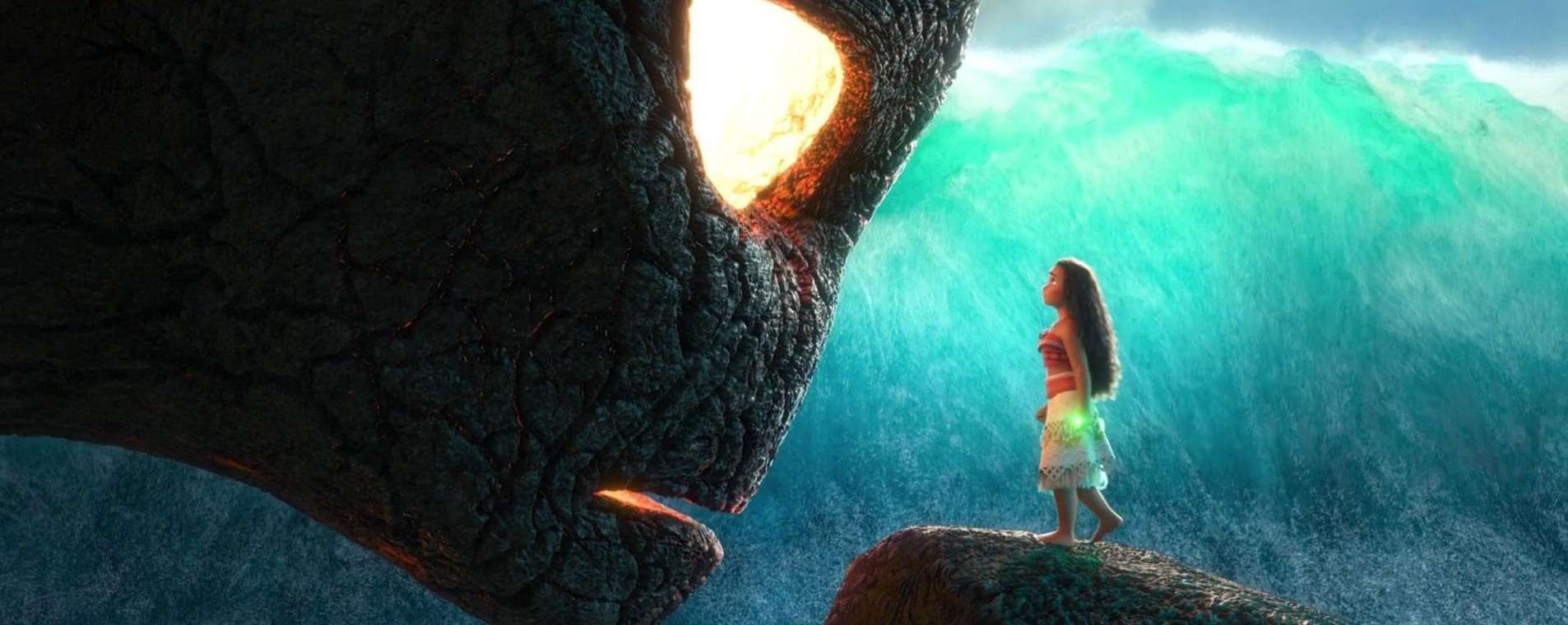
The issue gets forced when a blight hits the island, killing both the fish and the coconut palms the villagers rely on. This blight, Moana is told by her grandmother, is the result of the trickster demigod Maui stealing the (literal, not figurative) heart of the goddess Te Fiti, inadvertently starting the blight as well as being the cause of the pause in sailing between islands. The good news is, as a baby Moana was chosen by the ocean! For what? Well, as it happens, to leave the island, find Maui, and force him to return the heart of Te Fiti. Simple enough, yes? Well. No.
It does not pass my attention that in this film the initiating problem, and the various obstacles that Moana encounters, originate with men, and the aid and advice she gets is at the hand of the women characters (there is the volcano demon Te Kā, who is coded as a woman, but hold that thought). Again, the film doesn’t dwell on any of this — and both Maui and Moana’s dad have understandable and defensible reasons for what they do — but it’s there. Men in this film, in ways large and small, exist to be routed around and made to understand that they are supporting, not main, characters in this tale.
No one exemplifies this more than Maui, played by Dwayne Johnson in a frankly delightful bit of typecasting. If ever a movie star exuded “main character energy,” it’s Johnson. That same sort of heedless self-regard oozes through Maui, who despite being in exile for a thousand years, settles back into his own internal spotlight the second someone else gazes upon him. That Moana is having none of his guff is neither here nor there to him; she whacks him with an oar with seconds of meeting him and he reacts with mild puzzlement rather than comprehension. His signature song, “You’re Welcome,” is a literal paean to how awesome he is, and it’s perfect that Johnson’s singing voice is, how to put it, deeply imperfect. Maui wouldn’t care if he was off-key. Being on key is for people who aren’t demigods.
But the fact is, this isn’t Maui’s story, it’s Moana’s, and Maui’s journey will be to learn that being of service — the thing he’s always prided himself on — is not about filling the hole in one’s psyche.
Moana’s journey is also one of service — she wants to save her island and her people. She doesn’t know if she can do it, and there are times when she is sure that she can’t, but she is determined to anyway, and besides there is no one else who can do it. She’s learning on the job, so to speak, and what I like about her his that her doubts and fears and acknowledgements of her own deficiencies are right there in her story… and she keeps on regardless, and will do it all by herself if she has to. What saves her, and by extension saves everybody, is her ability to see, not where she has a chance to be a hero, but where she has a chance to heal what has been broken. It’s her story but it’s never been about her, or, rather, just about her.
This is a fairly subtle peace of storytelling — a story where the “big bad” isn’t defeated, or even redeemed, but is restored, from a harm perpetrated long ago. And the hero’s reward? Not riches or fame, or true love’s kiss, or a man in any shape or form. She just gets to go home, with the knowledge there is a home to go back to. This is a hero’s journey, to be sure. But it’s a different hero’s journey than we usually get, and one that I don’t think we often get to see when when the hero is a man. This is what Moana does, that the other “princess” movies up to that point didn’t really manage to do.
(Mulan comes close. But, Shang.)
I think it’s important that, while the film was directed and largely written by people who were not Polynesian, the filmmakers actively consulted and collaborated with Polynesians and Pacific Islanders about the movie, and listened about a number of things, like Maui’s appearance and why Moana wouldn’t be disrespectful regarding coconuts. Likewise, while Lin-Manuel Miranda is the marquee name for the movie’s songwriting, he collaborated with Opetaia Foaʻi, a Tokelauan-Tuvaluan composer and songwriter. I’m not qualified to say that the filmmakers got Polynesia “right” — please listen to others with better knowledge on that score — but at the very least it is good that there was an acknowledgement they were telling a story in a milieu that people currently exist in, and to which they owed respect.
I have not seen Moana’s animated sequel, which came out in 2024 and shoved lots of cash into Disney’s coffers, and bluntly, other than the obvious “for even more money,” I am confused why Disney thinks it’s a good idea to do a “live action” version of the story a mere decade after the animated movie hit theaters (actually, I do have a theory about this — the “live action” remakes of the animated movies serve the same function as releasing the classic Disney animated films did before the age of home video: bonding another generation of children to Disney’s character and stories, the better to keep them in the economic chain that continues on to Disney’s theme parks and cruises. Even so). I don’t imagine I will be going out my way to see the “live action” version anytime soon.
But that doesn’t decrease my appreciation for Moana, the original film. Disney doesn’t need me to tell them they got this one right. But they did. Of all the “Disney Princess” movies, this one, in theme and story, is the true queen.
— JS
Like this:
Like Loading…
← The December Comfort Watches 2025, Day Six: Trading Places