
Next year, they will play an old-school, eight-game, four-test tour in South Africa and compete in the inaugural Nations Championship.
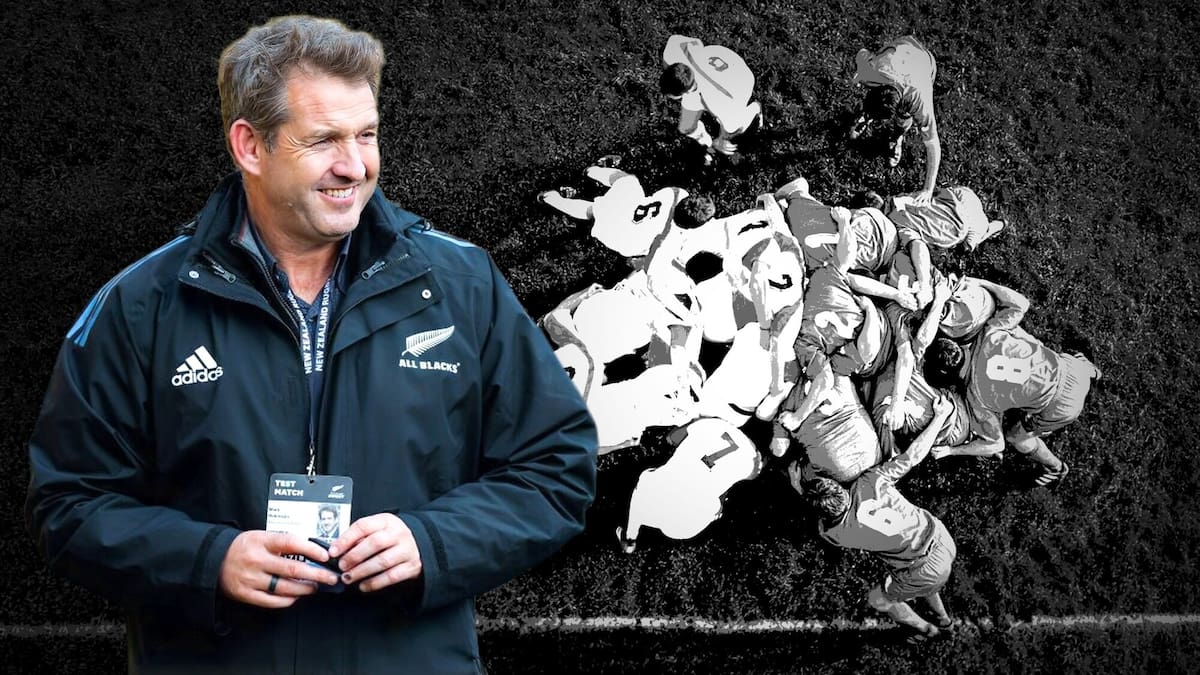
Mark Robinson’s time with New Zealand Rugby is ending. Photo / SmartFrame
In 2028, they will likely play at least one test in the USA, as they most likely will in 2029 and 2030 – years in which they will respectively host the British and Irish Lions and South Africa.
The upcoming calendar looks nothing like the typical All Blacks annual schedule did when Mark Robinson came into the job in 2020 – which is entirely deliberate.
The main achievement of Robinson’s tenure is arguably the shift that has been made to more coherently align the All Blacks’ high-performance needs with New Zealand Rugby’s commercial imperatives and create a higher-value fixture list that is supported by a stronger marketing narrative.
Under Robinson, there has been a more comprehensive strategic plan built around where the All Blacks play in the world and how New Zealand Rugby (NZR) capitalises on that commercially – both in the short term around gate revenue, and in the longer-term campaign to win new sponsorship partners, fans and build brand exposure.
The recent test against Ireland in Chicago was a prime example of how much more comprehensive NZR is now at cashing in – with the match-day revenue from the Soldier Field encounter netting an estimated $6 million, which compares with the circa $3m that was made in 2016 when the All Blacks played at the same venue against the same opponent.
The other key difference in 2025 compared with 2016 was how much better NZR was at promoting the All Blacks in Chicago and how much more consideration was given to servicing existing sponsors and wooing new ones.
This co-ordinated, well-planned approach even included NZR paying to take select journalists to Chicago – the Herald was represented by Media Insider’s Shayne Currie – giving unique interview access to key personnel.
The proof that this strategic international positioning of the All Blacks is starting to work can be seen in the growth of sponsorship revenue between 2020 and 2024.
NZR’s annual income from sponsorships in 2020 was $72m – in 2024, it was $125m and is expected to be higher again in 2025.
And those numbers are higher because international brands such as Toyota, Gallagher Insurance, Taisho and SAP have been locked into agreements, with more Japanese partners expected to be secured early next year.
The expectation is that the next five years will also deliver a lift in match-day revenue. Next year, the All Blacks will only play four home fixtures (France, Italy, Ireland and Australia), but the Greatest Rivalry tour to South Africa will operate as a 50:50 revenue share (and the fourth test will be played at a yet-to-be-determined major European venue), while the finals weekend of the Nations Championship (at Twickenham) is also being played under a revenue-sharing agreement.
Reducing the number of games played in New Zealand to take the All Blacks to larger, offshore venues will ultimately yield higher financial returns.
“I think developing presence in key markets,” Robinson says when asked why NZR has been better able to commercialise the All Blacks.
“Japan is definitely one that has worked as it relates to new fans and partnerships.
“Going back there regularly – being strategic and more long-term in our thinking and going back there regularly every year with different fixtures.
“We are starting to see signs of that in the US. I would package that all up in that revenue-generation, global partnerships, emerging markets, new fandom [space].
“The other thing that I am pleased with is the work we have done on the new calendar – I think over the next five years, fans would have to look at that and say that is an amazing schedule of rugby.
“We initiated a lot of the work around the women’s Lions, which will be a unique tour. The Greatest Rivalry – the jury might be out on some aspects of it, but we think it is a cool concept and I can’t comment on the commercials, but there have been stories in the UK speculating on the size of the broadcast support out of the UK for that tournament.”
Is it short-term gain for long-term pain?
If there is both a criticism and concern about Robinson’s efforts to use globalisation of the All Blacks as the preferred route to more effective commercialisation, it is that he has perhaps chosen short-term gain over long-term stability for the wider Pacific rugby region.
The Greatest Rivalry tour is a nostalgic concept that will have enormous fan support. But it has been rammed into the calendar at the expense of the Rugby Championship in 2026 and 2030 and there is a danger, having been sidelined the way it has, that interest in and credibility of the Southern Hemisphere’s showpiece tournament collapses over the next five years.
The double danger is that the Greatest Rivalry’s value is built on its rarity and nostalgic qualities, two factors that will be eroded if it becomes a staple of the calendar.
It’s also gone largely unnoticed that in the last five years, Tonga, but more specifically Samoa, have ceased to be any kind of international force, with the latter qualifying for the 2027 World Cup as the 24th team courtesy of a draw with Belgium.
Robinson can’t be held responsible for the demise of Samoa and can point to the licence granted in 2022 and continued financial support NZR gives to Moana Pasifika as the single most significant measure taken to build a high-performance pathway in the Pacific Islands.
But it is equally valid to wonder whether the launch of Moana was nothing more than virtue-signalling by NZR and that its continued support owes its existence to the club being as much a pathway to the All Blacks for promising players as it is a route to the Samoan and Tongan national teams.
Robinson is right when he says fans will love what lies ahead in the next five years, but what about after that? Can New Zealand really keep creating high-value, ad-hoc, five-year calendars around the broadcast negotiation cycle?
And tied into this is a yet more fundamental question about how or whether NZR can extract greater broadcast value from its content slate.
Robinson came into the job knowing that in 2021, NZR would begin a $111m-a-year broadcast deal with Sky. He is leaving his role with NZR’s broadcast deal between 2026-2031 likely to be slightly down on the $111m deal that was initially agreed with Sky in 2019, but slightly up on the revised agreement of circa $100m a year that was made in 2020 after Covid impaired international competitions.
The big difference between the new broadcast agreement and the existing one is that Sky is believed to have dropped its annual payment to around $80m, an estimated $2m-$3m is coming from TVNZ for the NPC rights, and the remainder is coming from international broadcasters as the rights to the Nations Championship are being pulled (ITV has reportedly paid $190m to buy the UK rights).
NZR’s issue is that despite viewing audiences for All Blacks tests regularly being greater than one million people, the lack of competition in the media market locally has left it unable to extract fair value for its content.
Will Silver Lake shine?
The other great unknown about the Robinson tenure is the likely long-term impact of having agreed an equity sale to Silver Lake.
The US fund manager has paid $262m for what will be a 7.6% share of NZR’s commercial assets. Currently that money operates as a loan – with a 4% repayment rate – and Silver Lake has the right to convert it to an equity stake any time it now chooses.
The money paid by the US firm has enabled NZR to make a near $40m cash injection into the provinces, set up a $60m legacy fund for grassroots projects and put aside another $40m to pay operating and start-up costs for initiatives such as building a streaming and content hub.
The argument to say the partnership is working lies with the growth in total revenue, which is expected to be close to $300m this year – up from $270m in 2022.
That revenue figure is expected to jump significantly again in 2028 after NZR renews the naming rights to the All Blacks kit.
It currently receives an estimated $70m-a-year for selling the front-of-jersey space to Altrad, the back-of-shorts space to Gallager and training kit to Toyota.
The national body is hopeful that number will be anything between 30%-50% higher by 2028, believing that through the advent of its content platform NZR+ and its cohesive offshore playing and marketing strategy that it has a data set that will show potential sponsors that an association with the All Blacks delivers enormous brand exposure.
Robinson is a believer that this growth would not have been possible without Silver Lake’s capital investment and contributed expertise.
The counterfactual, though, is that it was. NZR could have borrowed less money and hired greater expertise to instigate new commercial initiatives and that the danger of selling future revenue will only be fully realised when Silver Lake converts its loan.
The Herald understands that while the deal enabled Silver Lake to convert the loan after three years (that landmark was reached in June this year), it has signalled it’s unlikely to do so until NZR is running at a profit (it has made significant losses in the last three years) and when there is more tangible evidence that it has positively contributed to revenue growth.
But when it does convert, its annual distribution from NZR will jump from its current $10.5m to an estimated $19m (total net commercial revenue, which will be circa $320m minus operating costs and government grants and currency exchange gains circa $50m).
The low performance in high performance
Earlier this year, NZR’s newly appointed board made the decision to take Robinson off World Rugby’s executive council and replace him with Greg Barclay.
The board members felt they wanted one of their own directors to have a presence in Dublin and, to a lesser degree, they wanted Robinson more focused on domestic affairs as they were aware that some provincial unions had questioned how often the chief executive was travelling overseas.
Robinson was sensitive to the criticism as he feels, with due cause, that he’s played an important role in changing attitudes among his Northern Hemisphere peers around the future shape of the game as it pertains to law variations and the way it is refereed.
He was also an influential campaign manager of sorts for Australia’s Brett Robinson to be elected World Rugby chair and there is a sense that the sport is more unified across the two hemispheres than it has ever been.
So too should Robinson be credited with patching up key relationships with Sanzaar partners Australia and South Africa and there is no question that Robinson, affable and articulate, excelled as a diplomat and ambassador and positioned New Zealand well within the geopolitical rugby sphere.
But the cost of succeeding as an international statesman was that Robinson lost entirely the run of New Zealand’s high-performance strategy – a price the country is still paying as all its national teams bar the Black Ferns Sevens are not performing at recent historical standards.
There was flawed decision-making around appointment processes, a culture of commissioning endless reviews that were rarely acted upon and a blind eye turned to untenable conflicts of interest and constant board leaks.
Having previously been the most stable job market in world rugby, New Zealand has seen four assistant All Blacks coaches either be fired or mutually leave in the last three years.
No comment has been more damning about the state of New Zealand’s high-performance set-up than that made by chairman David Kirk while he was in Chicago.
David Kirk: “That was an unfortunate process.”
Kirk said to the Herald about the process to appoint incumbent head coach Scott Robertson: “It’s generally accepted by most people that that was an unfortunate process, and that it was suboptimal for everyone – actually for Scott as well as for Ian.
“We’re not in the business of having suboptimal processes. We would certainly seek to avoid that type of process in the future. I would very much hope not, certainly when I’m the chair.”
Rugby retains its social licence
In the never-ending battle to keep rugby relevant and teenagers playing it, Robinson has fared well. Participation grew 6% in 2024 and overall playing numbers stand at 155,500.
There were 29,217 boys aged 13-18 playing last year, which is almost in line with the 29,879 who were registered in 2019 (the highest number of teenage participants in any given year since NZR began keeping detailed records).
That 29,217 figure also represents a rise of 2400 registrations of teenagers in 2024 compared with 2023 (a 5% rise), while there was also a rise in the number of players aged 5-13, jumping by 4300 registrations.
Female participation remains the single biggest success story, with 33,757 girls and women playing in 2024 – a record total number and a 15% increase on 2023.
In 2019, of the 64,446 registered players aged between 5-18, 8623 were girls. In 2024, 13,257 of the 64,211 registered junior players were girls.
The number of females playing rugby has increased in recent years.
These figures represent a major victory for NZR at a time when the prevailing culture is moving against participation in collision sports and the country’s migration patterns are changing, with significantly higher numbers of people arriving from countries that have no affinity with rugby.
“Any sport, recreation or pastime that had a place in New Zealand is different to what it was 40 to 50 years ago,” Robinson says. “By virtue of the fact we have been able to grow revenues and invest in retaining the best of our players and invest in high levels into the community game has meant we have got a good stronghold in a lot of communities.
“And the thing I would also say is that a lot of the communities are different. You still see and hear a lot of great stories out of rural areas and maybe less so in metropolitan areas about the presence rugby has got there.
“It has still got a primacy that is real and I know that from going home to Taranaki. Rugby is talked about a lot and it is in the communities more and the rugby club and the fields are a big part of little townships and that is still the case.
They are different to what they were 30-40 years ago, he says, “but they are still very prominent. Whereas in some of the larger centres, clearly there is more competition in terms of sport and entertainment and there are different working patterns and family dynamics and rugby holds a different place”.
“I think we will always want to have a strong foundation for the game in New Zealand in terms of participation and presence in communities and schools.
“We are showing that viewership can grow when we have the participation numbers we have got and that comes back to the way we have developed our brand and we have thought about different parts of the world and where we play, that is having a positive impact.
“Ideally, you want to keep that participation base strong, but there is certainly a world where we can be highly competitive and drag large audiences to watch.”
Club rugby in Whanganui as Kaierau take on Border at Cooks Gardens. Photo / Lewis Gardner
The final judgment
Robinson’s successor – whoever it may be – will be coming into an organisation that is relatively well set up to succeed.
There is money in the bank, increasing value in the All Blacks brand, a free-to-air broadcast contract for the NPC and stability and relevant expertise within the board.
The sport continues to hold its place as a community unifier and despite the growth of football and basketball, rugby holds pride of place in the national psyche.
Robinson’s tenure was at times turbulent and chaotic – as much through external factors such as the Covid pandemic and governance upheaval, which saw him report to four different chairs in five years, as his own decision-making – but on balance, he’s left the organisation in better shape than he found it.
But because of the ongoing uncertainty about the long-term consequences of destabilising the Rugby Championship and selling equity to Silver Lake, his tenure could well be seen in a vastly different light in years to come.
Gregor Paul is one of New Zealand’s most respected rugby writers and columnists. He has won multiple awards for journalism and written several books about sport.