
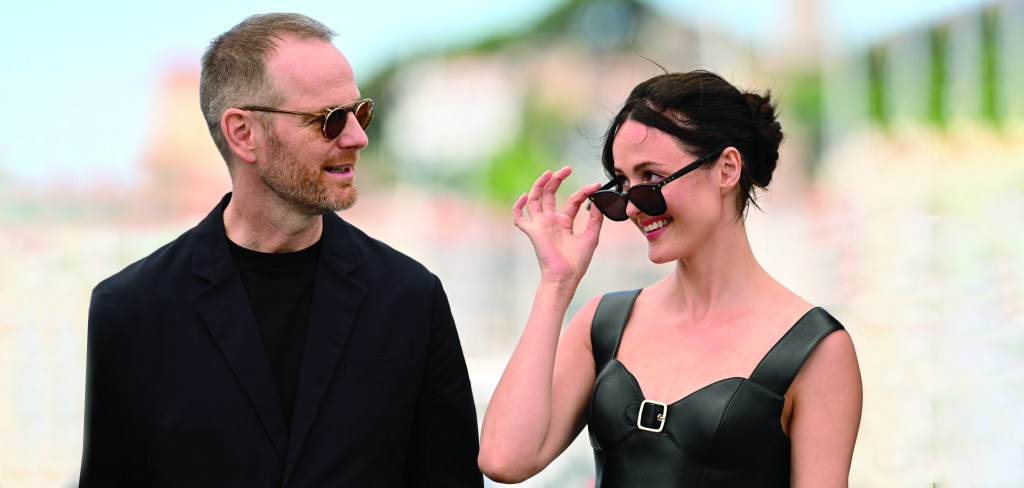
Norwegian filmmaker Joachim Trier reunites with his Oslo neighbor, acclaimed actor Renate Reinsve for their third collaboration, Sentimental Value, a movie about two bereaved sisters — Nora, a stage actor played by Reinsve, and her younger sibling Agnes, a historian, performed by Inga Ibsdotter Lilleaas — whose estranged father, Gustav Borg (Stellan Skarsgård) a once celebrated movie director, re-enters their lives. Each copes in their own way with generational trauma. The one constant in all their lives is the historical family home, a key character, that they once all shared until Gustav abandoned them. Nora and her surviving parent communicate as if strangers; she’s unforgiving and rejects Gustav’s entreaties to star in his deeply personal comeback picture which he’s written as a gift to her. Instead, he persuades Hollywood name Rachel Kemp, played by Elle Fanning, to replace his daughter. Admiring of Reinsve’s “energy, playfulness and charisma,” Sentimental Value is the second lead role that Trier has created for her; their last picture, The Worst Person in the World won a Best Actress prize for Reinsve at the 2021 Cannes Film Festival. “I feel like the luckiest actor to get to do this with Joachim,” Reinsve says.
“I sat down and we probably had two hours where I told her the structure of the story and the themes and why I thought it would be great to do it with her,” Trier recalls. They both wept as they investigated Nora’s longing for home and the realization that she’s only at home on the stage just as Trier and Reinsve locate theirs in cinema.
Trier collected Cannes’ Grand Prix award for Sentimental Value, which he penned with longtime writing partner Eskil Vogt. Reinsve talks of “laughing so hard” when Trier larked about on set with a package of sausages before shooting a scene of such heartache that she felt she was being “punched in the stomach”.
But that’s what draws her to work with Trier. Here, the two talk about their partnership that began when the director cast her in Oslo, August 31st 15 years ago. The role offered Reinsve just one line but the director saw enough in her performance to forge what has emerged as an acclaimed creative partnership.

Stellan Skarsgård and Renate Reinsve in ‘Sentimental Value.’
Kasper Tuxen/Neon/Everett Collection
DEADLINE: Joachim, Sentimental Value is your third collaboration with Renate. I want to go back to the moment you first met. When you worked together back in 2010, after you had cast her in a small role for your film Oslo, August 31st, she was totally unknown. What made you pick her?
JOACHIM TRIER: I’ll use a terrible term, but in English, I think you call it a cattle call. We basically wanted to try to find some young people that would surround the rather depressed character of Anders Danielsen Lie in that film… So we were meeting all the young actors in Norway from all the schools and everywhere, and I didn’t even know that Renate actually went to the most prestigious acting school in Norway [the Oslo National Academy of the Arts] the sort of national performance school that many great actors had gone to. I’m not saying this in retrospective romanticization of her talent, but I was looking at tapes and then immediately, I asked: “Who’s that girl in the green trousers?” There was something about her… she just broke into a laugh doing some sort of improv thing. And I just said, “OK, so let’s bring her in.”
She met Anders and we were both stunned at the energy and the charisma and the playfulness, and I immediately felt safe. We then shot her scene over eight days because we wanted to catch the sun coming out, so we had to sustain the light. So, every morning for one and a half weeks we heard her repeat the same one line of dialogue.
I was filming Anders in the center of the frame and she was creating some life over there doing autonomous character work… and I was looking at the rushes, and whenever she’s in frame she’s always doing something lifelike and interesting. After that I kept looking at her stage work, and we met socially… I was always asking: “What are you doing?” And she was being cast as the pretty girl that threatens the main cast love relationship or some funny characters and some TV shows, but smaller parts. Finally, I said, “Damn it, let’s do The Worst Person in the World,” and I wrote it for her.
DEADLINE: So, you did that first audition tape unaware that the camera loves you?
RENATE REINSVE: Yeah, because I hadn’t done any movies before that and I knew that at that time he was the only director I wanted to work with. So, I kind of went into it not thinking I would get the part… And so I did the self-tape. I was just talking and being myself. And being on the set was so easy and I felt like we were hanging out all of us as friends, and I didn’t have anything to compare it to. And then I did some other roles in other productions, small parts.
I did a lot of theater and I was very lucky with my roles in theater, but that is very different. And I always wanted to go into cinema, And then doing all these other films, I realized how special the production Joachim builds is, and how I probably would never have that experience again. He had made this great movie Reprise and he was, at the time, the director everyone in Norway wanted to work with… Actually, between doing Oslo, August 31st and The Worst Person in the World, I also had this feeling I never kind of found someone to work with or a production that was stimulating enough for me as an actor. And I’ve worked in the theater… so I decided that I wanted to quit and do something else. And then the weirdest thing happened: Joachim called me the day after [about The Worst Person in the World]. And of course, that was kind of the bullseye of what I wanted to do.
Reinsve with Inga Ibsdotter Lilleaas in ‘Sentimental Value.’
Neon/Everett Collection
DEADLINE: You give someone a couple of lines in a film and then go on to write a whole movie for them. What could you see?
TRIER: I had seen some amazing theater work. I’d also met Renate several times… Looking back now, I think the spirit of The Worst Person in the World coincided with a lot of things in my creative development. It was a wish to throw away any kind of expectations from whatever people wanted me to do and go back to scratch. I wanted to make something about young people and the spirit of youth and joy mixed with growing up and time passing. In a strange way, I think that fits very well with the spirit of Renate in a way.
I know you; I know your life. I know you’re a person that’s very sensitive and I know that life for all of us goes up and down and you have that deep understanding of what’s difficult in life too. But I see also in your performance in the new film that I couldn’t imagine anyone else being Nora than you without it being autographical. But I think you have this incredible range, you’re really funny. What moves me about Renate, like in great comedians, you see that the joy and the fun is also a mechanism of being in contact with the opposite. There’s a sense of, ‘Hey, we’ve got to make this interesting because life is not simple.’
There’s a dramatic purpose to your humor in a way. I go into a delicate area because I’m not saying that Renate walks around and is terribly depressed or anything. But you have a range in your life also. You see the whole picture of the human experience, I feel, and that’s what you bring to your performance. I know for a fact, that one of the motivations of him working on Sentimental Value was that Stellan Skarsgård was really intrigued by doing a role together with you. And when we had you two meet to do some rehearsal, Stellan, who has worked with everyone, said to me: “It’s extraordinary. Her skin changes color, in her performance, you see what she feels.” We’re getting a lot of compliments for Renate. I’m sorry I’m bragging [laughs], but I’m very proud. I mean by now you’re a superstar and you can fly off and do whatever, but I’m so proud that we keep working together.
REINSVE: You’re talking for 10 minutes about so many nice things about me. I’m getting shy and really, really moved.
TRIER: But I mean this, it’s true.
REINSVE: And I think we recognize something in each other, the playfulness, and to be able to laugh about these things and be curious and also go really deep into these themes. And we kind of have the same questions about it, not necessarily wanting an answer, but seeing the complexities and seeing what it is and the way you write your characters and your scripts. They’re so complex and they’re so dynamic and characters, they are never judged with all their chaos… But I’ve also laughed my ass off on your sets. You are so funny, Joachim, and we’ve had so much fun. I remember I almost ruined the whole take because you were pretending that this pack of sausages was the monitor. Before one of the takes you looked at me really serious and said: “OK, let’s do this,” and you hold this package of sausages. And I was just laughing so hard.
DEADLINE: Renate’s character is a theater actor and I’m wondering whether any of Renate’s experiences in the theater fed into the screenplay for Sentimental Value?
TRIER: Yes, several times because first of all, Renate doesn’t have this kind of stage fright [that Nora suffers from] just to make that clear, that’s her character. We know some people like that, we have a very good friend who when he plays Hamlet, he sometimes vomits before he goes out. It becomes a kind of urgent energy thrust that happens to him where he gets very anxious… And you have this other friend, a female actor, who almost tries to run away from premieres and stuff. She panics completely, but she tells everyone ahead of time that this is who I am…
I’ve never worked in theater. I look at these wonderful people, even if it’s a bad play, and sometimes I can tear up at the end because I see what they do for us. So talking about creative life, I think that’s a great way to start a film to see that the facade of it looks very controlled and crafted, but behind, if you go 180, you see that Nora’s whole dress in the play is held up with duct tape and it’s just chaos and anxiety. We thought that that was interesting. I don’t know, Renate, I mean you have this experience of going on stage.
I think we recognize something in each other, the playfulness, and to be able to laugh about these things and be curious and also go really deep into these themes.
Renate Reinsve
REINSVE: Absolutely. And I really love the launch of the character in Sentimental Value because you see her core problem through this very comedic setup that is very physical. You also see all the emotional weight that she’s carrying, unable to process, unable to communicate with the people around her in her real life. And she runs away panicking… because to be a good performer, you have to access everything inside of you. Also, on the subconscious level, you kind of have to have a contact with that and let anything come up. And she physically tries to run away, but when in the end she’s pushed on stage, you can also see where she gets her force as an actor. And you also see the similarity with Gustav, her father, that they are kind of the same, that the only place they can be really sensitive and present with other people is on stage because he also lacks that ability in his life with his daughters.
Trier and Reinsve after she wins the Best Actress Award for ‘The Worst Person in the World.’
Stephane Cardinale/Corbis via Getty Images
DEADLINE: What is the play she’s performing? Initially I had thought it was some sort of avant garde A Doll’s House because Renate’s character is also called Nora, and in the play she runs away, right?
TRIER: This is a misunderstanding, it’s not A Doll’s House, actually. The first play you see Nora perform is something that we have created from scratch, Eskil [Vogt] and I, based on an old tale by Anne Pedersdotter, The Witch, a true story of the last witch that was burned at the stake in Norway in the 1700s.
DEADLINE: Oh, I’m glad you’ve clarified that.
TRIER: It’s actually a witch-burning kind of modern take feminist story. It’s what we imagine a strong woman yelling at these patriarchs, the priests… These men who are frozen in time… And we did a lot of research and everything. We had a lot of help and Renate helped us a lot as well.
REINSVE: And also you see her scream at a father figure from the very start. You see her anger towards this man, a priest, in that whole scene. You see so much of her core and the journey she’s got to go on.
DEADLINE: Having discussed the idea of Sentimental Value, did you keep Renate apprised of the script’s progress?
TRIER: We started writing in late August, that must have been 2022. And by Christmas we had gotten most of the stuff in order. And I invited Renate for a cup of coffee at my house and I remember telling you what I wanted to do, and I kind of told the story a little bit from the point of view of Nora because we didn’t have all the pieces yet. But I knew her trajectory and the dynamic of her and the father and the sister. But I also told you it as if I was telling you a story about a friend…because I kind of had a sense of the character’s journey and we were both becoming quite emotional. And you really embraced the idea and physically embraced me because I remember giving you a big hug…And you were laughing and saying, “You know me so well.”
REINSVE: And also that you wanted to challenge me with a character that was more mature and was carrying more emotional weight. And I really loved the whole concept of the house surrounding the story of the family. [Trier leaves to answer the door of his hotel room.]
DEADLINE: While Joachim’s gone, please tell me the kind of plays that you studied at drama school?
REINSVE: For the exam of the school, I did play Nora [in A Doll’s House] and I’ve done a lot of those roles both in the school and also after. I’ve done a lot of Ibsen, Shakespeare, Chekhov. I worked with a great theater director from New York, Robert Wilson [Edda at Oslo’s Norwegian Theater]. Isabelle Huppert came to see it. I’ve never been so nervous in my entire life…
TRIER: [Returns] Can I just shoot in my version of that story? I know Isabelle Huppert very well. We did Louder Than Bombs together about 10 years ago. And as we were getting into doing The Worst Person in the World, Isabelle came because she was very close to Robert Wilson… So, Isabelle and I have tea the morning after the premiere and Isabelle says, “Oh, it was a great play last night, Robert is so good and then there was this one girl, this actress, she moved in a very special way. She had some special energy,” and I said, “Who was she?” “Oh, I don’t know her name. She had a purple dress.” And I said, “Ah, yeah, the girl in the purple dress, she’s going to be the lead in my next film.” And Isabelle laughed and said, “Ah, of course, this is great.” And then when the film was done and Isabelle saw it, she really helped promote The Worst Person in the World.
Reinsve and Jonas Jacobsen in ‘Sentimental Value.’
Neon/Everett Collection
DEADLINE: Renate, would anything in the world have stopped you from doing Sentimental Value?
REINSVE: I’ve never, ever ever had anything in the way of working with Joachim. There is no director like him. And I’ve been so moved by his work, even the films that I haven’t been in, and really just had such a growing experience working with him. And for me, also, it’s about what I really love about his movies, which is the emotionality, watching it grow on you really slowly and suddenly until you kind of get punched in the stomach. And I really felt that in the script too. I was kind of in the world of this family trying to figure out how to communicate. And these two sisters loving each other so much. There is no apparent big conflict between them, but they see each other’s choices in life.
There were just so much really subtle complexities about the characters and the scenes. And then for me, the point where it really punched me in the stomach was the scene between the sisters where they realized what they’ve been to each other and that the father has actually seen them this whole way without them realizing, it’s just that he struggles to express it. So that was really when the movie just got to me and it creeps up on you slowly…And I just love the way you, Joachim, collect everyone working on the set so it feels like we are really doing it together. It’s not necessarily about my role and how I will do the role because that will come from the dynamic between everyone on set. And it’s never about that one performance. It’s about what we want to talk about together in that scene or in the whole movie. And then it’s less pressure that way because it’s never about you or what you bring. It’s what occurs in the scene together with the other performers and the crew.
DEADLINE: The whole film leads to the scene you’re referring to between Nora and Agnes where Agnes tells you of a beautiful memory she has of Nora washing her hair because you think that you haven’t contributed to the relationship. You remain silent, your face tells us your reaction. How did you and Joachim discuss that moment?
REINSVE: She realizes that she has the ability to love someone. And that is, for me… even talking about it now I get emotional. It’s such a beautifully written relationship and that realization is so fantastic. And I love playing around with what Nora knew about herself and what she didn’t know about herself, and what she realized throughout the movie is really the strength of that character, I think.
DEADLINE: I’m fascinated that two guys wrote this, Joachim. How were you and Eskil Vogt both able to capture this haunting, unspoken depth between two sisters?
TRIER: The idea of writing women when you’re a man, I never found it problematic and I don’t know why. Eskil and I, we sit there and we’re not those characters anyway. And we both have sisters, by the way, and we both have female partners who have sisters.
I never saw it as an issue. And at the same time, I’m always interested in the vulnerability of people regardless of gender. My early films were a lot about men who felt that they were maybe too emotional to fit into the standardized kind of male machismo identity thing. So, I think it’s more about identity and characters than gender for me, if I may say so. It’s such a delicate subject, but that’s how I feel.
DEADLINE: And for you, Renate, when you read the screenplay and saw the relationship between Agnes and Nora, was there a backstory?
REINSVE: I think there isn’t as much backstory to working with you, Joachim, or it’s maybe not that necessary. We knew that for instance, Nora was depressed and she was struggling with mental health. And then that expression of what that is needs to be very specific and not some general kind of version of what that is. But how does her face change in that? Where does she feel it? What does she specifically struggle with in her relationship when in the different stages of that depression? So those things are very specific to be able to be in the situation as your character and then really be very free about what happens in the scene with the other actor or with the whole room actually.
So, it’s more about being very detailed about the work… It’s very specific craft that we do, even though it looks very free and we do improvise on set, not just the actors, but the whole room.
TRIER: I think what you’re describing is to work from the inside. And it’s kind of a slow process because we have rehearsal, we have calm time to talk about everything and get to know each other with the other actors. There’s a lot of discussion about method acting at the moment. I could work with any technique, I think, if I can try to support an actor’s needs, but I don’t know what that is. In a way, I know that Renate becomes Nora without having to wear a mustache and a hat and speak differently over lunch. When we talk about letting something occur that’s unplanned, it’s because I know and trust that she’s done the fundamental work beforehand.
We shoot consistently so you’re in this bubble of being the character, and it’s when it all ends and we give each other a hug on the last day, and I say, “Thank you for carrying Nora. I know that was really heavy.” And we both cry and you say, “That was pretty tough. We’re letting go now.” So, I know that you get yourself into this situation. It’s like it’s not a forced thing. It just happens if you prep it properly. And then those things will occur on the day when you shoot the scene of the dynamic. And just listening to your sister, receiving her love and knowing that Nora, who you have kind of halfway become in that moment, resists that because it’s so hard for her to feel loved and she yearns for it so much, and then something will occur… And that’s the advantage of working a couple of films together is that you know that’s what I want.
Skarsgård and Reinsve
Neon/Everett Collection
DEADLINE: Also, Renate there’s the scene with you and Stellan in the restaurant where he shows you the script and you reject him and it. There’s rawness and cold fury behind your eyes and I thought, Christ, how does she do that?
REINSVE: I know Joachim loves working like that, and we both do, to build something in a character, like a strong emotion and then work against it and on as many levels as we can. To kind of find the dynamic between strong emotions within a character and the layers in the character. And then what I really love working with Joachim is that he will pick up on the subtleness. So, I never as an actor have to show him what I’m doing. He trusts that it lives within me and that the camera will capture it. And Stellan said something really nice about that. He said, “The camera will actually capture more than the naked eye.”
TRIER: Ingmar Bergman said it.
REINSVE: And Joachim is right there next to the camera. He’s not behind the monitor. And in that way, he can also pick up on all the little things and direct us, because you need to lose control and not be intellectualizing what you’re doing. And we can in that way, be really raw and very subtle in what we do because we never have to show him anything. And that is very unusual for a director, that when you get that amount of trust, you can really go very far within.
Read the digital edition of Deadline’s Oscar Preview magazine here.
DEADLINE: Joachim, what are you writing for Renate next?
TRIER: It’s so embarrassing… I don’t know. I’m letting all of these different ideas percolate. I don’t know what the story is. I’m thinking about vibe and mood, but I don’t know. When a lot of this traveling is over, I’ll get back to the writing room with Eskil. I cannot imagine not doing it. I can’t promise anyone what the next one will be because I need that free space to just think. But the best days I’ve had on set in my life have been with Renate. I have some people like Renate and Anders, several others that I know that they’ll be good days on set. And I feel that so urgently with her. Even if there’s a film that we skip, then I hope she will not give up on me.
REINSVE: Never give up on you. Never.
TRIER: I would love to see her age. I think that’s the magic of cinema as well, that she keeps developing, maturing, conquering new things. I would love to be a part of that.
REINSVE: I’m so curious also about the process around the movie with you, Joachim. If and when, next time I’m not in your movie, will you let me into your editing room just to watch a little bit?
TRIER: Yes.