
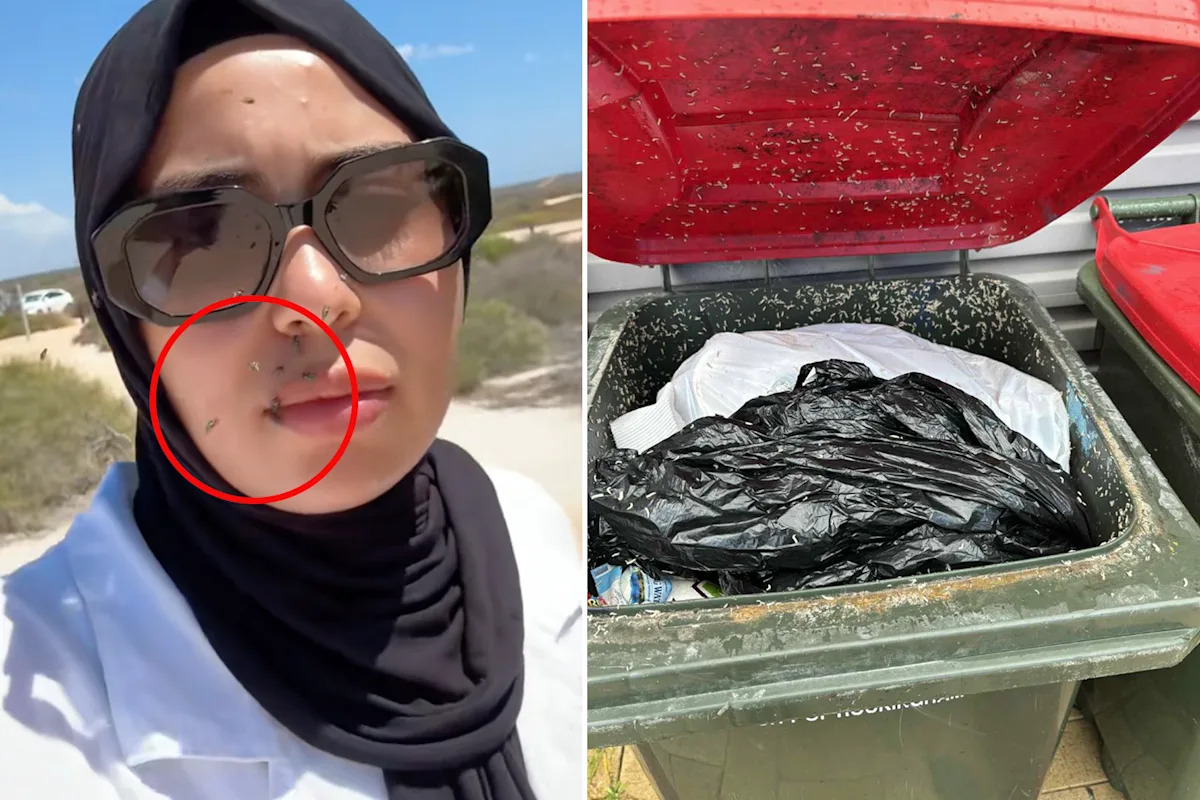
Experts are warning millions of Australians to brace for a boom in fly numbers this summer, with the incoming plague expected to be the worst in 40 years. Conditions that favour the pests have led to the explosion, with billions of them soon set to swarm on one major city in particular.
In Western Australia, entomologists are warning residents in Perth and the South West to prepare for the problem to intensify in the coming weeks.
Northerly and easterly winds are carrying enormous numbers of flies down from their breeding grounds in the livestock-heavy Mid West.
The outbreak has been sparked by an unusually long, wet winter that created ideal conditions for them to thrive.
While late spring and early summer are typically peak fly season, this year’s infestation is particularly severe.
And with an influx of flies also comes the issue of maggots.
Pest controllers have previously warned Australians that prevention is key.
Warren Bailey from ABC Pest Control said, “dealing with maggots is probably the worst experience you’ll have”.
He said that storing food correctly, especially meat, during the summer is crucial to stop flies from laying their eggs in your home.
“Make sure you’ve got fly screens and remove any rubbish, don’t let any lie around,” he had earlier told Yahoo.
“They’re a real pain in the neck.”
Perth woman Kim Amer told Yahoo News just last week how she was battling to contain an “influx of maggots and blowflies” on her property.
On social media, West Aussies have already complained about the massive numbers of flies making life uncomfortable.
One UK expat went as far as describing flies as “the worst thing about Australia”.
What’s driving the fly boom?
Associate Professor Theo Evans, from the University of WA’s School of Biological Sciences, said the months of heavy rain produced an abundance of green feed for livestock, and the resulting moist droppings have provided an ideal breeding ground for flies.
Larvae have been able to thrive largely unchecked, as cooler temperatures have kept dung beetles from performing their usual clean-up across pastures and bushland.
“The summer-active species of dung beetles we have in WA won’t come to the surface until the soil is warmer, and until that happens, the animal poo remains where it is,” he told PerthNow.
That means, on farms and in agricultural regions, there’s an abundance of dung available for flies to both feed on and breed in.
“As is the case every year, the summer beetles won’t be out helping until the end of December,” Professor Evans said.
“The difference this year is that we have had a winter that was quite wet.
“It was the kind of winter we used to have in Perth 40 years ago, and now we are seeing the kind of fly population that we used to have 40 years ago.”
Professor Evans said many residents may soon be in for a shock.
“The wet, sloppy poo that moist green feed creates is why the flies are driving people crazy now,” he said.
How do dung beetles control fly populations?
Dung beetles play a critical role in managing the state’s animal droppings.
As larvae, they consume vast amounts of animal waste while growing into adults.
Once mature, they dig tunnels and bury dung up to a metre underground, both storing it for food and creating a protected environment for their larvae, while also reducing the amount of dung available for flies to breed in.

Expats are taking to social media in droves to share their frustration at the flies in Perth. Source: TikTok/troopercoooper
By breaking down and burying manure, they also help improve soil structure and nutrient cycling, boosting pasture health for livestock.
When beetle activity drops off, dung accumulates on the surface, giving flies far more opportunity to feed and reproduce.
That pause in the beetles’ natural clean-up cycle is a major driver of the blow-outs in fly numbers seen during unusually wet or mild seasons.
Love Australia’s weird and wonderful environment? 🐊🦘😳 Get our new newsletter showcasing the week’s best stories.
