

Clear your calendar for August 2, 2027. A total solar eclipse so rare and cinematic it’s being dubbed the “eclipse of the century” will sweep across Europe, North Africa and the Middle East, plunging entire cities into midday darkness for more than six minutes.
According to NASA, the Moon will fully obscure the Sun for a staggering six minutes and 23 seconds, placing the eclipse among the longest totalities theoretically possible on Earth.
Previous


Next
Although physics allows for a maximum theoretical totality of seven minutes and 32 seconds, eclipses reaching anywhere near that limit are exceptionally rare.
The last comparable event occurred on July 11, 1991, when a total solar eclipse swept across Hawaii, Mexico and much of Central and South America, lasting six minutes and 53 seconds at its peak.
The next eclipse of similar length is not expected until 2114.
Where Will The Eclipse Be Visible In Australia?
Unlike many long-duration eclipses that unfold over open ocean or remote terrain, the 2027 path of totality cuts across major, well-connected regions. For viewers in Australia, however, witnessing it in full will require some travelling.
The Moon’s shadow will cut across parts of North Africa, the Middle East and southern Europe.
CountryStart TimeEnd TimeAlgeria8:37 am CET11:42 am CETBritish Indian Ocean Territory4:37 pm IOT6:40 pm IOTEgypt11:19 am EEST2:39 pm EESTGibraltar9:41 am CEST12:01 pm CESTLibya9:54 am EET1:19 pm EETMorocco8:33 am WEST11:09 am WESTSaudi Arabia11:41 am AST3:00 pm ASTSomalia12:27 pm EAT3:19 pm EATSpain8:32 am WEST12:15 pm CESTSudan10:29 am CAT1:52 pm CATTunisia8:52 am CET11:35 am CETYemen12:16 pm AST3:13 pm AST
Among the most sought-after viewing destinations is Luxor, Egypt, where observers will experience nearly the full length of totality alongside some of the world’s most iconic ancient monuments.
The map below shows the full path of the eclipse as it moves across the globe.
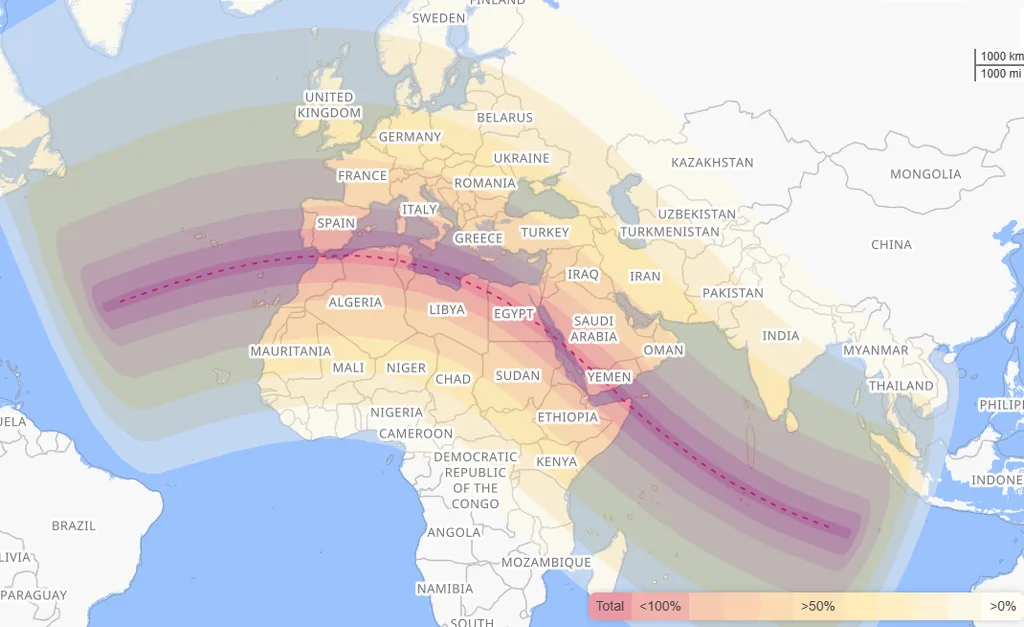 Image: Time & Date
What Makes This Eclipse So Special?
Technically, the longest eclipse of the century occurred in 2009, but it peaked over the open Pacific Ocean, with land visibility limited to an uninhabited island. The 2027 event is capturing global attention because this time, millions of people will be able to see it clearly and safely from major cities.
The lengthy darkness is the result of a rare cosmic sweet spot. The eclipse will occur just hours before the Moon reaches perigee, its closest point to Earth, making it appear slightly larger in the sky and allowing it to block the Sun for an extended stretch.
Other Major Total Solar Eclipses Ahead
August 12, 2026 — Greenland, Iceland, Spain; partial eclipse in parts of northeastern U.S. and Canada
August 2, 2027 — Spain, North Africa, Middle East
July 22, 2028 — Australia and New Zealand, including Sydney
November 25, 2030 — Southern Africa and Australia
March 30, 2033 — Alaska, including Nome and Utqiagvik (2m 37s max)
March 20, 2034 — Africa, Middle East and Asia (intersects 2027 path in Egypt)
September 2, 2035 — China, Japan, North Korea, South Korea
July 13, 2037 — Australia and New Zealand
December 26, 2038 — Australia and New Zealand
August 12, 2045 — Sweeps across the continental U.S. with over six minutes of totality
What Is A Solar Eclipse?
A solar eclipse occurs when the Moon passes between the Earth and the Sun, temporarily blocking the Sun’s light and casting a shadow across parts of the planet. Depending on the alignment, the eclipse can be total, partial or annular.
During a total eclipse, day briefly turns to twilight as the Sun is fully covered and its glowing outer atmosphere becomes visible.
Sign up for our newsletter
Want 15% off at Adore Beauty? Sign up to the latest news at Marie Claire.
By joining, you agree to our Privacy Policy & Terms of Use
About your privacy Are Media Pty Limited collects your personal information through this site to process registrations, send out newsletters, communicate offers, discounts, competitions, or surveys, and to provide you with targeted advertising based on your online activities. Our Privacy Policy contains information on how you can access or correct your personal information, which entities we may disclose your personal information to (including overseas recipients), how to opt out of targeted advertising, and how to lodge a complaint.