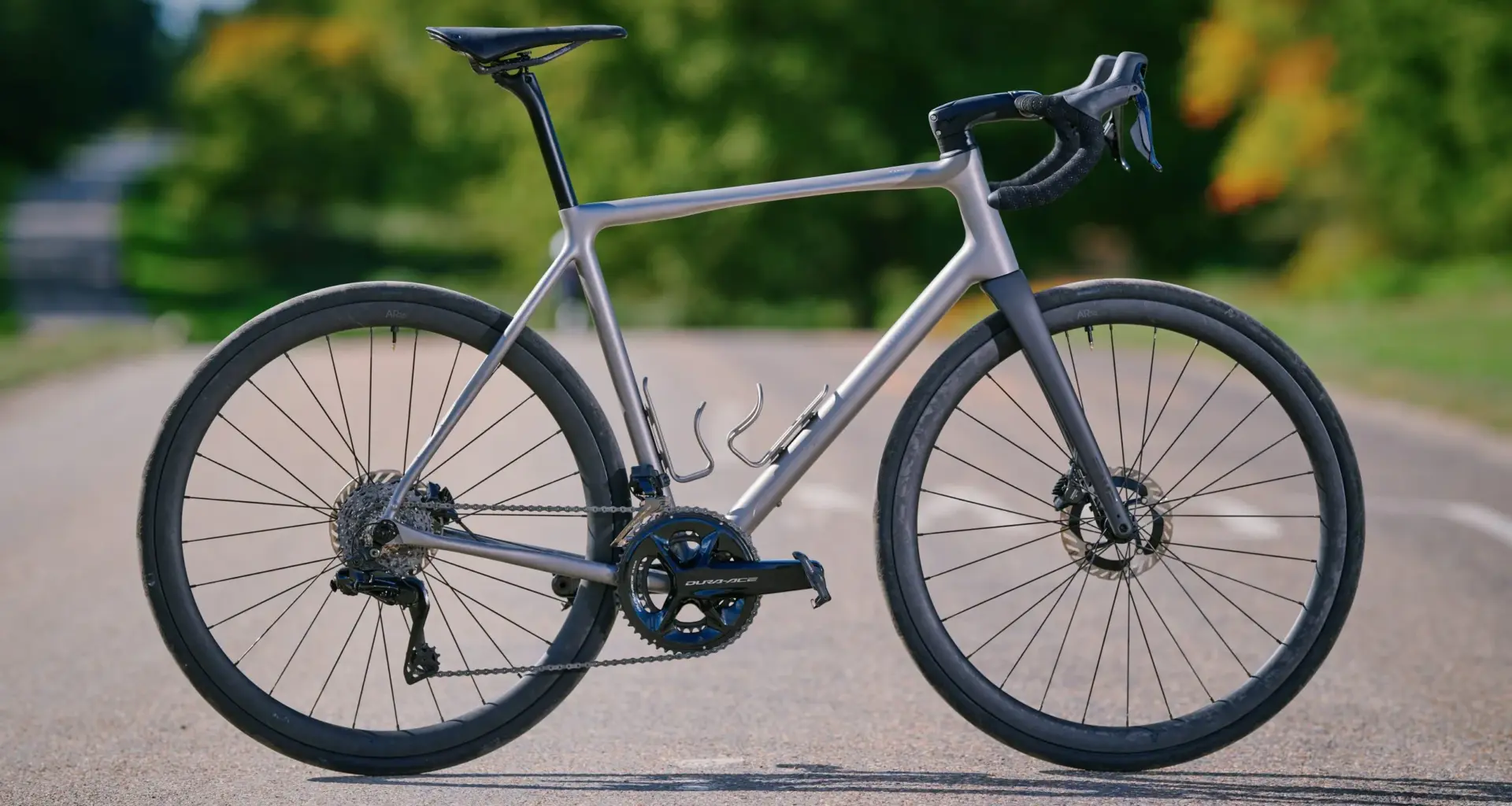
The emergence of 3D printing, otherwise known as additive manufacturing, is having a growing influence on the bike industry, particularly in the realm of titanium bike frames. J.Laverack has taken it further than most in its latest AM64 bike series.
‘AM64 is the use of additive manufacturing to form the junctions of the frameset’s double butted tubes,’ says Dave Clow, J. Laverack’s co-founder. ‘We honed our skills using this on elements of the Aston Martin .1R project. Using AM64 gives us freedom to be more structurally efficient wherever we need to, helping to save weight and smooth the tube joins.’
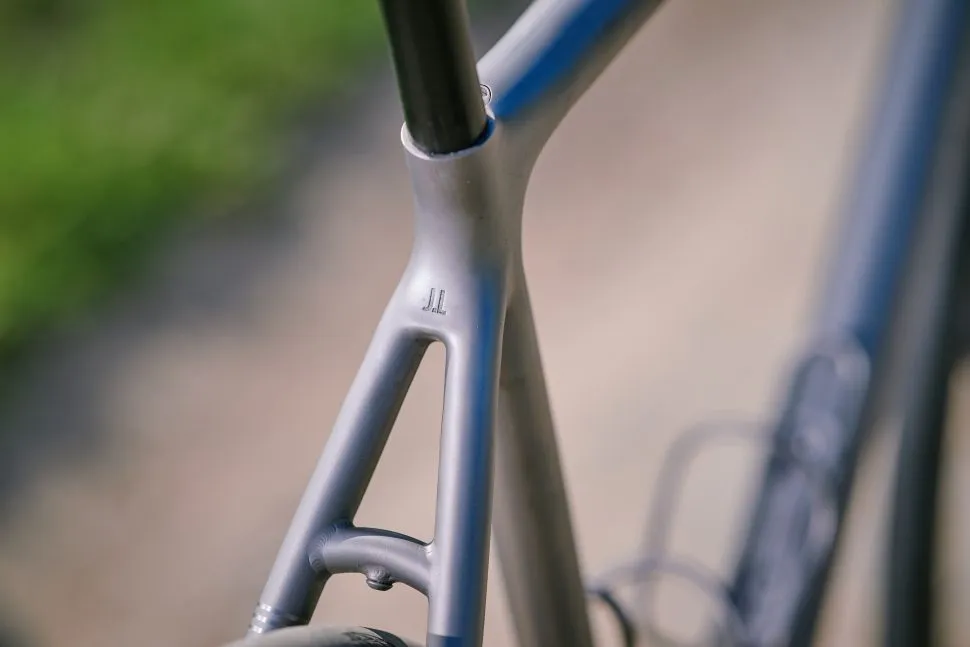
It’s an optional extra that customers can add to any of Laverack’s framesets when they are going through the build process, and one of the ways riders can modernise the otherwise classic-looking J.Laverack framesets.
‘Every AM64 bike is made to order and can be tailored to specific requirements. We do the bike-fit and then design the frame and make all the additive parts according to the rider’s riding position,’ says Clow. ‘Regardless of customisation, in any size it’s got a reasonably tall stack and a short reach which makes it comfy. It’s popular amongst ultra riders and it makes a great all-round bike.’
Clow says giving the AM64 treatment to a bike like the J.Ack is a particularly appropriate application of the technology.
‘At its core it’s still the all road J.ack model that we launched with ten years ago,’ says Clow. ‘Designed for smashing cobbles, Paris-Roubaix and Flanders-type riding and long days in the saddle. People gel with it very quickly because the handling is quite predictable.’
Related questions you can explore with Ask Cyclist, our AI search engine. If you would like to ask your own question you just need to , or subscribe.
Frameset design and 3D printing
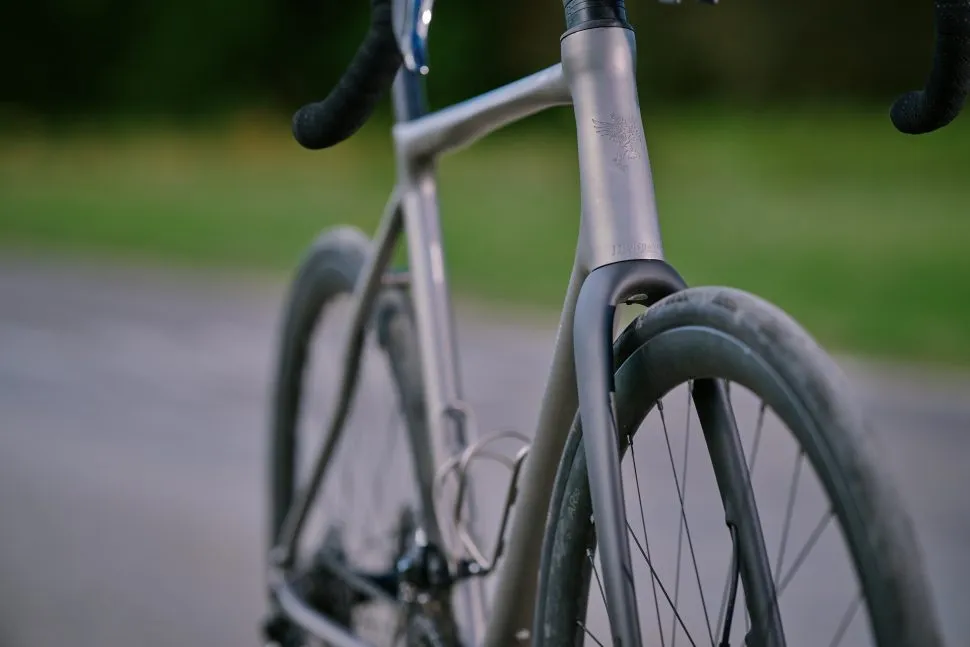
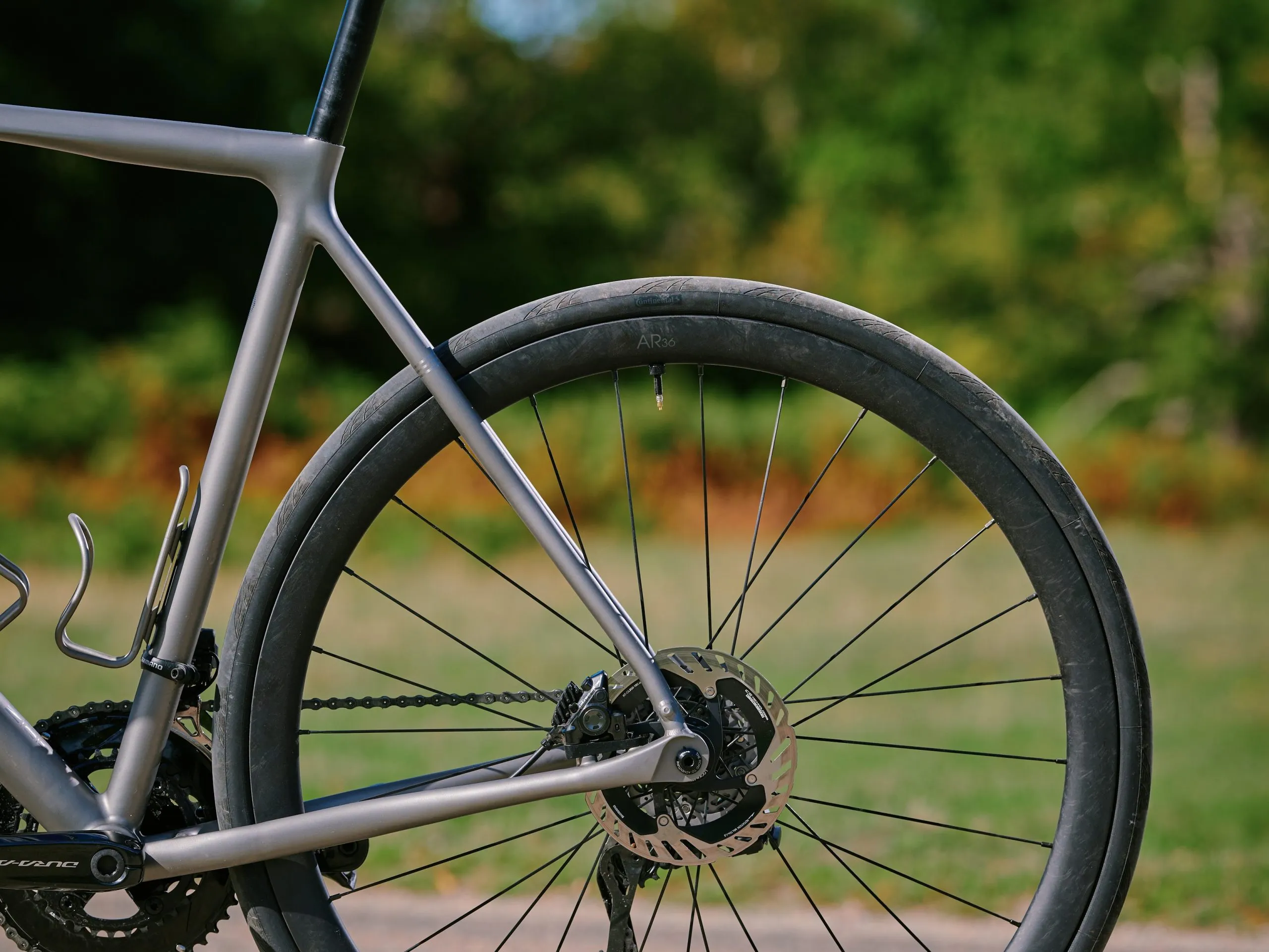
While the frameset has conventional titanium tubing for its main members, elsewhere on the J.Ack III AM64 the printer is hard at work smoothing edges and shedding weight, with J.Laverack suggesting it has been able to fabricate frames that are up to 300g lighter. The head tube, bottom bracket junction, seat tube lug and dropouts are all 3D printed from 6Al-4V titanium. The threaded Streamline BSA bottom bracket can house and hide cables, for gears as well as brakes if desired, while the chainstay bridge has been machined into its structure.
‘With normal titanium, a mitre tube is joined up, TIG welded and the weld is visible,’ says Clow. ‘On the AM64 frames it looks seamless. Before being welded, the printed parts are heat-treated which relieves residual stresses and refines the grain structure. The welds themselves are then dressed to bring the mating surfaces in line with each other.’
Overall, this adds over £3,000 to the price of a frameset kit. Though, according to Clow, that isn’t necessarily because of the materials and equipment.
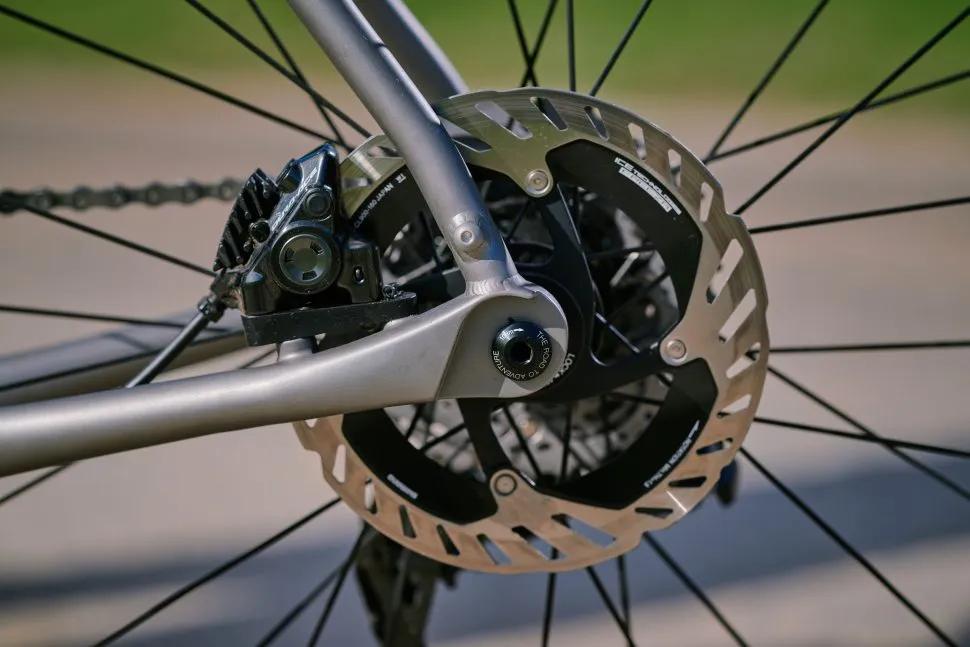
‘It’s a very complicated and expensive technology to work with but it allows you to do things that aren’t possible otherwise,’ he says.
While the visual impact of AM64 is clear, the impact on how the bike feels on the road should be more subtle.
‘It would be hard to accurately test any changes in ride feel as a consequence of AM64,’ says Clow. ‘The biggest difference isn’t in how the bike feels – though there are weight savings – it’s predominantly an aesthetic and customisation thing.’
The build
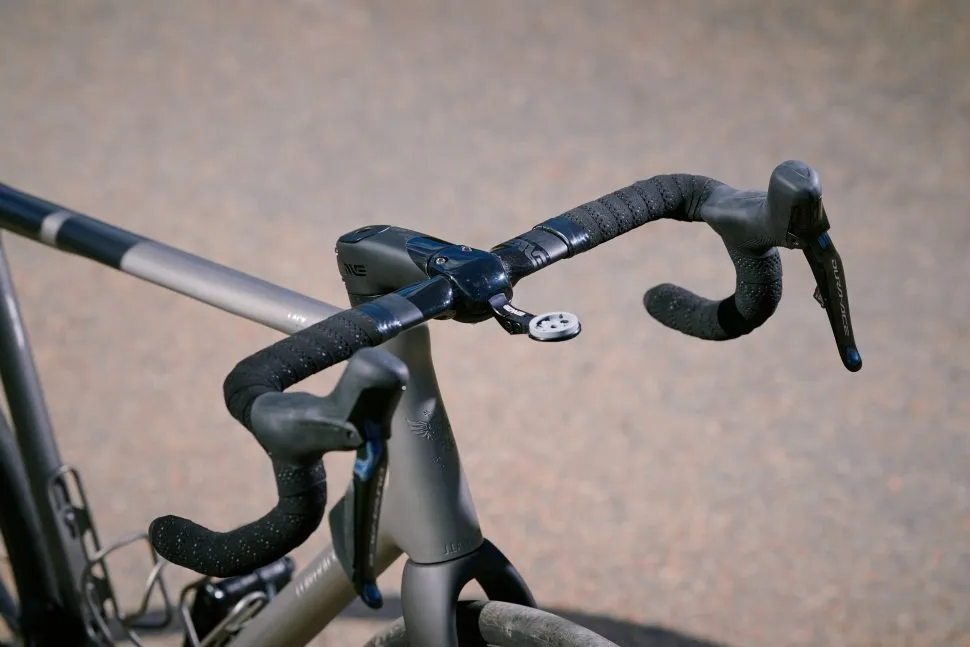
You get what you pay for, and at J.Laverack that translates as comprehensive customisation.
‘Over 95% of our sales involve custom geometry and tubing,’ says Clow, who is also a qualified bike fitter. ‘People want to take advantage of what we can do here.’
As well as the Enve in-route headset system, this test bike was equipped with Shimano Dura-Ace Di2, an AR|36 Carbon wheelset from J.Laverack’s sister brand ÆRA and Brooks’ fancy C13 Alcantara saddle. J.Laverack also offers additional mounts, internal dynamo cable routing, groupset tweaks and two seatpost diameters.

The stock geometry
J.Laverack’s stock geometry on the J.Ack III is pretty standard for a most-purpose bike with all road-worthy 38mm tyre clearance. On this size 56, the 583.5mm stack and 382.1mm reach combined with a 1015.6mm wheelbase and a 68mm trail point to a reasonably upright position with a ride feel at the stable end.
‘Even after the bike-fit, we try to keep the core geometry characteristics consistent – namely the head tube angle and the trail – because that gives you neutral, predictable steering,’ says Clow. ‘Then we zoom out and look at the contact points and make changes to the head tube length, top tube length, and occasionally the seat tube angle.’
Riding the J. Laverack J.Ack III AM64
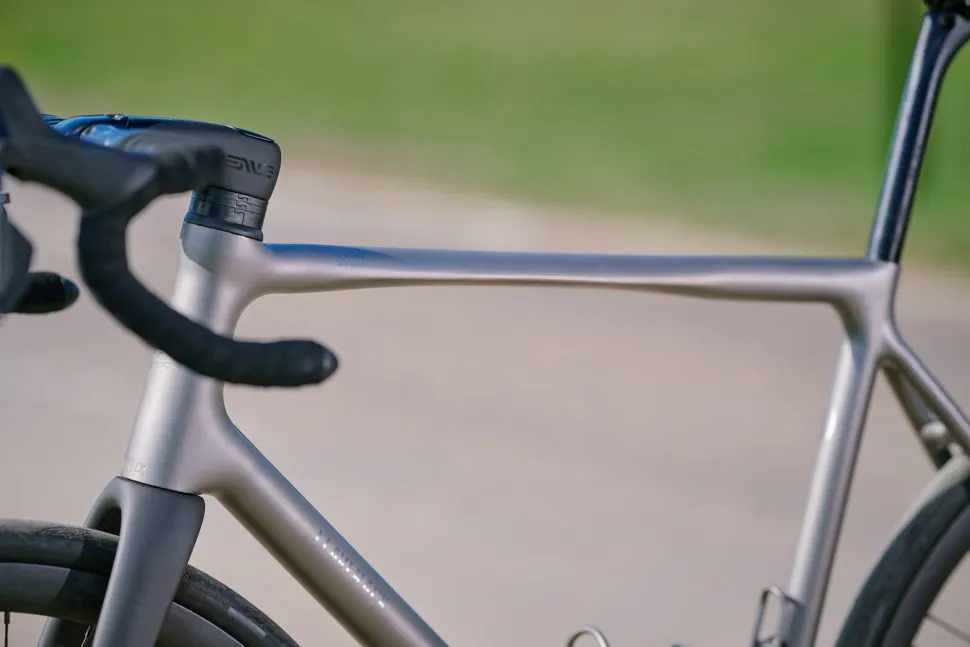
The frameset’s joints are all uniformly smooth thanks to AM64. The pinched top tube is notable as the only point of angularity on the frame. There is also a hard transition between seatpost and frame enabled by the eradication of the seat tube collar, adding to the contrast. The simplicity of the profile is made all the better by knowing how painstaking it was to create.
Needless to say, I wasn’t treated to custom geometry but that scarcely seemed to matter. The J.Ack III is resoundingly comfortable, but not at the cost of responsiveness. The titanium contributes its own undercurrent of shock absorption, as does the long length of exposed carbon seatpost allowed by the sloping top tube. Even still, the feedback was always the right side of lively.

According to Clow, attention was paid to keeping a high level of lateral stiffness in the bottom bracket, and that is detectable. You’ve got a frame that’s sufficiently stiff and constructed with a forgiving geometry, so, as Clow suggested, it’s easy to feel at home almost instantly.
The J.Ack climbs capably and responds dutifully to mid-turn line changes when cornering, despite that relatively high trail figure. On mild descents and flats, unsurprisingly, it doesn’t really trouble the speed gun but it is resoundingly stuck to the tarmac.
The ÆRA wheelset was stiff and tough, and 36mm seems like a smart depth choice for the kind of mixed riding the J.Ack is pointed towards. The comfort provided by the tubelessly set up 30mm Continental tyres made me wonder about its range limit when wrapped with full width 38mm tyres. If you can bear the sound of gravel twanging off your fancy undercarriage, I’d say there are few places you couldn’t take the J.Ack.
J. Laverack J.Ack III AM64 review verdict
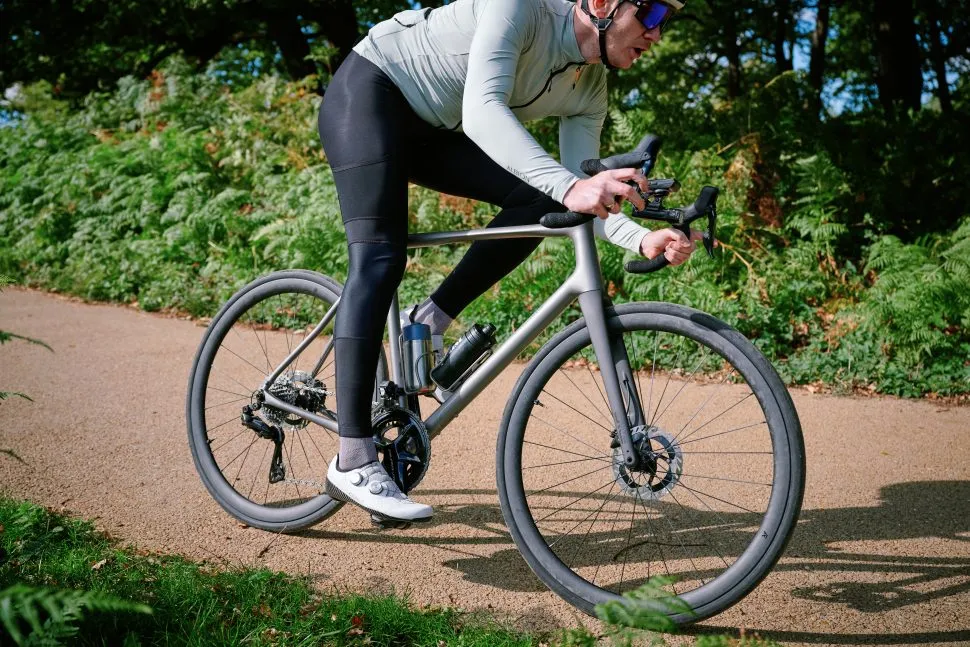
A bespoke, 3D printed J.Laverack with custom geometry is an expensive purchase, but it surely represents far better value than an off-the-shelf superbike from a mass-producing supplier that can’t provide a comparable one-to-one service.
The J.Ack III, complete with the weight and aesthetic advantages afforded (quite literally) by the AM64 fabrication method, is a bike that’s hard to fault. It looks fantastic without being at all showy (especially in this blasted matt finish) and delivers a lightness and ride feel that all titanium fanciers will be delighted with.
The Enve fork and In-Route cockpit completes the setup beautifully and gives the J.Ack a deeply modern feel. If you’re not fussed about weight savings or custom geometry, then the AM64 element might be something to skip out on. Just don’t go looking at one first, or you may well struggle to look past it.
The reviewed spec
Model: J.Ack III AM64
Price: £11,339
Weight: 8.2kg
Groupset: Shimano Dura-Ace Di2
Wheelset: ÆRA AR|36 ‘Black Marble’ carbon
Finishing kit: Enve In-Route SES AR, Brooks C13 carved 145mm Alcantara, Continental GP5000S TR 30mm ‘Stealth Edition’
Buy now: jlaverack.co.uk