
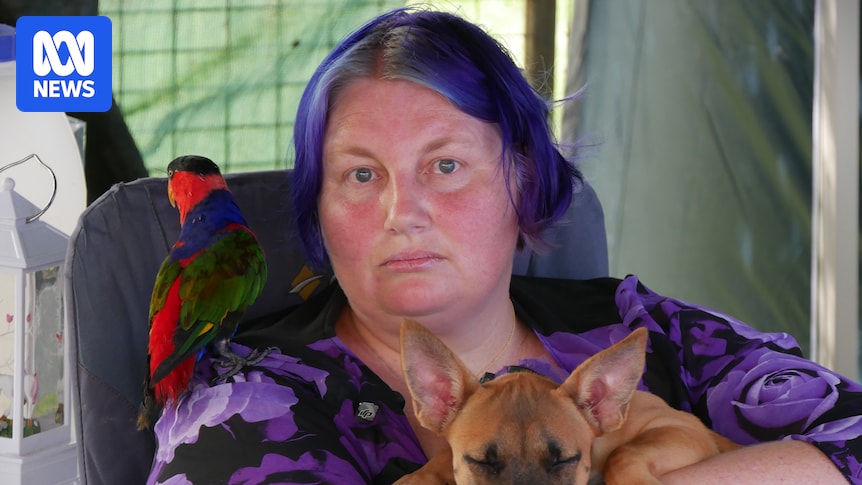
A regional Queensland family leasing a powered tent site at a caravan park has been told it is no longer considered homeless and not eligible for crisis accommodation.
Simone and Steve Owen moved to Bundaberg, about 400 kilometres north of Brisbane, with their two children earlier this year after the lease on the property they rented at Townsville for seven years was not renewed.
Despite applying for “about 100 properties” since January, the couple was unable to secure a home in the town and couch surfed with family and friends until moving to the tent site one month ago.
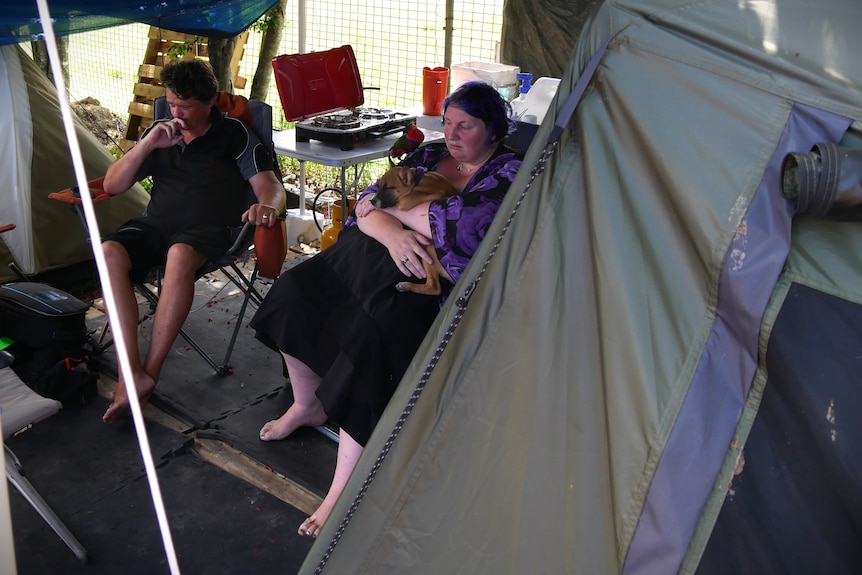
The family signed a lease at a caravan park one month ago. (ABC News: Johanna Marie)
Mrs Owen said they signed a six-month lease with the caravan park because it was “safer” than camping in public parks.
“We’re paying $680 a fortnight to live here,” she said.
“It’s ridiculously expensive to live on a bit of dirt.”
The family’s weekly charge is comparable with the fees for non-permanent visitors at the park.
Mrs Owen said that after signing the lease, community housing provider Regional Housing Limited explained that because the agreement was considered “independent living”, the family did not qualify for crisis accommodation for people considered homeless.
The family will remain on the social housing register, which has an average wait time of two-and-a-half years.
Mrs Owen said the situation had been particularly difficult on her children, aged 11 and 13.
“As a mum, I feel bad for my kids that they’re in this situation,” she said.
“I just want a roof over my boys’ heads. That’s all I’m asking for, just a tiny bit of help and compassion.”

The couple is making the best of the situation for their children. (ABC News: Johanna Marie)
Short-term and emergency housing
A spokesperson from the Department of Housing and Public Works declined to comment on the couple’s case for privacy reasons.
In a statement to the ABC, the spokesperson said the department funded community housing providers, including Regional Housing Limited, to support people experiencing or at risk of homelessness.
They said the department had allocated more than $396 million to 91 organisations in the 2025-2026 financial year to provide specialist homelessness services across Queensland, including three in the Bundaberg area.
Queensland’s social housing register has reached a record high, with the latest data showing 54,922 people on the waitlist in October.
That figure has grown by about 1,000 since the end of August.
Families make up a large portion of people on the social housing register, with 30,709 active households waiting for a home.

Tom Smith says more needs to be done to help people into homes. (ABC News: Johanna Marie)
Bundaberg has a rental vacancy rate of 1 per cent and according to the Residential Tenancy Authority, a median weekly rent of $560 for a three-bedroom house.
The Queensland Council of Social Services told the ABC in October that rent prices in the town had increased by almost 80 per cent in the past five years.
Member for Bundaberg, Labor’s Tom Smith, said the government’s partnership with community housing providers was failing people in desperate need of homes.
“There is absolutely no doubt that there’s been changes and that we’re seeing more and more families, which means more and more children living in tents, living in cars, living in the backyard of a friend’s place,” he said.
“That’s simply not good enough.”
Storm season in a tent
On the cusp of the school holidays, Mr and Mrs Owen — who are each on a disability support pension — are bracing for the summer in their polyester-walled makeshift home.
They have already replaced tents and other equipment that was damaged during storms in November.
“Whenever we get rain, we hear it,” Mrs Owen said.
“Whenever the wind blows, the tent’s moving and we have to constantly lower this [awning] so this doesn’t get damaged.”
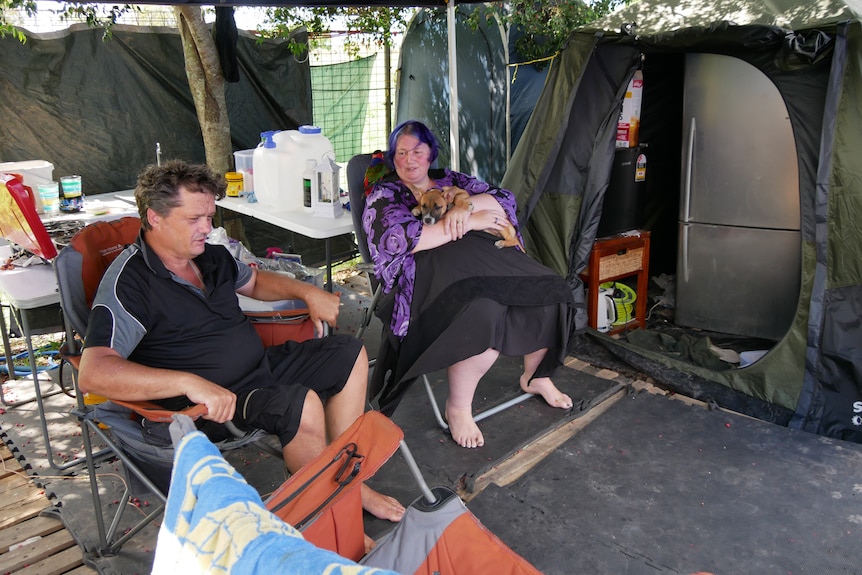
The family expects summer weather to be a challenge. (ABC News: Johanna Marie)
She said they hoped to one day secure social housing but in the meantime would continue applying for private rentals despite feeling overlooked, “discriminated and judged” by real estate agents.
“They look at us and say, ‘You’re not going to be able to afford that’,” she said.
“They talk about the vulnerable Australians — well, that’s us, that is my family.”