
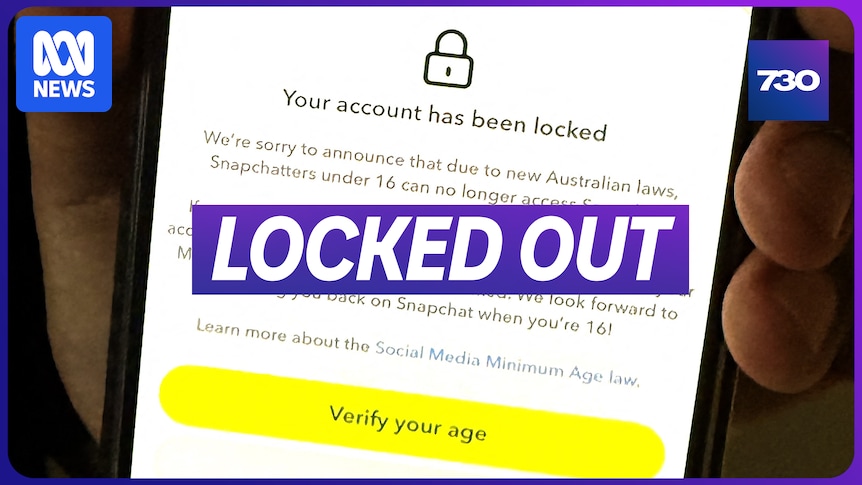
JACOB GREBER, POLITICAL EDITOR: Australia’s social media Big Bang, launched today at Kirribilli with the Prime Minister determined to give families control over the tech giants.
ANTHONY ALBANESE, PRIME MINISTER: It is one of the biggest social and cultural changes that our nation has faced. It’s a profound reform, which will continue to reverberate around the world in coming months.
JACOB GREBER: An idea backed by both sides of politics.
ANTHONY ALBANESE: This legislation passed the parliament last year with bipartisan support. Peter Dutton, someone who has always cared about the impact of harm on young Australians.
JACOB GREBER: Setting the nation on a bold social and technological experiment.
ANTHONY ALBANESE: It won’t be perfect; it won’t be perfect because this is a big change, but I’ve been asked this morning in media interviews, what will success look like? Success is the fact that it’s happening.
FLOSSIE BRODRIBB, ADVOCATE: We deserve time with real people, to learn body language, tone, empathy, and all the social cues you can’t get from a screen.
TIK TOK VIDEO: I should get some sleep …
JACOB GREBER: Even though not every social media user is convinced.
Today’s ban has inspired a thousand memes. As a generation woke to the reality that politicians have denied them something they once took for granted.
Whether they all grow up to become anti-government libertarians remains to be seen but its clear many parents are relieved.
WAYNE HOLDSWORTH, ADVOCATE: Our kids that we’ve lost haven’t died in vain, because today they’ll be looking down very proud of the work that we’ve all done.
JACOB GREBER: Yet for all the government’s eagerness to champion the ban, there was no escaping ongoing outrage over politician’s family reunion travel.
A political rubbish-bin fire that continues to dog the Communications Minister, who has been revealed as one of parliament’s most enthusiastic entitlement claimers and is now the subject of an audit by the politician’s travel expenses watchdog.
ANIKA WELLS, COMMUNICATIONS MINISTER: Parliamentarians entitlements should be scrutinised. I’ve said that from the get go, I’ve always said that. It’s something I deeply believe in, and that’s why I’ve always put all of my travel through the independent regulator.
JACOB GREBER: The minister continued to put on a brave face even as the opposition called for her to step aside.
JAMES PATERSON, LIBERAL FRONTBENCHER: I think there’s a chance that the Ministerial Code of Conduct has also been breached. It should be referred to the Secretary of PM and C to investigate, and Minister Wells should stand aside while that investigation takes place as is standard practice.
JACOB GREBER: The expenses row is now a week old, and it’s overshadowing what the government was hoping would be a strong end to a stellar political year.
The Prime Minister showing signs of frustration at what has become a daily media frenzy.
JAMES GLENDAY, NEWS BREAKFAST: Are you expecting other members of the parliament to be referring themselves over the summer months as more and more journalists dig through expenditure records?
ANTHONY ALBANESE: Well, the important thing here is ‘dig through’ is the term that you just used. They’re all declared, they’re all there, it’s there for everyone to see. There’s a monthly report, people have to sign off on all of the reports. They’re all published.
JACOB GREBER: Ministerial travel expenses are not the government’s only headache.
After former Coalition defence minister Linda Reynolds told 7.30 last night that she would persist in her bid to win damages against the Commonwealth over its handling of a payout to her former staffer Brittany Higgins, whom a court found defamed the former minister on social media.
LINDA REYNOLDS, FORMER DEFENCE MINISTER (Last night): But it’s taken five years almost to get the truth told by the judges, and to make the truth binding.
HAMISH MACDONALD, 702: Would you apologise to Linda Reynolds?
ANTHONY ALBANESE: She’s got a claim, Hamish, against the Commonwealth at the moment. And the idea therefore that I, as Prime Minister, should give detailed commentary on that, I think you’d be quite clearly, it would be inappropriate.
JACOB GREBER: Scandals aside, there’s a sense of haste across government as the Christmas break looms.
Cabinet met today for the second time this week, as it prepares for the mid-year budget update and to discuss plans for an east coast gas reservation.
For now, though, the Prime Minister is happy to spruik one of his government’s biggest achievements.
ANTHONY ALBANESE: This is a day in which my pride to be Prime Minister of Australia has never been greater.
SARAH FERGUSON, PRESENTER: Julie Inman Grant is the eSafety Commissioner.
Julie Inman Grant, welcome.
JULIE INMAN GRANT, ESAFETY COMMISSIONER: Thank you for having me.
SARAH FERGUSON: Day one. How will you judge over the coming weeks and months whether the ban is a success?
JULIE INMAN GRANT: Well, I think we have to look at it from the short term, the medium term and the long term.
It’s not even 24 hours in, but we’ve had 10 of the largest, most powerful technology companies in the world, somewhat kicking and screaming, deploying technologies.
How well they’re deploying them will remain to be seen, but we will be sending them information notices that they need to comply with within the next seven to 10 days, and we will then have baseline data from which to gauge.
SARAH FERGUSON: One in three parents are reported to have told researchers that they will help their children circumvent the ban. What would be your message to them?
JULIE INMAN GRANT: Well, this has been a phenomenon that’s been at play for a long time. So before this was even instituted, we know that almost 84 per cent of eight- to 12-year-olds had access to a social media account, and in 90 per cent of cases, parents helped them set it up. The primary reason being they didn’t want their children to be excluded.
Now, what this legislation does and this regulation does, is it takes away that fear of exclusion or that FOMO (fear of missing out) that young people might have, and parents can now say there’s a social media delay in place, the government is saying that you’re not old enough to have a social media account until you’re 16 and neither should any of your friends.
SARAH FERGUSON: In that sense, your idea is to help parents.
JULIE INMAN GRANT: It’s a normative change to back parents, but there will be parents who will choose to have their kids be on social media for whatever reason, and I suppose that’s their right.
There won’t be any penalties for parents or children for circumventing the delay. It’s the onus is purely on the platforms from preventing under 16s from having or holding accounts.
SARAH FERGUSON: Just talk about what powers you will have in relation to those companies. You say you’re going to write to them; you’re going to get more data from them. They have to take reasonable steps.
JULIE INMAN GRANT: That’s right.
SARAH FERGUSON: To keep under-16s off their platforms. What happens if they don’t comply?
JULIE INMAN GRANT: Right. Well, as I said at Kirribilli House today, the changes here aren’t going to be miraculous and instantaneous, and we’re already seeing that there have been some teething issues with the way that some of these companies have been deploying the third-party age assurance technologies.
My primary powers starting today, and which I’ll be exercising tomorrow, are in these compulsory information notices.
We’ll be, of course, doing other kinds of intelligence gathering and monitoring to see if these are working.
If there’s egregious non-compliance. I think that will be pretty obvious pretty quickly, and then we start an investigation. There’s obviously fairness and evidence that we need to gather. It needs a hand up to stand up in a court of law, but of course the fine is up to $49.5 million.
We also know that there are a number of companies out there that have been briefing barristers, so they may be waiting in the wings for that information notice or waiting for me to take enforcement action. We’ll be ready for that too.
But one thing I’ve learned in my nine years in this role, that is it’s not just the regulation that deters these companies. It’s the reputational damage and the impact on revenue.
SARAH FERGUSON: Obviously, we’re going to hear a lot over the next couple of days, about the next period of time, about children coming up with workarounds, whether it’s their parents helping them, whether it’s them doing it. What tools do you have available to you as people deploy those workarounds?
JULIE INMAN GRANT: Oh, well, we’ve allowed for that in the regulatory guidance that we developed. I mean, we were gamed a number of different scenarios more than six months ago. We knew there would be defections, if you will, or migratory patterns to smaller platforms.
So we started reaching out to a number of them a long time ago when there of new ones that have come on the scene. But what I would say is because these powerful companies that kids have been on for months or even years have them so entrenched and entranced, they have a critical mass of kids there.
If they disperse to 15 or 20 different platforms, they’re not going to have the same critical mass of friends there. So, it may be temporary, but kids will adjust.
We also put the onus back on the platforms themselves to prevent circumvention. So that means preventing recidivism, which means preventing them from creating additional or fake imposter accounts from location-based circumvention like VPNs, but also from spoofing their AI systems.
SARAH FERGUSON: Now, you originally wanted a different version of this ban, one based on a harm reduction framework that would’ve enabled you to differentiate between the lower risk and the higher risk platforms. Do you still think that would’ve been more effective?
JULIE INMAN GRANT: I think if I had a combination of those tools, probably we would’ve been able to be a little bit more targeted. I think we would’ve been able to explain to the public in a much clearer way why some companies are in or out. I mean, people’s eyes glaze over, my eyes glaze over when we talk about sole and significant purpose.
SARAH FERGUSON: But you can work with a system that you’ve, obviously it’s politics that’s taken you to this place. It’s a more straightforward notion that of a one single delay or ban, you can work with this.
JULIE INMAN GRANT: Right. We always work with the tools that we’ve been given, and I’ve got a really smart, dedicated team, and we’ve really figured out the mechanics of how this will work. Whether or not the technology companies will comply and how well they comply with the technology in terms of how well they’re deploying it.
That could be a strategy that they have in and of themselves. We’ll say we’re complying, but then we’ll do a crappy job using these technologies and we’ll let people get through and have people claim it’s a failure.
SARAH FERGUSON: Now, part of the motivation that you have had, I’ve seen you talk about this in the past. You referred to some internal documents that you got from discovery in a US Court case about Meta. What is it about the social media company’s attitudes towards recruiting children shocked you so much and motivated you through this?
JULIE INMAN GRANT: Well, I suppose I’d always known it from being inside the companies, even companies who I’d seen behave benevolently. In my early years, about 20 years ago at Microsoft, they were putting a lot of time effort into the digital crimes unit and a lot of the work that we did.
But once the company started to evolve into an enterprise company focused on the cloud, they just lost interest in that consumer level.
So there are examples of that. There are companies like Anthropic that are based on doing good, but even when I came across Roblox, when I first met the Roblox team in 2017, they were in a little office on the top of a sandwich shop, and they really cared about kids.
I asked them why they would introduce a virtual mall and a virtual dating service when the primary users were three to 15, and they said, well, to keep the platform sticky, to keep the users on later. And I’m like, oh my God. They’ve become one of them. And by the way, their lobbyists are all former Meta people.
SARAH FERGUSON: Watch out for the lobbyists. A final question obviously is a lot of questions today around privacy. Does this ban mean that we are all going to be subject to more surveillance, more data collection from social media companies?
JULIE INMAN GRANT: Well, I don’t think so. One, I don’t think that it’s possible to have more surveillance than has been already baked into the algorithms in these systems.
The second reason is Carly Kind is an amazing Privacy Commissioner, and she is my co-regulator here, and she will be watching closely.
And thirdly, we tested these third-party technologies to ensure that they were privacy preserving. You wouldn’t make sales as an age assurance provider if you were creating honeypots of information.
SARAH FERGUSON: But in terms of us all being subject to more surveillance, more inquiry, increased data collection, is that something we just have to accept to make this work?
JULIE INMAN GRANT: I don’t think so. We have said things in the regulatory guidance to companies like it’s not acceptable to age verify your entire user base. That is too invasive.
We’ve written both privacy and safety by design into our regulatory guidance as well. This is where I think sometimes privacy and safety can be intention, but sometimes it’s mutually exclusive. Our kids aren’t going to be safer if more of their PII (personally identifiable information), or their private data is being held by these companies or third-party companies
SARAH FERGUSON: Day one. Obviously, the whole world is watching. It’s an extraordinary, it’s an extraordinary experiment we’re engaged in. Thank you very much for joining us.
JULIE INMAN GRANT: Thank you.