
MYLES HOULBROOK-WALK, REPORTER: Eliesa Katoa, a rugby league player at the peak of his powers.
Making the journey from a tiny village in Tonga to scoring a try for Melbourne Storm in the grand final.
CHRISTIAN WELCH, RETIRED ATHLETE: He’s just a ripping guy, representing his people and his culture so proudly, playing for Tonga
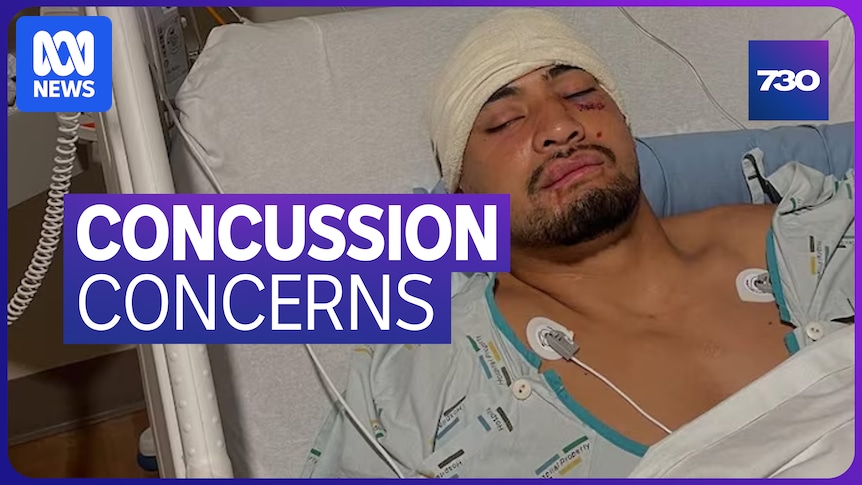
MYLES HOULBROOK-WALK: Now there are fears he may never play again, after suffering a series of massive head knocks while representing Tonga in a match against New Zealand last month.
ALAN PEARCE, NEUROSCIENTIST, SWINBURNE UNIVERSITY: I was pretty horrified to see the amount of force, and then was, you know, even more, uh, surprised to see that he had gone on to play.
MYLES HOULBROOK-WALK: Before the kick-off, Eli Katoa suffered a serious blow to the head during the team’s pre-game training.
A Tongan trainer steps in to help him. After he was treated by team doctors, Eli Katoa was given the green light to play.
Within the first 10 minutes of the match, another head injury.
FOOTBALL COMMENTATOR: He had that head knock before the game. He’s coming off again.
MYLES HOULBROOK-WALK: Katoa was cleared to continue playing. Then, at the 51st minute, a third knock.
FOOTBALL COMMENTATOR: He’s been through the wars Eliesa Katoa…
MYLES HOULBROOK-WALK: He’s pulled from the field before suffering a seizure.
CHRISTIAN WELCH: Obviously tragic to see what’s happened to him and I just hope he really recovers well.
MYLES HOULBROOK-WALK: Eli Katoa was rushed into surgery to treat a brain bleed. He’s now recovering in Melbourne.
The injury has already ruled him out for next year – what’s next, we don’t know.
Two key questions have emerged in the wake of this incident: How did it happen and what, if anything, will anything change as a result?
People want answers.
Jamie nice to meet you, I’m Myles, mate.
JAMIE BUHRER, RUGBY LEAGUE PLAYERS ASSOCIATION: Myles, how are you mate.
MYLES HOULBROOK-WALK: Jamie Buhrer is from the Rugby League Players Association
JAMIE BUHRER: I think we’ve got to continue to have a look at everything we’re doing and if we need to make changes, make changes, but we also need to be cognizant of the fact that it’s a physical sport and that’s also what people love about it. So it’s a, it’s a balance. It’s definitely a balance.
MYLES HOULBROOK-WALK: For more than a decade the NRL has had policies in place for concussion but how its monitored changes between training and game.
During a game, independent doctors watch several camera angles to identify potential injury. There’s also trained concussion spotters and doctors from each team.
In training though there are no requirements for independent doctors. Instead, clubs have trained concussion spotters present. Spotters don’t have to be doctors; they just need to complete the required concussion training.
Training is filmed, but there’s not as many cameras, giving spotters fewer angles to assess any problem contact.
Because Eli Katoa sustained his first head knock during the warm-up, it was up to Tonga’s officials to decide whether he needed a head injury assessment. They decided against it and allowed him to play.
JAMIE BUHRER: I think it was an unusual one in that you don’t often see some of that in a warmup, and certainly not in my time. Initial view, it was quite distressing, uh, to see that incident take place.
MYLES HOULBROOK-WALK: The players association surveyed more than 552 male NRL players and found that 27 per cent had suffered a suspected concussion in training during the last 12 months.
Of that group, 60 per cent of these players said they continued to train afterwards.
The players association say it’s worth reviewing all solutions including more monitoring of training.
JAMIE BUHRER: Are we doing enough to identify potential concussions? Um, you know it’s kind of taken out of the player’s hand.
MYLES HOULBROOK-WALK: The players union says one way to improve safety is reviewing the amount of full-contact training.
JAMIE BUHRER: We know there needs to be some level of contact, but we do feel like there can be too much.
Players have identified the equivalent of about five contact sessions a week in a pre-season. We’ve had others identify the equivalent of two contact sessions a week.
MYLES HOULBROOK-WALK: Professor Alan Pearce monitors brain health and is one of Australia’s foremost concussion experts
ALAN PEARCE: For me, this seemed to be more than a comedy of errors, but rather just a serious breaches of our, our international consensus around concussion.
MYLES HOULBROOK-WALK: This week the NRL has handed down breach notices over the incident. Tonga’s head doctor, assistant doctor and head medical trainer have been banned for two years from working with any professional team.
The assistant medical trainer for Tonga has been issued a formal warning.
All four have until the end of the week to respond to these breach notices.
Alan Pearce says sanctions on individuals may serve as a timely reminder, but they don’t change the root issue to have more involvement of independent doctors
ALAN PEARCE: If the NRL are serious about athlete health and wellbeing, then this is as much in the warmups, uh, as much in the cool downs, not just in the game itself. It shouldn’t be just only the game.
MYLES HOULBROOK-WALK: The NRL declined 7.30’s interview request saying it couldn’t comment on the matter.
Tonga Rugby League did not respond to any requests for an interview or comment.
Christian Welch retired at the start of the year. He played for the Melbourne Storm, alongside Eli Katoa.
He believes by and large the code has done well to manage concussion and has experienced what it’s like.
CHRISTIAN WELCH: Yeah, I actually had, yeah, a fair few concussions. Um, I think I had eight official ones.
I think the NRL have done a pretty good job moving in that space lately of trying to make the game as safe as possible
MYLES HOULBROOK-WALK: He says players need to remember they have a long life after the sport.
CHRISTIAN WELCH: I retired at 30, I played for 10 years, that’s an amazing run of a career. But I think the average career is three years.
You got the rest of your life to live, you know, you, hopefully you have kids, you have family, you have grandkids. You want to be of healthy mind and, and your body and being able to enjoy the rest of your life.